
'A lot of people don’t realise it is paper – they look at it and think it is paint,' torn paper artist Jan Folan
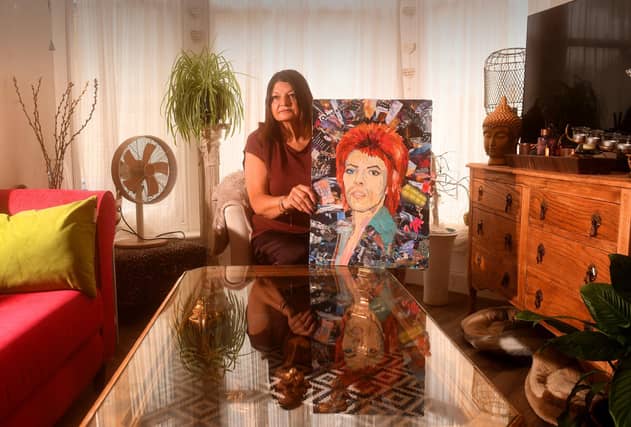

Picking up a piece of paper, Jan Folan deftly demonstrates her tearing technique. For as simple as tearing paper may sound, when put into practice for art, it is – as Jan demonstrates – an intricate process.
For example, tearing down from the top one way creates the perfect edge, while tearing down the other way results in a feathered effect – perfect for adding texture and detail to the pictures Folen produces.
“From being a child I was always drawing and doing bits of art. Over the years I have also done lots of paper cutting – decoupage,” she recalls.
Looking back, there is, perhaps, a tinge of regret that, after achieving her O’ Level Art, Folen didn’t pursue the subject at college, but chatting with the artist in the comfortable sitting room of her Huddersfield home, where the walls are lined with her artworks, demonstrates that not pursuing further education in her chosen field hasn’t held her back.
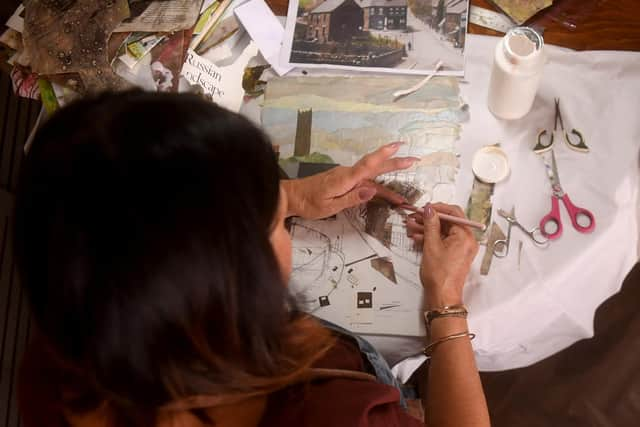
“Somebody told me ‘you have a good eye for colour’. I have had no practical training; I never went to art school, but working as a teaching assistant, I was used to making things and layering up. Whenever there were any big displays to do, I was always doing them, so with the torn paper and everything I had done in the past, it all came together.”
It is eight years since the self-taught artist took up torn paper art after being inspired by demonstrations on social media.
“When I had foot surgery, I was off work for a while, and I was looking for something to do.”
She spotted some wildlife art created with torn paper, which prompted her to experiment with her own designs. “I found a picture of a kingfisher, and that is how I started doing wildlife at first.”
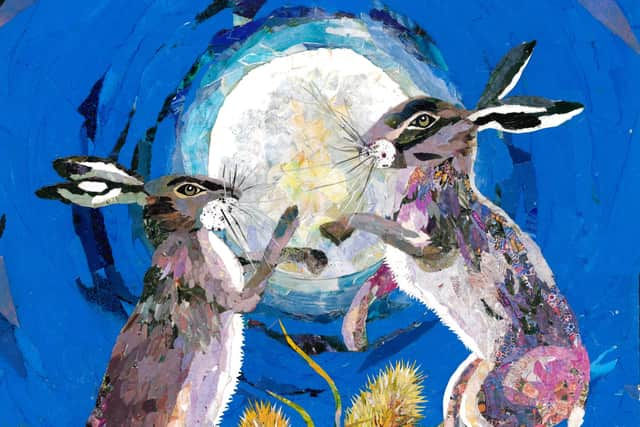
Blue jays, boxing hares, elephants, giraffes, rabbits, sea otters and turtles have since been reconstructed in paper art forms.
Folen recalls her first torn paper production was a rabbit which she entered into a Kirklees art competition – and she ended up selling her entry.
“I was amazed that somebody really wanted to buy my art. It has taken a lot of years to have the confidence and belief in my art to call myself an artist.”
Enthused by her success, and with encouragement from family and friends, Folen began seeking outlets to sell her torn paper pictures. Her artwork is currently available at Handmade in Huddersfield, The Gallery in Slaithwaite and The Reading Room in Whitby. Her website and online shop have helped her to expand her audience. One of her works, an octopus, is now proudly hanging in a customer’s home in Spain. She produces commissions too.
Retirement has given Folen the opportunity to network with other artists when she takes her work to fairs. She is also a member of the Penistone Art Collective and has participated in and demonstrated her techniques at Holmfirth Art Week.
Over the years, Folen has expanded her repertoire from wildlife to landscapes and seascapes.
“During lockdown I had to shield because of my immune system, and I thought, ‘What am I going to do?’ I was also a bit emotional, thinking about my mum, whom we lost, and her favourite place was Polperro,” she says.
Her torn-paper reproduction of the fishing village on the southeast of Cornwall was created in memory of her mum. “It was a very emotional piece. It brought back so many memories of our holidays together.”
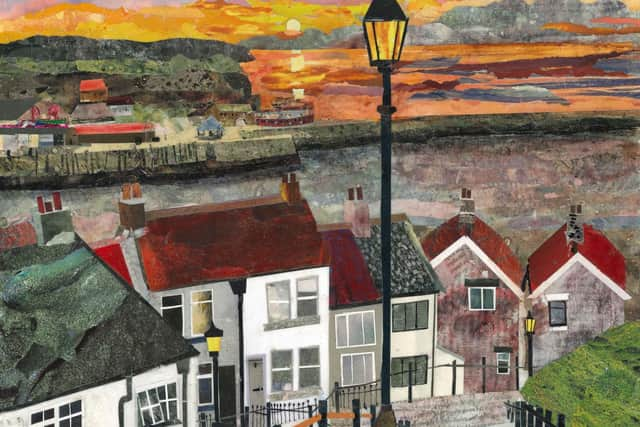
It also inspired Folen to create seascapes. Staithes, Robin Hood's Bay, Runswick Bay and Whitby on the North Yorkshire coast, and Tenby, in Wales, are among the places she captures on camera, or through online inspiration, to reproduce in torn paper.
Castle Hill, and its landmark ancient monument, the Victoria Tower, looming above her home city of Huddersfield, is a familiar focal point of interest in many of Jan’s pictures proudly displayed around her home. Many more are neatly arranged on the dining room table where she spends hours painstakingly tearing and cutting.
Talking through the piecing-together process, Folen explains how, after deciding on the subject, she begins to create the design onto the canvases she upcycles and recycles from charity shops and online marketplaces, along with glossy magazines and art books.
“I sort through my vast collection of papers, hand-painted papers, painted with inks, acrylics and watercolours, magazines and old art books,” she explains. “I then draw it out, building up the layers, starting with the sky, and add the details with intricate cutting and sometimes finish with a black gel pen to add depth.”
Folen says photocopy paper is perfect for skies. “It also tears easily into strips. I have learnt what aspect works for doing things. I sometimes buy specialist papers, handmade papers, because when torn, the little strands can be used for fur or little animals. I am experimenting more with papers and inks.”
Peering closely at one of the windows in a characteristic cottage within a rural scene, tiny fragments of black and white words come into view – their printed form visible for artistic purpose.
Finer details, achieved with nail scissors, are demonstrated in the intricacy of the dry stone wall fronting the property – Folen explains each stone is individually cut from paper.
“The dry stone walls are little bricks individually cut with scissors. I feel I now know how you build a dry stone wall,” she smiles. “I love doing really detailed bits.”
Such is the effectiveness of Folen’s torn paper artwork; she says viewers are often surprised it isn’t a painting. “A lot of people don’t realise it is paper – they look at it and think it is paint.”
Others remark on the patience required to create such painstakingly produced art.
“I would say it takes around 30 to 40 hours to do a picture. Two boxing hares took me the longest to do. I put teasles on the picture, and they took forever because for each one I cut a triangle out for a spike, and there were four or five teasles.”
Applying the natural cleanser, Citra Solv, to the pages of her recycled National Geographic magazines is an effective process for achieving the rustic colours that Folen requires for the landscapes and buildings in her artwork.
Once the picture is complete, she covers it with adhesive, sealer and finisher. Wax is applied as an alternative protection for unframed artworks.
Producing so many beautiful pictures, it is difficult to see which would be her favourite, but Folen has no hesitation in extracting her paper-torn idol – David Bowie, surrounded by familiar cut-out song titles – ‘Ashes to Ashes’, ‘Starman’ and ‘We Can Be Heroes’ from her expansive collection.
Sunflowers, tall trees and picturesque locations, such as the creative community of Hebden Bridge in the Upper Calder Valley, also brighten up Folen’s living space. A torn paper picture of Blackpool pier is perhaps one of the most memorable, created on a blustery day in the Lancashire seaside resort, with family and friends trying to shield her from the wind, after she was chosen as a wild card in a previous Sky Arts ‘Artist of the Year’ competition.
“It was windy and raining, and I had to do it visually – I have always worked from a photograph, but it was an experience,” says Folen.
Her most popular artworks are Whitby’s famous 199 Abbey steps and Castle Hill – which features in some of the commissions she has created for customers as a reminder of their time in the town.
“I think a lot of my art brings back a memory. It is also like therapy; it takes your mind off anything – you get so absorbed in it.”
www.janfolanartist.com.