
Acclaimed American artist Ann Hamilton's installation inspired by the history and regeneration of Salts Mill
Some historic buildings are so evocative, their history seems to permeate the atmosphere within them. We are lucky enough to have many such places around Yorkshire, and Salts Mill in Saltaire is one of the most splendid examples.
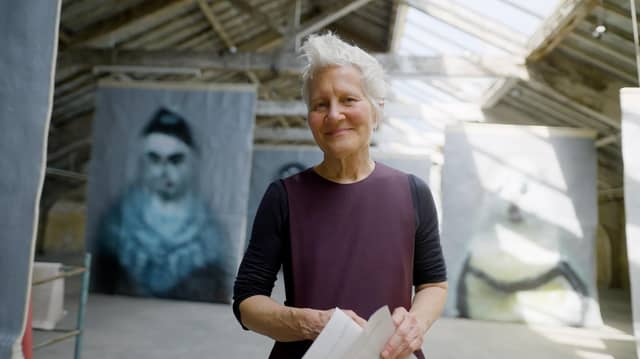


There’s such a strong sense of the past embedded in the walls of the majestic 19th century edifice, you can almost feel the spirits of the many thousands of lives that have passed through there. It is grounded in the present too, successfully repurposed as a thriving arts, retail and business space, which also gives it a bridge to the future. That idea of the mill straddling the past, present and future is one of the key elements of an extraordinary new artwork which is currently installed in the building’s vast top floor roof space.
We Will Sing, created by internationally acclaimed American artist Ann Hamilton as part of Bradford 2025 UK City of Culture, is an experiential site-responsive installation inspired by the history and regeneration of Salts Mill and the district’s rich textile heritage. Hamilton’s own background is in textile design and that personal connection adds an extra layer of resonance and authenticity to a beautifully multi-faceted reflective piece. This is Hamilton’s first show in the UK for over 25 years and her largest to date.
We never tire of investigating Yorkshire’s history - so subscribe to our Heritage newsletter

“It is a rare thing to be invited to work with a whole architecture – it’s been an amazing two and a half years,” she says. “I had started talking with the curators June Hill and Jennifer Hallam who contacted me when they were part of developing the Bradford 2025 bid and they asked me if I would be willing to be part of it. I happened to be visiting the UK, walking with friends in the Lake District, when the bid was announced and I was only an hour and a half away. So, I went down to Salts Mill the next day; it felt like it was meant to be.”
That first visit to the mill confirmed it for her. “When you are in a space you can sense what is possible. Meeting June and Jennifer and Zoe Silver, the director of Salts, and some of the people she is working with, I just thought ‘this is a very special place’. I was so touched by being there. You go through the door and you enter a room full of the scent of lilies, filled with books and with opera playing. I came to really sense all the ways that there is a belief in beauty there and that it is a place for people to feel welcome. There are so many different models of what happens to those old mills. Some of them become ruins or are converted into housing – this is a very special vision; you can feel that and I was inspired by it.”
Hamilton describes We Will Sing as a work of memory and imagination responding to what she discovered at the mill. “When you are working with such extraordinary architecture and that volume, it is not about filling the space, in a way it is already full,” she says. “It is more how does a project take form; how do you refine it and focus it and allow people into the experience of it. Over time and the different visits, exploring different parts of the mill and going through some of the storage spaces, we really found everything that we needed there.”
The installation is spread over three rooms. It brings together song, printed and spoken word, historical artefacts, cloth, raw and woven wool. The textiles were sourced from local companies including H Dawson founded in 1888 and now based at Salts and the 150-year-old company William Halstead. In the main space, hanging from the ceiling are large-scale figurative almost portraits. Slightly indistinct, they look like a figure but are not recognizable and have an ethereal quality to them. They could be ghosts of the women who worked in the spinning room. Next to each picture is a stand with a cloak in a vibrant colour hooked onto it.

The portraits are based on little porcelain figures known as fèves – traditional French trinkets that are placed in epiphany cakes – that Hamilton found in the antiques shop at the mill. “Whoever gets the slice of cake with the fève in it is granted good fortune for the year,” explains Hamilton. “I love the way they are hand-painted; they are a little damaged-looking and have an emotional quality to them. I scanned them and printed them quite large in my studio. I wasn’t sure at first if they would be part of the project but then I went back to them.” They inhabit the space in such a light touch way and feel as though they belong there.
For the song element of the piece, Hamilton worked with vocalist and composer Emily Eagen, who she has collaborated with before, on creating two soundscapes – each installed in the two smaller rooms at either end of the main exhibition space. “I had been thinking about a solo voice on one side and a collective voice on the other side,” explains Hamilton. “Emily came with me to the mill and we made some recordings in the space. She has a wide range which includes world music, early music and lullabies. I wanted something without lyrics, a kind of humming.” The end result is powerful, moving and haunting. The collective voice features schoolchildren, adults and older people singing. “There is an intergenerational element to it as one of the schools already had a connection with an Armchair Aerobics group,” says Hamilton. “We did a series of workshops with them, which Emily led, and it was magical. People were so generous.”
Collaboration is an important part of Hamilton’s creative practice and throughout the project she has worked with others including schoolchildren, community groups, textile manufacturers and students from Bradford College. “For me a very rich and gratifying part of the making and the process is sharing it with people,” she says. Early in the project she extended an invitation to the public to write a letter to the future with the prompt ‘what does the future need to know?’ “The response has been incredible,” says Hamilton. “People have really got behind it; some of the letters are so heartfelt and moving.” Volunteers take it in turns to read out letters from a booth, which would have been an overseer’s office, at one end of the main space. The sound of reading accompanies you as you walk through the installation. It is extremely affecting and the recurring themes in the letters – love, family, friendship, community – speak to our common humanity so powerfully.
Throughout the exhibition space there are benches spaced out at regular intervals where people can sit and reflect. It is certainly a piece that invites you to do that – there is so much to engage with and think about. “What I hope is that people will take away their own experience, thoughts and response to the various elements of We Will Sing,” says Hamilton. “It is a piece where you can just be. When I was there after the install, I was watching a family who were sitting on one of the benches. They chatted, wrote a letter, spent time looking around together and that was wonderful to witness.”
We Will Sing is at Salts Mill until November 2.