
Artist explores time, loss and restoration in new exhibition at Sheffield's Graves Gallery
Whenever we look at a work of art in a gallery, we are in effect entering into a kind of conversation between the past and the present. Especially if the artwork is centuries old, there is a palpable sense of the passage of time and our place in it.
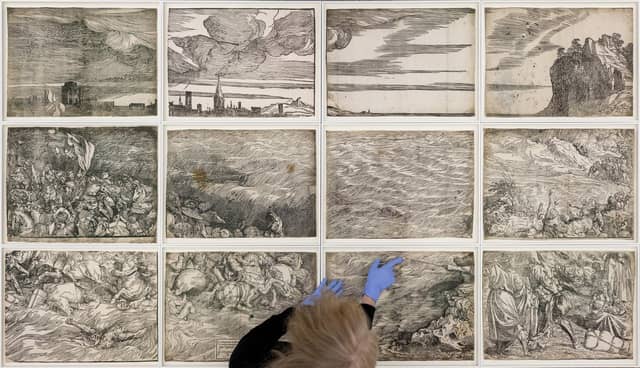


It is partly this notion of the line of continuity through time that is explored by Sheffield-based artist and academic Penny McCarthy in her latest exhibition which has just opened at the city’s Graves Gallery. In How to Look Through Time McCarthy sets out to consider time, loss and preservation by using a 16th century Titian print from Sheffield’s collection to examine the role that historic artwork can have in our lives today. A striking large scale woodcut, Titian’s work The Submersion of Pharaoh’s Army in the Red Sea (c. 1549) was last seen in the 2022 exhibition Artists and Water at the Millennium Gallery which was the first time it had been on display in Sheffield since the 1980s.
“I had only really known Titian for his painting and then I was introduced to this print from the Titian studio by David Alston who was director of the city art galleries in the 1990s,” says McCarthy who is an associate professor in fine art at Sheffield Hallam University. “It is a beautiful graphic work of 12 sections made for the city of Venice and individual prints of it would have been fly-posted on the walls of a palazzo. It wasn’t for the gentry; this was for the people. It was also a way of sharing information in an era that was largely illiterate. After I’d seen the print, I just kept thinking about it.”
Made in Yorkshire by Yorkshire journalists - get the YP’s daily newsletter
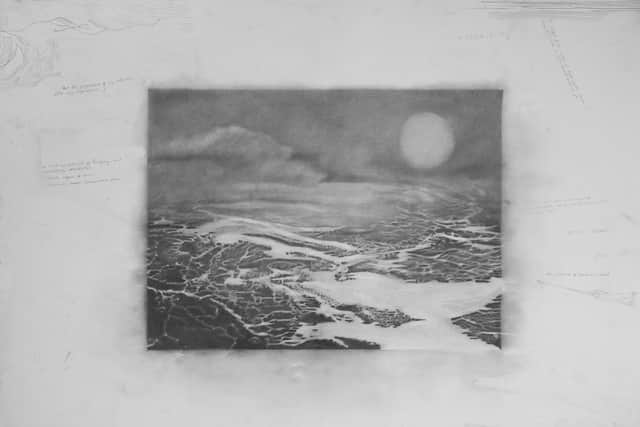
The print, which is 12 individually printed woodcuts creating a single image on a grand scale, depicts the Venice lagoon as seen from the window of Titian’s studio and at its centre is an expanse of rising water. “Around it are citizens of Venice who are trying to escape the flood and at the edge of the picture is Moses holding back the tide,” says McCarthy. “What I found really interesting was that to our modern-day eyes it looks like a warning about climate change. It felt very prescient.”
In her creative practice McCarthy frequently uses drawing to reconfigure, rethink and reactivate material sourced from archives. She spent months carefully studying the Titian work and the exhibition presents her drawings in response to it. “What was really important to me was to look at the work in detail, working through the layers of time. It felt like I spent as much time looking at the work as Titian had which was really exciting for me.”
The drawings explore what happens to an image when it is closely studied, recontextualized and re-encountered. “I’m interested in time and what it does to a work of art and what happens when an artwork enters a museum collection and how it is positioned in a particular way. Things change and keep evolving and I wanted to give a sense of that in the exhibition.”
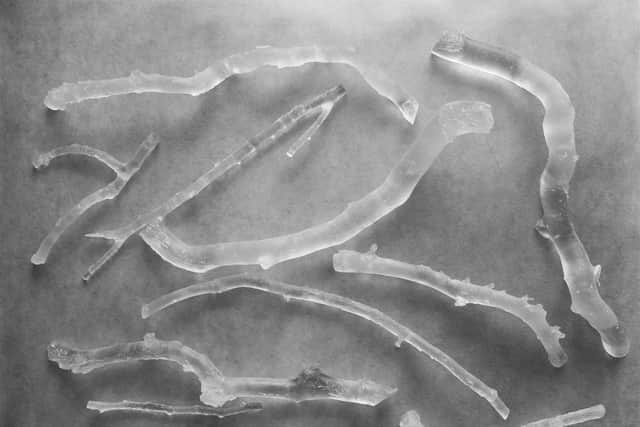
Alongside the works on paper, the exhibition also includes a series of glassworks The Light of Other Days. “As the exhibition relates to Venice, it made sense to make some works out of glass. I worked with one of my students who is a glassmaker and we experimented. I collected branches, which had been pruned from trees in the Botanical Gardens in Sheffield, and cast them in glass. They look like ice and contain light in a most surprising way.”
McCarthy has also made a new short film made in collaboration with filmmaker Hugo Glendinning. “I like using a range of different media to explore a theme,” she says. “We worked with the view of the Venice lagoon from Titian’s studio as a starting point to make the connection between past and present. Some things have changed since Titian’s time and other things haven’t changed at all. In Venice, it is like walking through history, you keep crossing bridges to the past.”
McCarthy has found the experience of working on the project enjoyable, thought-provoking and inspiring. “It’s been brilliant,” she says. “I feel extraordinarily privileged to have been able to touch something that’s been touched by Cinquecento hands. It is a really powerful feeling. I wanted to retrieve something by pulling it out of history passed from hand to hand.” She hopes that visitors to the exhibition will enjoy it. “Everyone can understand picture making, and I would like people to think about the fact that this is pencil on paper – there is value in those humble materials, they can make something really special.”
Penny McCarthy: How to Look Through Time is at the Graves Gallery Sheffield until December 20. Sheffieldmuseums.org.uk