
David Hockney: Unseen photo of Yorkshire artist uncovered at auction as mother image sells for £12,400
Young David Hockney dons a topper for a play in a previously unseen photo as a picture of his mum emerges at auction. John Vincent reports.
It's easy to imagine Laura Hockney, loyal and loving mother of her artistic son David, hunched over the Singer sewing machine in the parlour of the family's Bradford home, making do and mending, as everyone did in the war and over the ensuing years of scrimping and saving.
Lots of mending there must have been, too, for Mrs Hockney, what with five children and a husband (accountant Kenneth) to tend to.
The teenage David, by now a student at Bradford College of Art, would have watched her working at the hand-operated machine dozens of times during his youth.

In those days, he liked to draw and paint scenes of everyday life around him, including, memorably, his local chippie, the Sea Catch, piling his paints into a little cart made from an old pram and wheeling it around the suburbs of his home city.
Indoors, his vegetarian and committed Methodist mother, was a loyal and patient model for the up-and-coming artist.
It was no surprise, then, that he posed her sitting behind her trusty old Singer in 1954 for his first tentative steps into printmaking, producing the rare, early lithograph in colours entitled Woman with a Sewing Machine, which has fetched £12,400 at Tennants after surfacing from descendants of friend and fellow artist David George Fawcett (1935-1973).
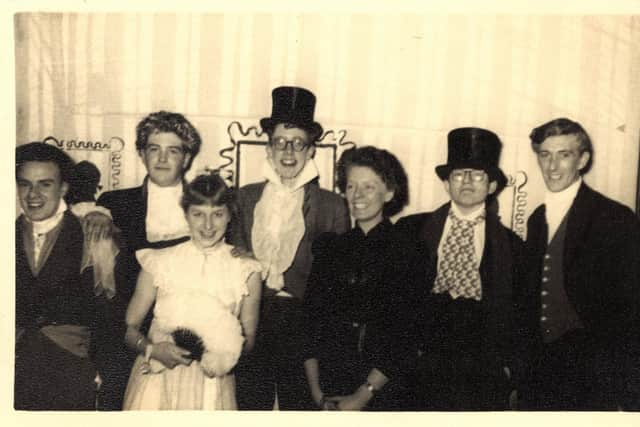
The sale saw the emergence, courtesy of the vendors, of two family photos for the first time.
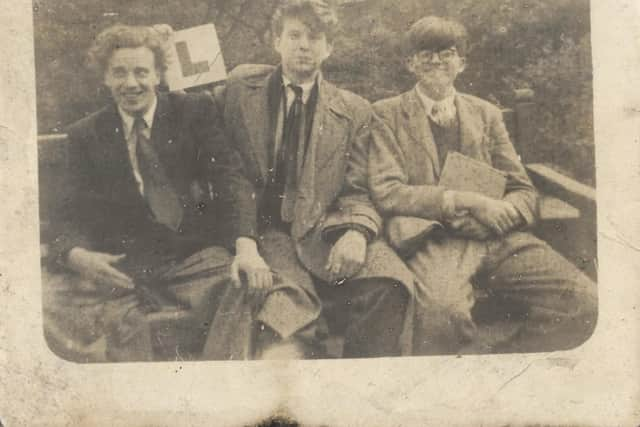
One shows the budding artists among the cast of a play and the other of Hockney with Fawcett and another friend, one of whom was presumably learning to drive.
Hockney and Fawcett were friends at Bradford Grammar and Bradford College of Art before Fawcett gained his teaching diploma at Birmingham College of Art and moved to Kent, where he taught at grammar school and art colleges.
The two men shared a studio for a time in Kent and Hockney was best man at his friend's wedding.
Fawcett worked in an impressionistic style and exhibited at the Paris Salon and the Royal Academy but died in a plane crash in 1973.
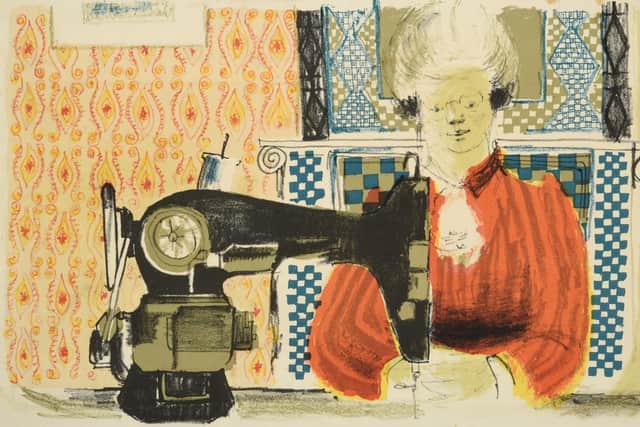
Back to the lithograph....loosely based on the family's front room in Bradford, Hockney depicts his mother, seated with hands clasped, among a riot of pattern and colour created by her orange pullover, red and yellow wallpaper and blue, white and muted green fireplace.
Dominating the foreground, of course, the machine itself: a remarkable labour-saving device, perfected in the 1850s by American Isaac Merritt Singer (1811-1875), whose name became the best known on the planet.
Operators could at last create designs, mend clothing, or even craft entirely new garments in a fraction of the time it would take by hand.
The non-electric machine, cotton reel in place and handle clearly visible on the left, brings back to me the clear memory of a genteel seamstress named Miss Springall - Springie to me - visiting my Norfolk family home for a couple of days each May.
As a small child, I would watch, fascinated, as she clattered away on my mother's old Singer, lengthening, turning-up and darning her way through a pile of shirts, dresses, socks and trousers, all in need of repair.
Dear old Springie would receive bed, board and a small remuneration before packing her valise and heading off to the next house on her winding journey through the Norfolk countryside..
The age of the peripatetic seamstress died out with Springie's generation and there seems little call for needlework in today's throwaway society.
Those that could afford one, had a sewing machine but, even without one, women had to be handy with a needle and thread in those days of make do and mend.
*The same sale at Tennants showed the enduring popularity among Yorkshire collectors of the work of award-winning Stuart Walton, who was born in Dewsbury in 1933 and is best known for his portrayals of gritty northern industrial landscapes.
A collection of paintings depicting views, some obscure, of Hunslet, Beeston and Hull also included Cat sitting on a window ledge (1990), showing a black and white feline in front of a boarded-up window amid an large expanse of red brickwork. It fetched £1,610. Wensleydale from near Spennithorne, by Anne Isabella Brooke (1916-2002), who was born in South Crosland, Kirklees, realised £4,930. The oil was shown at the Royal Academy Summer Exhibition of 1963.
At Hartleys of Ilkley, Walton's Northern Street Scene went for £625 and Barnsley-born William Mellor's Windermere from the Hills and Posforth Ghyll, Bolton Woods, Yorkshire made £720 and £550 respectively.