
Edmund de Waal curates major exhibition of Danish ceramicist Axel Salto's work at the Hepworth Wakefield
Considered to be one of the greatest masters of 20th century ceramic art, the acclaimed Danish ceramicist Axel Salto (1899-1961) might not be as well known in the UK as he perhaps should be but the latest exhibition at the Hepworth Wakefield is aiming to remedy that and bring his work to a wider audience.
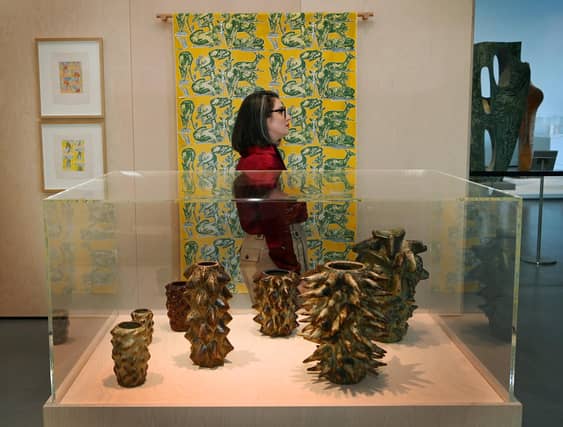


Curated by artist and author Edmund de Waal, a longtime admirer of Salto, Playing with Fire, which has just opened at the gallery and runs until May next year, is the first major solo exhibition of the artist’s work in the UK, and most of the artworks have never before been seen here. As well as a range of Salto’s beautiful ceramic pieces, the show features his woodcuts, prints, illustrations, textile designs and writing. There is also footage of him at work in his studio which gives a fascinating insight into his processes.
As a successful multi-disciplinary artist himself, de Waal, who is both a ceramicist and the author of several acclaimed books including his bestselling family memoir The Hare with the Amber Eyes, feels an affinity with Salto. It is a longstanding connection – he explains that he has been engaging with the Danish artist’s work and philosophy for the past thirty years. “This is not a retrospective,” he stresses. “It is a look at his practice with affection and in depth; it is a personal conversation with someone. The exhibition demonstrates the huge range of Salto’s work – his ceramics, prints, textiles and also his writing – and how he thought about his creative practice. And there is also work that I have made in response to his.”
Our Lifestyle newsletter is a great weekend read
De Waal says he is delighted to be bringing the exhibition, made in partnership with CLAY Museum of Ceramic Art in Denmark and Kunstsilo, Norway, to the Hepworth. “It is the perfect setting for this show,” he says. “The Hepworth is known for its ambitious ground-breaking programming – they have a track record for creating inspirational shows that defy convention, celebrating artistic practice in a range of materials.” He mentions that another reason he is so pleased is that he has a connection with Wakefield that goes back a long way through his friendship with William ‘Bill’ Ismay who was head librarian at Hemsworth Library. Ismay had built up an extensive collection of 20th century studio pottery, one of the largest in the world which on his death in 2001, was bequeathed to the Yorkshire Museum in York. “He was an extraordinary man,” says de Waal. “He lived in Wakefield in a modest house and from the 1950s onwards he put together this amazing collection. When I was apprenticed, I got to know him – he was in his seventies by then – and he came down to Sheffield when I lived there and bought some of my work. In some ways this show is also me raising my hat to that lovely, charismatic man.”
Walking through the exhibition the impression you get of Salto is of an inquisitive, highly intelligent and innovative creative force. Having graduated from the Royal Danish Academy of Fine Arts in Copenhagen as a painter he went on to become a radical multi-talented figure, working as a ceramicist, designer, editor and writer. He was intrigued by modernism and after travelling early in his career to Paris where he met Picasso and Matisse he turned to Denmark keen to share the new ideas and approaches that he had encountered. In 1917 he founded the avant-garde journal Klingen (The Blade); from the 1920s he began designing porcelain vases and bowls for the Danish manufacturer B & G (Bing & Grondahl) and was linked to the stoneware studio at The Royal Copenhagen Porcelain Manufactory.
He had numerous solo exhibitions in Scandinavia and Europe and his many accolades included winning the Grand Prix at the World Expo in Paris in 1937, the Milan Triennale in 1951 and a gold medal at the international ceramics exhibition at Musee des Beaux-Arts in Ostend, Belgium. In the 1950s his ceramics and textiles played a significant role in promoting Danish design and crafts, known as Danish Modern, in the United States. “I have been hugely inspired by Salto,” says de Waal. “He is one of those people who worked across boundaries – and in fact, didn’t even see the boundaries; whether he was making ceramics, designing or writing.”
Salto was constantly experimenting, trying out new techniques and materials. There are recurring themes in his work, much of which was inspired by the natural world. Trees and budding, sprouting, organic forms often feature – and he was aware of the transitory nature of life, how everything is in flux and nothing remains the same. One memorable quote from Salto’s writing included in the exhibition states: “No living thing is complete in itself; everything is in motion, rising and falling.” That sense of movement, transformation and metamorphosis is present in all his work and also links to his interest in the relationship between poetry and clay, which connects to de Waal’s practice too.
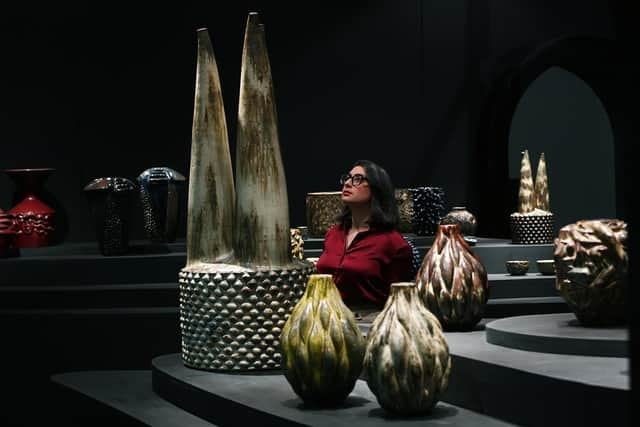
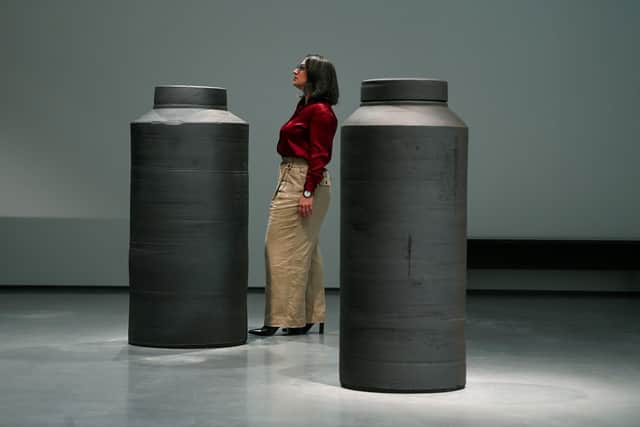
There are two major new works by de Waal in the exhibition, made in response to Salto’s work. One is the burning now, a pavilion with liquid porcelain-coated walls in which the artist continues his dialogue with Salto through words inscribed into wet clay slip; inside are shelves behind glass filled with the delicate small porcelain vessels for which de Waal is known. The other work is an installation of de Waal’s elegie vessels – the largest free-standing clay vessels he has ever made which are inscribed with words or phrases from poems by Rainer Maria Rilke. “Those vessels demonstrate how I think about ceramics and poetry as being completely intertwined,” he says. “It is at the heart of what I do and poetry was an important, integral part of Salto’s creative practice. He edited magazines and published and translated poetry and he turned the stories, and particularly the poetry, of Ovid into pots, prints and textiles.”
There is a lot of playfulness within the work of both Salto and de Waal and play is a significant word in their approach to and thoughts about their work. “Salto loved play and he was a passionate advocate for art in children’s lives,” says de Waal. “There is an area in the exhibition space where children – and adults – are encouraged to make things and draw and use printing stamps and pick things up. It’s an inspirational show and it is wonderful to open it in the middle of winter – it is full of colour, full of conversation and full of texture. I hope it is going to be a real success.”
While the exhibition provides plenty of food for thought on some profound metaphysical questions, the overall tone is upbeat. “I would like people to go away from it happier than when they came in,” says de Waal. “It is about optimism and being fully present, about recognising real, complicated emotions – anxiety, fear, excitement and joy. Salto recognises them and explores them in depth. I think he is a touchstone for really powerful, cogent values and ideas about the world.”
Playing with Fire: Edmund de Waal and Axel Salto is at the Hepworth Wakefield until May 4, 2026. An accompanying illustrated book Playing With Fire, published by Forlaget Press, exploring the dialogue between the two artists, is on sale at the gallery. Hepworthwakefield.org