
Ground-breaking exhibition in Wakefield explores sculpture through touch
Thanks to social media and constant access to our mobile phones, we are living in an increasingly visual world – according to some sources there are around 3.2 billion images shared every day and it is estimated that around 80 percent of our experience is dominated by vision.
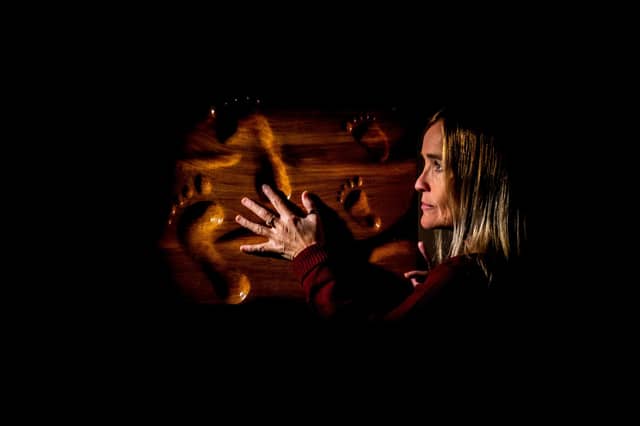


A ground-breaking immersive exhibition which opened last week at the Art House, Wakefield explores how our over-dependence on sight could mean that we are missing out on a more rounded sensory experience of, and engagement with, art. The Sense of Sculpture showcases works by artist Dr Victoria Claire, a pioneering sculptor who is registered blind. The exhibition takes place in a completely darkened gallery and invites visitors to experience the artworks using touch, sound and spatial awareness.
Claire staged a similar exhibition Blind: A Sixth Sense in 2018, the first of its kind in the UK. “It was a phenomenal success,” she says. “It opened up a lot of questions about arts and culture and had a big impact on audiences who found it so interesting and intriguing.” She is delighted that the Art House is putting on this new exhibition which is an expansion of the original and demonstrates the way in which her creative practice redefines how we encounter sculpture. “Wakefield is the centre of sculpture in Britain and this is a great opportunity not only to show my work but also to have an impact with what I am trying to do in terms of changing how we think about arts and culture.”
Claire was diagnosed with Retinitis Pigmentosa at the age of 19 and over a career of spanning three decades she has created hundreds of sculptures, taught widely and has been an advocate for the visually impaired. She was awarded an Honorary Doctorate of Arts for her Outstanding Contribution to Public Art from the University of Greater Manchester University (formerly the University of Bolton) where she now lectures in Fine Art. “My sight loss started 30 years ago and so did my career and as time has gone on, I have definitely had to make adaptations,” she says. “Then there came a point when I realised I couldn’t keep changing the environment and I had to lean in to my situation. I just have to use what I have – touch, taste, smell and hearing – and that’s when my work really started to take its own form. My work started out more realistic and has become more symbolic and abstract over the years – I would suggest that actually my work has improved since my loss of vision.”
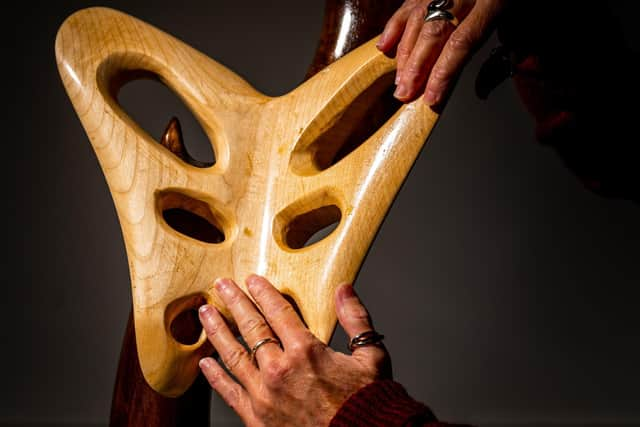
Through the research she is conducting for her PhD, Claire hopes to challenge and alter attitudes not only in the creative sector but also more widely. “I will never leave sculpture and I will always create it, but I am angling my career more towards academia and advocacy now,” she says. “I am so thrilled to be working towards trying to make this kind of change in arts and culture and society.”
The Sense of Sculpture features a variety of sculptural works by Claire. “There are eight pieces – two are floor standing pieces, one is a wall hanging and the other ones are table-top sized pieces displayed on plinths,” she explains. “A tactile guide rope leads you to each plinth and then you will find the sculpture.” A member of staff will be at the entrance to the gallery to support people and explain the experience. “I think that sculpture is supposed to be touched,” says Claire. “Henry Moore and Barbara Hepworth both had that ethos and wanted people to touch their work. It is quite rare now to be able to do that in a gallery.”
The show challenges us to think about different ways in which we can engage with arts and culture. Claire believes that by allowing ourselves to open up our other senses when encountering artworks, we can find another more profound level of emotional connection. “I hope that people who come to the show might find a new way to relate to arts and culture, but also with other things too,” she says. “I believe that taking away vision might allow them to gain a deeper understanding; because we are so dependent on vision it can prevent people from connecting with something on a more profound level.”
The Sense of Sculpture is at The Art House, Wakefield until November 1. Accessible interpretation will be available and the gallery is fully guide-dog friendly. There will be a programme of workshops running alongside the exhibition. Free entry.