
I photographed the back streets of Nepal and ended up in the Royal Academy
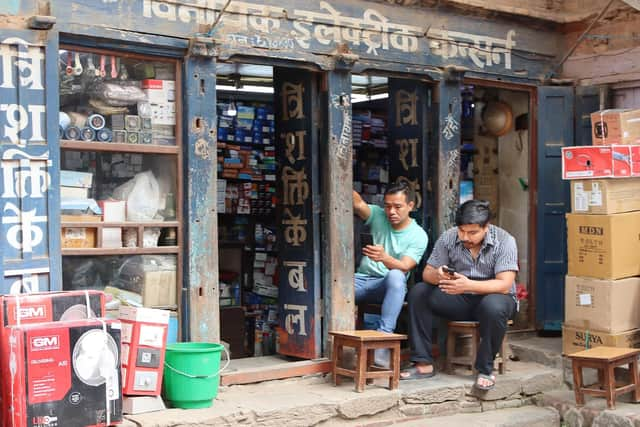
Exploring the backstreets of Nepal Emma Drohan came across an eclectic scene she was keen to capture on camera. Outside an electrical shop flanked by stacked boxes and goods either side of the faded frontage technology defies tradition.

Two men perch side by side on stools, each engrossed on their mobile phones. For them, in that moment, their handsets open a window to the world while they stay put.
For them, in that moment, their handsets open a window to the world while they stay put.
“It was that clash of old and new that caught my eye,” says Emma. “Here they were, staying put but connected to the world – while I’d travelled halfway across it to get there.”
Intrigued by the analogue clutter in comparison to the mens’ digital focus, Emma shot the scene and, in doing so, captured a moment in time that can now be viewed in one of the prestigious art institutions in the world.
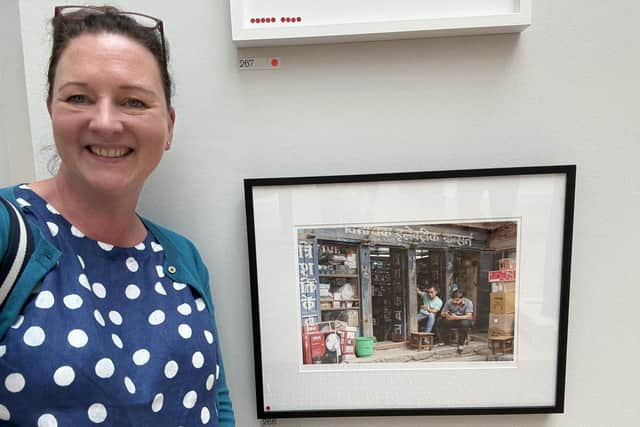
Titled ‘Without an Electric Concern’ the image was chosen by artists Vanessa Jackson RA and Sikelela Owen RA from as many as 36,000 entries for the Royal Academy Summer Exhibition, the world’s oldest open-submission art exhibition.
“I was absolutely delighted. My photograph is behind a Grayson Perry vase,” says Emma, referencing the calibre of the accomplished artists exhibiting in the same showcase.
The addition of a red dot beside her photograph denotes a sale – two in fact, so far. “It is an edition of 30, but just knowing a stranger connected with it enough to want it on their wall is fantastic. It is so exciting and it makes me feel 10 feet tall. It validates what I am doing and it isn’t just family and friends saying ‘you are really good’ – someone else has seen the value in what I do.”
Running until August 17, the Summer Exhibition is now in its 256th year and brings together more than 1,200 works across all media selected by a panel of Royal Academicians and guest artists.
‘Dialogues,’ this year’s theme, was chosen by architect Farshid Moussavi OBE RA who also coordinated the 2025 exhibition.
Seeing her work selected proved her ability in a creative medium which has been part of her life since childhood.
“I have always liked taking photographs. I call myself a visual kleptomaniac. Some people may collect objects – I collect images. I like to have a physical record of things I have seen,” says Emma.
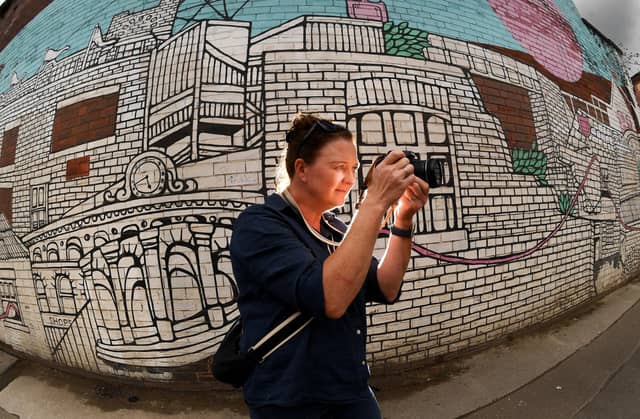
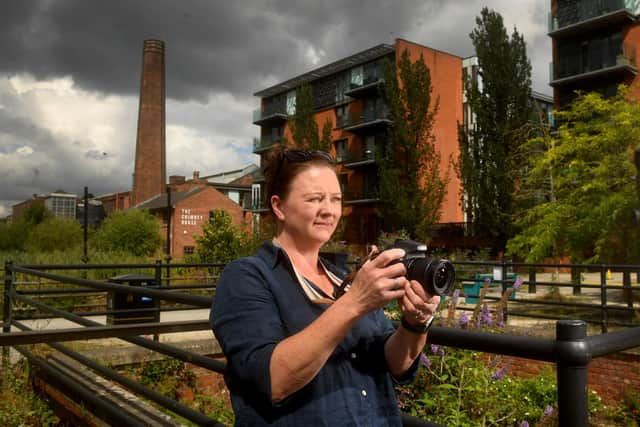
A sideways glance of a view down a side street, or something people may pass by without noticing, are among the visual documents Emma produces from her travels or regular saunters through the streets and landscapes surrounding the steel city where she grew up.
It is in Sheffield where Emma’s photography interest began. “My Dad used to have a dark room and when I was younger he gave me two old Pentax cameras. I would shoot black and white film and he taught me how to develop the photographs.
“For my GCSE and A level Art I included photography projects so it has always gone alongside everything I do.”
After leaving Edinburgh College of Art, where she studied Drawing and Painting, Emma completed a PGCE in Art & Design at Bretton Hall and taught in Sheffield before focusing on family life with her two sons.
When they started school she ran her own interior design business.
Photography came to the fore again as she caught her sons in action on the rugby pitch. This led to her capturing precious moments at sporting events and countryside pursuits.
“My family are the most photographed people on the planet,” she laughs.
Buoyed by the enthusiastic reception to her photography, Emma set up her own website to showcase her work capturing everyday life through a lens.
Travel and urban street scenes are her favourite locations. “We went to India just after we got married – my husband, Simon, had business there and we visited Delhi, Agra and Jaipur. I loved that trip – the culture, the colour, the smells, the energy – everything.”
Unfortunately, some of the photographs Emma took documenting their travels were lost in a mix-up with the snaps as she recalls.
“I had a small digital camera and I sent the photographs off to be developed, got them back, and I received a lot of photographs of Venice and not many of India!”
Twenty years later the couple had the opportunity to return to India through Simon’s work and extended their stay to travel in India and Nepal, and of course, Emma took her camera. “People saw the photographs and really liked them so that sowed the seeds that I could become professional. “I turned 50 last summer and started reassessing things. I realised I wanted to spend more time doing what I love – photographing the world as I see it.”
Living in the city renowned for its steel heritage prompted Emma to take her camera around more familiar landscapes and locations. “My dad had an iron foundry back in the day. It closed in 1990 when I was in Sixth Form at school but I did a lot of photography there in black and white.” Fond memories of helping to make little moulds in the foundry came back with every click of her camera. “That has always been a big part of my life, the iron industry.”
Emma’s grandmother’s family ran a sickle and scythe workshop in the city – connections she was keen to document and explore through her regular photo walks around her surroundings. “Sheffield has changed so much, the places I used to go as a child are gone or transformed - it is always evolving,” says Emma. “It is the things I remember growing up there, and it made me think this place is changing so much, it needs documenting otherwise you lose the essence of where it came from. Finding out about my industrial heritage got me thinking about other places. There are a lot of empty buildings – are they going to be restored or knocked down? At the same time there are a lot of new and interesting buildings going up. It has that contrast with the old and the new, the changing face of the city. I started to explore the iconic Park Hill flats. I was interested in the lines of the architecture.”
The Grade II* listed housing estate Emma references opened in 1961, and is understood to be the largest building in Europe. Looking at the building through a photographer’s eyes gave Emma a completely different perception of the Brutalist structure over-looking the city centre which has been re-freshed through re-development in recent years to accommodate a modern and mobile population while retaining its ‘streets in the sky’ styling.
“I quite like the funky new colours they have used. I started reading a bit more about Brutalist architecture and you can see the beauty in it, and behind it the visions for these estates, and that ties back to how the city has changed. You get some great photographs because of the shadows and the views over the city,” explains Emma. “It’s amazing how one subject leads on to another. It is like a big exploration, documenting my journey. Sheffield has so much history, but as manufacturing moves abroad now we are losing parts of that heritage so it is about trying to keep it alive in some way.”
Looking to the future, Emma says: “I’m planning new photo projects focused on overlooked urban and rural life – capturing real, everyday moments to preserve local histories and ensure they remain visible and relevant for the future.”
Visit emmadrohanphotography.mypixieset.com. To see Emma’s image at the Royal Academy visit https://se.royalacademy.org.uk.