
"I worked as an artist at Harrods and now live and work from my little black van."
Life on the road provides an ever-changing backdrop for nomadic artist Sara Abbott. Nine years ago, she swapped bricks and mortar for an off-grid lifestyle aboard her ‘Little Black Van’ – an SWB Ford Transit Custom.
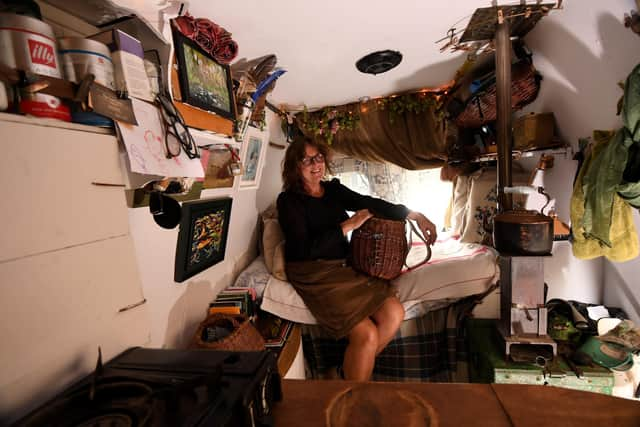
Bearing all the creature comforts of a home from home, a small counter surface affords some space for Sara to work while on the move. Beside the sliding door sits a small stove powered by charcoal. Every corner of the cosy surroundings provides practical storage solutions in this neatly organised living space.
“I’m houseless but not homeless; living this way is just a different perspective on the world, a different mind-set. Less is definitely more,” says Sara.
Mobile living was born out of a nomadic lifestyle which began in the eighties when she and her then-partner lived on a 1967 Bedford Super Vega bus.
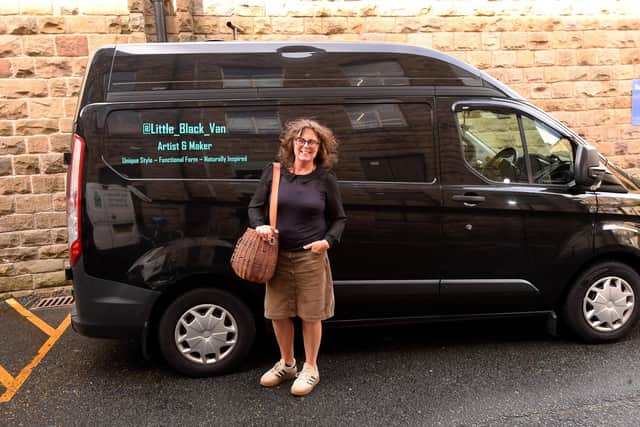

“It was brilliant. We worked hard on farms and in day-to-day life; you knew how to use an axe to split wood, you knew where to find water, and you just learned real survival skills without being too feral,” she says.
Born in Dover to parents who regularly moved around for their work in the corporate world, Sara’s yearning to lead a simple, more natural life came in response to a Cold War childhood and seeing TV adverts instructing how to build a fallout shelter.
“I thought, ‘I am going off to live in the woods and have no part in this modern world’. As soon as I was old enough, I did, for about five years. We were a nomadic community. Pruning apple trees, working in hop gardens, picking strawberries – that is what we did.”
Motherhood prompted the move into bricks and mortar. “When my two children were old enough to go to school, that is when I settled into a more regular lifestyle, but once they had flown the nest, and my life changed again, I got the Little Black Van. I have been living in her for nine years.”
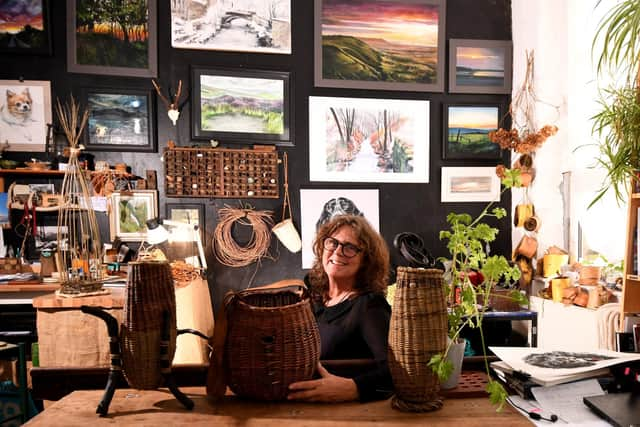
Sunsets captured in oil on canvas over Devil’s Dyke and Loch Strathbeg, and the full moon setting over Mull, are among the views Sara has documented from her travels, now mounted in frames around her studio in the Salem Community Centre, Hebden Bridge. “As an artist you are always trying to make sense of the world around you and the environment.”
For 25 years Sara has been a professional artist creating fine oil-on-canvas portraits of horses and dogs, several for the Kennel Club. She was also an artist in residence at the Knightsbridge department store, Harrods.
“Before becoming a full-time artist, I worked at Culpeper the Herbalist and contracted growing crops for the pharmaceutical industry, but during a time when I was unwell and off work, I picked up my brushes as part of my healing process and started painting. I painted a picture of Diana the Huntress with her dogs. Somebody saw the painting and asked if I could paint their dog for them.”
That led to a 15-year career creating portraits of horses and dogs for commissioning clients – and donating part of her fee to help dogs in rescue in the process.
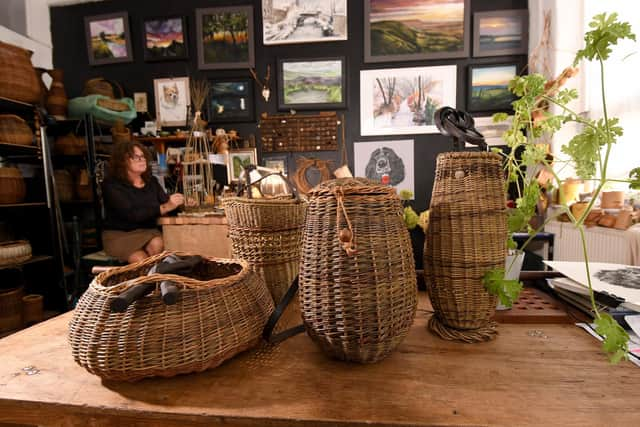
Five years ago Sara arrived in Hebden Bridge, where her daughter now lives.
New beginnings, and the loss of her 18-year-old rescue chihuahua, Karma, three years ago, whose portrait hangs on Sara’s studio wall, turned her attention to a craft she had previously tried and long admired.
Basketry is critically endangered on the Heritage Crafts Red List, but through her artistry Sara is helping to retain this traditional craft.
In recent years, she has switched from pet portraits to sculptural and contemporary basketry. Taking the techniques she learned at Creative with Nature, previously based in Todmorden, Sara’s mission is to carry traditional basketry into the future, designing baskets that can be used today and incorporating found materials from the landscapes that she visits in the van.
“Basketry has declined in popularity because the baskets made don’t fit with our modern needs. We need something to carry our laptop or water bottle, something stylish to use as a handbag.”
Sara explains when soaked, the willow becomes malleable to work with, enabling her to weave and shape it into all manner of styles and designs.
Sculptural pieces and practical possessions – beautiful handbag and shoulder bag baskets demonstrate how woven willow can create such an eye-catching and fashionable tote.
Sara’s own basket handbag is more than a fashion statement – its thick and supple leather shoulder strap was a Cub Scout belt. The large antique key woven into the basket design serves as a personalised reminder, ‘a visual prompt’, she says, not to forget her keys.
“Using my own basket is one of my sales pitches – you go out anywhere and people will say ‘I love your basket’ – it’s encouraging more people to use baskets; they are the ultimate bag for life,” she says.
Slender, small, tall or wide, they come in all shapes, sizes and styles. A bridle hanging on a hook is among the recycled equestrian tack providing Sara with the straps and buckles for her bags.
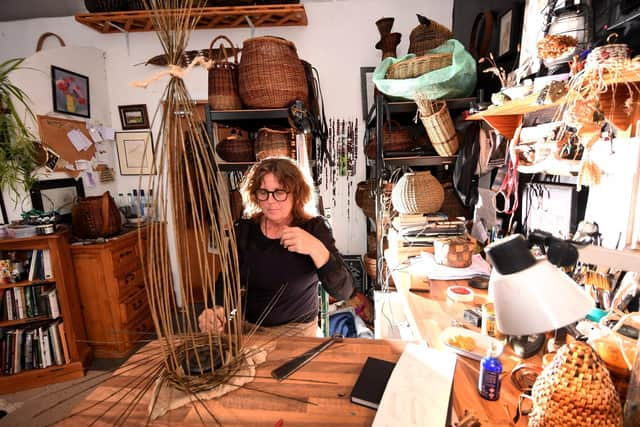
“Basketry is referred to as the mother of pottery, as it was our first way of making vessels, and the structures grow in the same way. But the over-and-under movement of the weave is buried in the dawn of time.
“Early humans survived and thrived weaving cloth, shelter from wattle and daub, and making basketry to carry anything – it could be lined with beeswax to carry water and fishing nets, all woven. Even our DNA is twisted like cordage, and it is such a comforting movement to perform now and a meditative process too,” says Sara.
Shells, feathers and oak galls, along with unusual elements such as clay, nettle cordage and Medieval and Roman spindle whorls, made of lead, add detail to Sara’s designs.
“Spindle whorls were used in spinning and weaving, but they were regularly lost and have been buried in the ground for thousands of years,” she explains.
Many are unearthed by the metal detectorists she sources them from.
‘Love bombs’ are an example of Sara’s interior pieces. Willow structures are filled with meaningful foraged finds – nettle seed for strength and courage; rose hips and hawthorn berries for love and compassion and fruit pips and stone for joy and celebration.
‘Maiden Mother Crone’ – a beautiful willow basket symbolising the bond between Daughter, Mother and Grandma – sits on three ebonised legs cut from one piece of stag oak – an oak branch that has died on the tree and so-called for its similarity to stag antlers.
“These are womb-like vessels that held us from which we all come – like pearls on a necklace, one following the other.”
From October 16 to 18 Sara is debuting her baskets at the Great Northern Contemporary Craft Fair, Victoria Baths, Manchester.
“I am really pleased with myself, if I can be a little bit smug, but I have worked hard to create a collection of contemporary baskets for this show,” says Sara.
In November she is participating in Crafts in the Pen in Skipton and Hebden Bridge Open Studios in December.
Sara has a permanent exhibition at the Heart Gallery in Hebden Bridge.
“Weaving for my living is a privilege I take seriously and responsibly. I believe in it; it’s a sustainable, beautiful, human craft that brings joy. Through my one-of-a-kind works, I hope to ensure this most ancient of skills travels with us into the future, and, like the malleable willow, my designs will always bend to fit our changing needs and desires.”
Visit Little_black_van on Instagram.