
Major retrospective of the work of Helen Chadwick at the Hepworth Wakefield
Over the years The Hepworth Wakefield has championed a number of artists who have for whatever reason been overlooked or undervalued. A good example was last year’s Ronald Moody exhibition which brought the work of the undeservedly little-known sculptor to a wider audience and their latest show highlights the creative significance of another underrecognized figure.
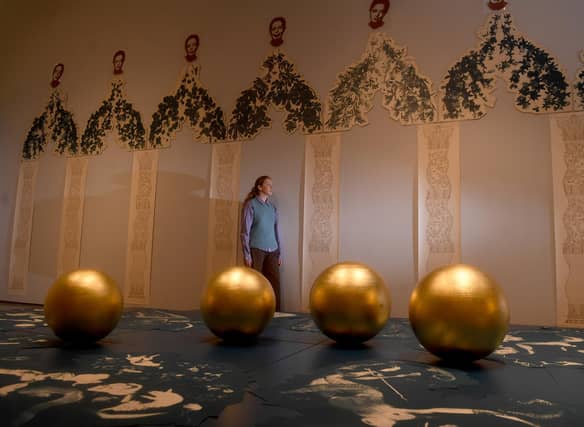


Helen Chadwick: Life Pleasures which opened last month and runs into the autumn is a major retrospective of the British artist Helen Chadwick (1953-1996) whose influence on and contribution to contemporary art both in the UK and internationally is far-reaching. The exhibition showcases her diverse creative practice which encompasses a wide range of media including sculpture, photography, installation, performance, lightbox works and print. Working as a visiting lecturer at London’s Goldsmiths University, Chelsea School of Art, the Royal College of Art and Central St Martin’s in the 1980s and 1990s, Chadwick taught many of the group of artists known as the Young British Artists (YBAs) – including Damien Hirst, Tracy Emin and Sarah Lucas. She was also one of the first women artists to be nominated for the Turner Prize.
“It may be a bold claim but I don’t think that British contemporary art would look like it does without Helen Chadwick, both as an artist and a teacher,” says Laura Smith, director of collection and exhibitions at the Hepworth, who curated the exhibition. “She was unapologetically curious and experimental and she thrived on using new materials and radical techniques.”
Chadwick was constantly pushing at the edges in terms of the materials she used and incorporated into her work including chocolate, snow, milk, fur, hair, milk, urine, bubble bath, rotting vegetables, pig intestines and the cells and form of her own body. Throughout her career she consistently expressed an unapologetically feminist perspective – right from the beginning with her renowned degree show In the Kitchen (1977) – and her work frequently challenged cultural expectations around what it meant to be a woman and questioned traditional perceptions of beauty.
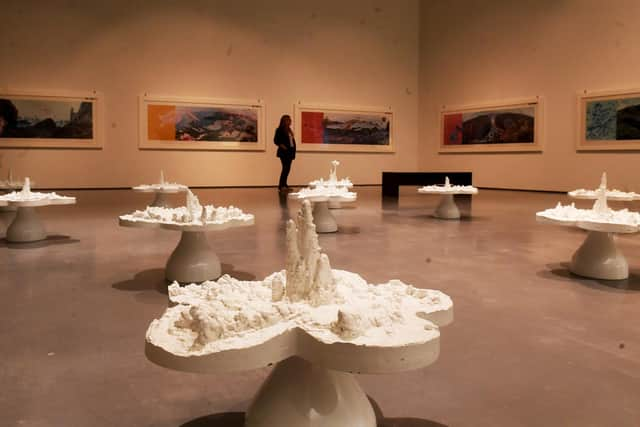
“When Chadwick was making her work, there weren’t many artists doing what she was doing – making us feel something before we think something, and that’s what gives her work its longevity,” says Smith. “We have on display works that haven’t been shown for 20 years but they look as if they were made yesterday and they are still so relevant today. She explores sex, death, disease, questions around gender and she does it so tenderly and cleverly to stir our emotions.”
There is a playfulness in Chadwick’s work too and a wry humour. Among the works in the exhibition is Cacao (1994) which is a monumental fountain of liquid chocolate, bubbling and making a glooping sound like a swamp or a sewer. It is a work that has the capability of being both delicious, desirable – and disgusting. Other works on display include Carcass (1986) a huge 2m high glass cuboid tower into which food waste from the Hepworth’s café will be deposited and allowed to decay, an evolving, organic sculpture designed to represent the cycles of life and death and The Oval Court (1984-86), consisting of 12 photocopied images of Chadwick floating naked in a pool with animals, insects, flowers, fruit and fish swimming around her. “Somebody asked me if Chadwick was deliberately crossing boundaries – I don’t think she saw boundaries,” says Smith. “She just used the material or medium that felt relevant to the work she wanted to make. She was endlessly curious. Her work is challenging but it’s also really beautiful and I don’t think she ever deliberately wanted anything to be sensational. I don’t think she ever set out to be provocative; she wanted to test things out.”
Sadly, Chadwick died young, aged only 42; it is poignant to think about what she might have gone on to achieve had she lived longer. “She would have been 72 this year, imagine what she could have done in the last 30 years,” says Smith. “We have filled four galleries with 15 years’ worth of work; it is one of our largest exhibitions which demonstrates the level of her output and how prolific she was.”
Smith hopes that the exhibition will resonate with people and bring Helen Chadwick’s work the wider recognition it so richly deserves. “I would love visitors to recognize what a genius she was and how generous she was with her creativity,” she says. “She didn’t hold anything back, she put everything into her work. I would really like people to see that, to witness the joy she found in making art and to feel that same joy.”
Helen Chadwick: Life Pleasures runs at the Hepworth Wakefield until October 27. Hepworthwakefield.org