
New exhibition at Leeds Arts University explores the pressing issue of climate change
One of the many reasons the arts are so important is that they are a perfect tool for investigating and illuminating some of the most pressing issues of our time, raising awareness and enabling greater understanding. A new exhibition at Leeds Arts University is a case in point.
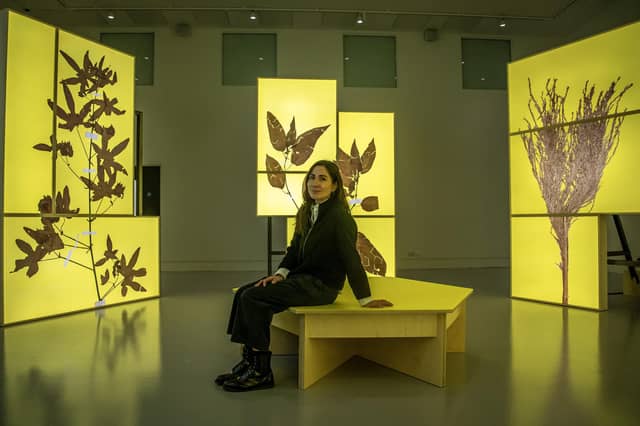


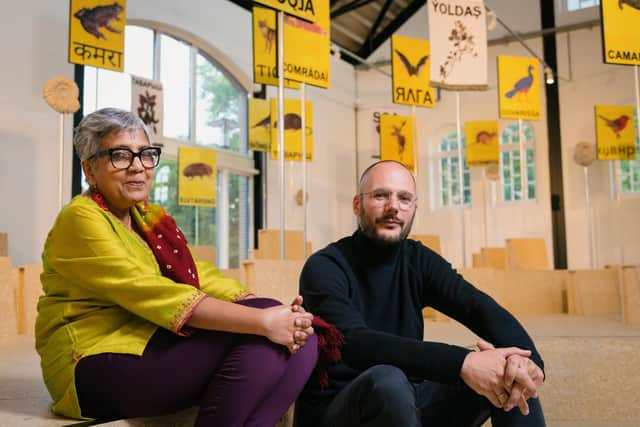
The University’s Blenheim Walk Gallery has been transformed into a courtroom with the public acting as the jury for the latest immersive installation from Dutch visual artist and researcher Jonas Staal and Radha D’Souza, an academic, lawyer, writer and activist from India. Court for Intergenerational Climate Crimes (CICC): the British East India Company on Trial, making its UK debut outside London, was created to explore intergenerational climate crimes committed by states and corporations.
In particular the exhibition focuses on the historical ecological impact and environmental damage made by the British East India Company. A joint-stock company, it was founded in 1600 to exploit trade initially with East and South East Asia and India and operated until 1874 and played a significant role in the colonization of the Indian subcontinent. Staal, whose work deals with the relation between art, democracy and propaganda, and D’Souza, who is professor of Law Development and Conflict Studies at the University of Westminster, have through their collaboration on CICC previously hosted tribunals prosecuting Unilever, ING Group, Airbus and the Dutch State for their climate crimes, as well as Hanwha Group, Doosan, POSCO Group and the Republic of Korea.
“Jonas and Radha have been working on this project for a while and held their first exhibition in Amsterdam in 2021,” says Dr Marianna Tsionki, associate professor and curator at Blenheim Walk Gallery. “After that it was presented in several museums and galleries internationally and this is an iteration that was initially commissioned by the Serpentine Gallery in London. It has a particular focus on the British East India Company and the part it played in colonialism in India and other parts of the globe.”
Our Lifestyle newsletter is a great weekend read
Now on an international tour, the exhibition has come to Leeds after being shown at the Irish Museum of Modern Art (IMMA) in Dublin, and will go on to several European venues. “I am so happy to have it here in Leeds,” says Tsionki. “It is a really important project, one of the few discussing climate change and I think Jonas Staal is one of the most important contemporary artists working today. It is the kind of project that you tend to see in London exclusively so it is really exciting to be able to bring it to the North of England.”
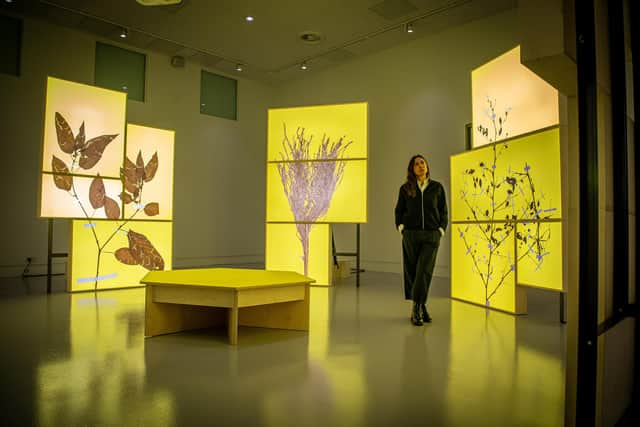
The exhibition features a collection of large lightboxes displaying botanical specimens connected to the continued consequences of the East India Company’s trading operations, developed in collaboration with experts at Kew Gardens. A new projection summarizes the public hearings that have been held in other venues so far, presenting key arguments on the lasting impact of climate crimes on ecologies and communities of the past, present and future. During the opening weekend of the exhibition at the end of last month, the University auditorium hosted an inaugural talk presented by D’Souza introducing the legal framework of the CICC and the case against the British East India Company. The subsequent discussion featured contributions from legal scholars, historians and activists and the public was invited to participate as jurors.
“The project is so well-researched and brings into the conversation the role of the law,” says Tsionki. “It is urgent and conceptually rich work which demonstrates how art can engage critically with these kinds of challenging issues. Involving the public makes it a participatory process and the focusing on the intergenerational aspect of climate change connects the past, the present and the future. Activism is part of the fight against climate change and I think this project is a starting point for further investigation.”
For many of us the sheer scale of the climate crisis can make us feel helpless in the face of something so overwhelming. Tsionki believes that the exhibition and the ongoing project has the potential to counter that feeling of powerlessness. “It really conveys the idea that climate change is not something that happened suddenly,” she says. “I think that is really important because it helps people to situate a human crisis within the wider context of socio-political decision making. And the exhibition is also about encouraging people to contribute to the debate; I think that is empowering.”
Court for Intergenerational Climate crimes: the British East India Company on Trial is at Blenheim Walk Gallery, Leeds Arts University, until January 31, 2026.