
New exhibition at the Brontë Parsonage Museum - From Haworth to Eternity
The enduring fascination with the Brontë family and the peerless novels of Charlotte, Emily and Anne has been attracting visitors to Haworth, where the sisters lived and worked, for well over a hundred years and the Parsonage Museum is this year exploring the ways in which this continuing literary legacy has shaped the village and perceptions of it, beginning with a new exhibition entitled From Haworth to Eternity.
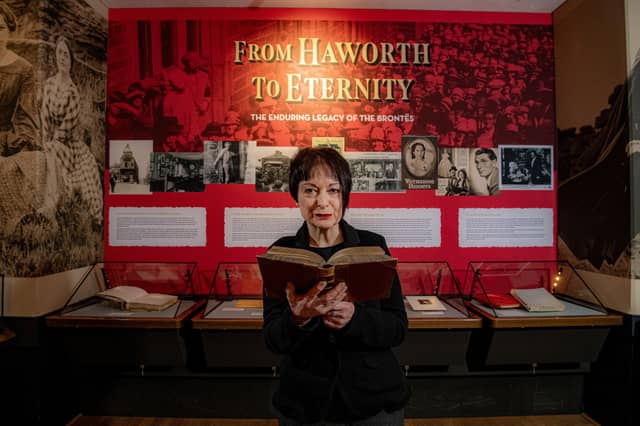


The exhibition looks at the different elements that have led to Haworth becoming a global tourist destination and a place of pilgrimage. “Haworth was a hard-working industrial township – it was never considered to be a romantic place until the Brontë novels first appeared in 1847 under the pseudonyms of Acton, Currer and Ellis Bell,” says Ann Dinsdale, principal curator at the Brontë Parsonage Museum. “By 1850 people were starting to work out that the novels had been written by three clergyman’s daughters living in West Yorkshire and people began finding their way to Haworth.”
Tourists were keen to explore for themselves the landscape and locations they had read about in the Brontës’ stories. “There was a belief from very early on that you could actually visit all the places mentioned in the books,” says Dinsdale. “Emily and Anne were dead by 1850 so Charlotte was the one who experienced this literary celebrity. After her death in 1855 the interest, rather than diminishing, actually increased.” Much of that interest was fuelled by the publication in 1857 of Elizabeth Gaskill’s biography of Charlotte Brontë. It was an almost instant bestseller (it remains one of the most popular biographies ever written) and it brought the lives and works of the literary sisters to an even wider audience.
Our Yorkshire Post newsletter is packed with our best stories - sign up now

“It was a moving tribute to Charlotte and such an extraordinary story – these three women of genius living on the moor,” says Dinsdale. “In the book Gaskill portrays Haworth as a remote, inhospitable place but rather than putting people off, it encouraged them to come here. Tourism started to really take off – there were shops on Main Street that were selling photographs of Patrick Brontë.” Patrick himself received a number of visitors who would call on him at the Parsonage. “He got a lot of requests for samples of Charlotte’s handwriting,” says Dinsdale. “So, he would cut up letters to provide snippets, and some of those are on display in the exhibition.”
The term ‘Brontë country’, far from being a modern-day marketing invention, had already been coined by the end of the 19th century and from the 1860s onwards there was a steady stream of visitors to Haworth. “People often wanted to take away a souvenir and in the early days there were a lot of collectors seeking out people who knew the Brontës and persuading them to part with their memorabilia,” says Dinsdale. Some of the souvenirs were quite unusual. In 1861 an American businessman called Charles Hale travelled from Boston to Haworth shortly after the death of Patrick Brontë when the Parsonage was undergoing major renovation in preparation for its next inhabitants. Hale managed to purchase a number of items including the whole of the lower sash of Charlotte’s bedroom window and some of the woodwork from the rooms. Once the Brontë Society purchased the Parsonage in 1928, interest grew further as for the first time people were able to visit the actual house in which the Brontës lived and wrote their works.
The exhibition features a number of selected pieces from the Museum’s extensive drama archive including props, stills photographs, manuscripts and letters, to illustrate the impact of the numerous films and television series inspired by the Brontës and their novels. Recent examples include writer-director Sally Wainwright’s 2016 BBC drama To Walk Invisible and filmmaker Frances O’Connor’s 2022 film Emily. “We definitely notice a boost in visitor numbers each time,” says Rebecca Yorke, director of the Brontë Parsonage Museum. “Particularly after the Emily film, we had a lot of younger people coming. There was some criticism that it wasn’t historically accurate, but it was an artistic response – Frances O’Connor described the film as a reimagining of Emily’s life. I think it is great that each new generation of artists finds inspiration in the Brontës’ lives and work.”
The very first film version of Emily Brontë’s Wuthering Heights, a silent movie shot on location in and around Haworth, appeared in 1920. The shooting script, annotated by the director A V Bramble, is one of the items on display in the exhibition. It was acquired by the museum back in 2014. “As the film itself didn’t survive, the script is a really valuable resource,” says Dinsdale. “We also have film stills and production notes on costumes and locations.” Another version of Wuthering Heights, starring Laurence Olivier as Heathcliff and Merle Oberon as Cathy, came along in 1939 and was filmed, less authentically, in Hollywood studio lots with the outdoor scenes shot on location in Thousand Oaks, California.
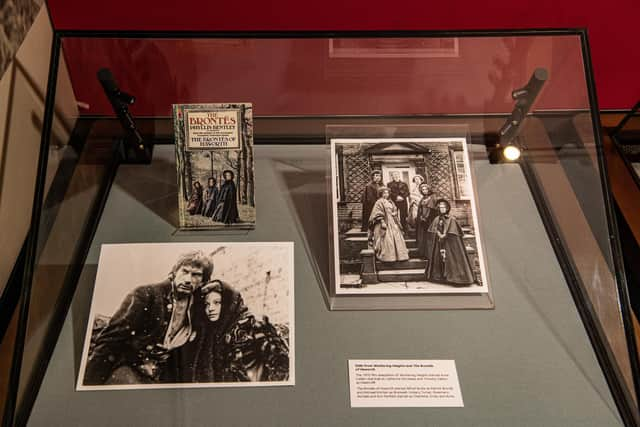
Orson Welles and Joan Fontaine starred in the 1943 film version of Jane Eyre and on display in the exhibition is the original production script with handwritten notes from Aldous Huxley, one of the co-writers of the screenplay. In 1946 Devotion was released, a highly fictionalised account of the Brontë story with Ida Lupino as Emily, Olivia de Havilland as Charlotte, Nancy Coleman as Anne, Paul Henreid as Arthur Nicholls and Arthur Kennedy as Branwell. Historical accuracy was not a priority but it proved popular with audiences. “Visitors to Haworth really started to grow during that period despite the petrol rationing,” says Dinsdale. “Then in the 1970s there was another bit of interest with TV adaptations of Jane Eyre and Wuthering Hights and a five-part YTV series The Brontës of Haworth. After that was broadcast 200,000 visitors came, which is still a record.”
The exhibition also looks at how Haworth was portrayed, especially in the early days of interest in the Brontës, as being a remote, rough and insular place which fed into the misconception that the sisters led a lonely, unsociable existence. It couldn’t be further from the truth. “Although the Brontës were cut off from literary society and the publishing world, which was primarily in London, they were not isolated at all,” says Yorke. “They read newspapers and periodicals and attended lectures and concerts in Keighley. We have on display in the exhibition what we call the Thackeray dress which Charlotte wore when she travelled to London to meet her literary hero the novelist William Makepeace Thackeray. In terms of everyday life, the Brontës were surrounded by this amazing landscape and were very much part of the village community. There was a lot of inspiration for their stories – they were aware of local news and gossip and they would have made visits to local families with their father.”
Dinsdale hopes that visitors to the Parsonage will enjoy taking a closer look at the perceptions of the famous literary family and their home. “The exhibition really delves into why the Brontës continue to be so popular,” she says. “It’s a combination of things – the power and originality of their writing, added to that their tragic life story, all set against the backdrop of this wild countryside. It is a potent mix.”
From Haworth to Eternity is at the Brontë Parsonage Museum until January 1, 2026. A full programme of events runs alongside. Details bronte.org.uk