
New exhibition explores the ongoing work of pioneering organisations Women's Aid and Leeds Animation Workshop
A timely new exhibition at the University of Leeds’ Treasures of the Brotherton Gallery is exploring the ongoing work and the decades-long histories of two pioneering organizations – Women’s Aid and Leeds Animation Workshop – that emerged from the Women’s Liberation Movement of the 1970s.

Animated Activism: Women Empowered, which opened last month and runs throughout this year, is an inspiring account of half a century’s struggle for women’s rights told through items selected from the organizations’ archives, both of which are held in the University’s Cultural Collections. Women’s Aid, an activist collective led by women, was founded in 1974 as a national network of independent refuges for women experiencing domestic abuse and went on to launch helpline services and lobby for vital legislation. In 1978 a small co-operative of feminists formally set up Leeds Animation Workshop on the back of their successful first film about the need for pre-school childcare. Both groups pushed for much-needed societal change.
The exhibition celebrates the vital campaigning, resilience and major achievements of these grassroots organizations and also serves as a reminder of how much work there is still to do. Among the exhibits on display are posters, photographs, badges, animation cels, pasted-up newsletters and short animated films. In addition, there are items from Feminist Archive North, created in the 1980s and now also held at the University, revealing the challenging context within which Women’s Aid and Leeds Animation Workshop were established and began their work, against a backdrop of discrimination, inequality, misogyny and violence.
Our Yorkshire Post newsletter is packed with our best stories - sign up now


The archives, both acquired by the University in recent years, are a rich resource and plans to showcase some of the highlights have been in the pipeline for some time. “They are hugely important collections for us to be able to make available for research and it is such a privilege to have them here,” says Sarah Prescott, archivist in Special Collections at the University and co-curator of the exhibition. “We were very lucky to get funding from the Wellcome Foundation to catalogue both archives which shows how significant they are. Once we finished cataloguing, we wanted to celebrate both organizations and get some of the objects out on display. It is very exciting for us as this is one of the few times that we have been able to co-curate an exhibition working with the people who actually made these archives, and that really helped us shape the stories we were able to tell.”
The exhibition highlights the individual histories of both Women’s Aid and Leeds Animation Workshop while at the same time highlighting the links between them in their approach, ethos and commitment to effecting positive social change. “I was a teenager in the 1960s – part of the postwar boom generation – we all thought things were going to improve and that we were going to make the world a better place,” says Terry Wragg, worker-director and founder member of Leeds Animation Workshop. “So, we all took it on to change the world and that was part of what we were doing. We were girls who had grown up being told what we couldn’t do; in the Women’s Movement we made friends with like-minded people. In the mid-1970s there was a little group of us in Leeds making a film called Who Needs Nurseries? We Do. Most of us weren’t mothers at that time but we were feminists and we saw the lack of nurseries as something that would hold women back. We were aware that during the war the government had opened nurseries so that women could go to work and then closed them once the men returned from the war to their jobs. Women were frustrated that they weren’t able to work. There were things that were unfair that we thought needed changing.”
The nursey film made a tremendous impact. It was picked up by numerous nursery campaigns around the country and was distributed nationwide. “Most of us had never made or edited a film before but it seemed to work,” says Wragg. “So, we thought we would make another one.” Nearly fifty years later and with more than forty films under their belt, they are still going strong, based in the house in Harehills that they bought in 1982 with a grant from the British Film Institute, and still making a difference. A not-for-profit, cooperative company, the Workshop has throughout its history been run solely by women. Today it is a multi-generational core team of seven aged from their mid-20s to early-70s. They are involved in all stages of the production process, from initial research right through to distribution. “We regard our work as four-fold – production, distribution, education and exhibition,” says Wragg. “We organise screenings not just of our own films but also those of other women animators from around the world and we run courses.”
In their short animated films, the Workshop have over the years covered a wide range of intersecting social and educational issues including equal pay, racism, domestic abuse, homophobia, child protection, nuclear disarmament, parenting and the environmental crisis. All their films are created in collaboration and consultation with groups, organizations or individuals involved in the relevant area. The beauty of animation is that it can convey a sometimes complex and challenging subject in a direct and relatable way. “There are lots of things that distinguish animation from live action filmmaking – it is more intense,” says Wragg. “I think animation is to live action what poetry is to prose, it is so condensed and distilled. It is a good way to make things understandable very quickly, to show another person’s perspective and to encourage discussion. Every project is another opportunity to ask important questions.”
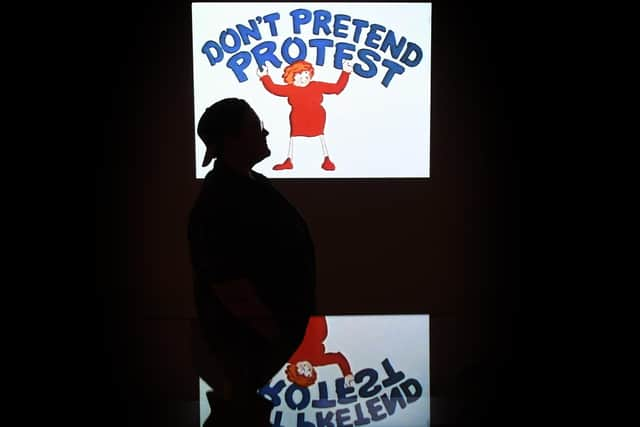
Their most recent project is a newly commissioned short film exploring the related and separate histories of Women’s Aid and Leeds Animation Workshop and how their archives came to be at Leeds. It is screening in the exhibition for the first time alongside storyboards, scripts, stop-motion animation paper characters, funding proposals, Women’s Aid photographs of marches and inside early refuges, badges and posters. “The exhibition really packs a punch to show the different activities and campaigns both organizations have been engaged in over the years and how active they still are,” says Prescott. “We also wanted to show how resilient they have had to be – it wasn’t a smooth ride for them. They were radical and disruptive, fighting for change and they were viewed with suspicion, irritation and annoyance by the authorities, they got bad press – it was important to show all that too. And the energy, wit and resourcefulness that the two organizations have in common.”
Creating the exhibition has itself been a perfect example of a group of women combining their skills for a greater good – to tell stories that need to be told, recognized and not forgotten. “Women’s history does tend to get buried and we all felt it was so important to record it,” says Wragg. “We have worked together to preserve this work, for the sake of young women in the future. Women working together are a very powerful force.”
Animated Activism: Women Empowered is at the Treasures of the Brotherton Gallery, University of Leeds until December 20. Admission is free and open to all. Tuesday-Saturday, 10am-5pm.