
Quirky Sheffield: New book reveals Steel city's hidden gems
There’s much more to Sheffield than stainless steel. An unashamedly ‘green’ settlement, Sheffield has more trees per head of population than any other city in Europe. Anyone touring its 78 public parks, 10 public gardens and 170 woodlands would find George Orwell’s description of Sheffield as “the ugliest town in the Old World” hard to understand.
A new book – Quirky Sheffield – celebrates the city’s inexhaustible capacity to surprise. Long before the Industrial Revolution, Sheffield also boasted a fortress which grudgingly played host to some of the most famous figures in history. The author Robert Nicholls, who was born in Norton on the south side of Sheffield, has written Quirky Sheffield as a tribute to the city which provided him with a happy childhood.
“My favourite green part of Sheffield is Graves Park, where I spent an awful lot of time playing as a child,” he said. “I had wonderful views from my childhood bedroom window.”
The park, developed between 1926 and 1936 by the entrepreneur and politician Alderman J. G. Graves, and then donated to the city, remains one of the UK’s finest green spaces. Sheffield boasted the cleanest air of any industrial city in the UK during the 20th century, when many of its rivals were choked with smog. “The views in Sheffield are extraordinary because the city has so many steep hills,” says Nicholls. “One third of the city is in the Peak District and large areas are difficult to build on because of the river valleys. Leaders like JG Graves also played a big role in protecting the greenery.”
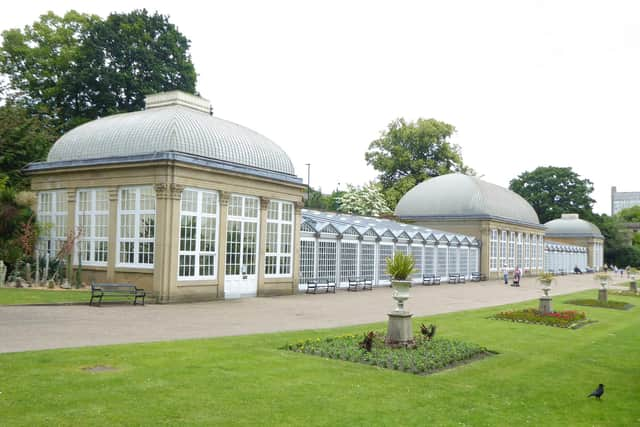

Sheffield is proud of its botanical gardens, which occupy 18 acres and date from 1836. The gardens were laid out by Robert Marnock (1800-89). Around the same time, he laid out Sheffield General Cemetery. He was clearly just getting into his stride because he would later devise the gardens of the Royal Botanic Society of London in Regent’s Park and Kenwood. Sheffield has often inspired those who have gone on to achieve global acclaim. The quirky urban walks include the Rivelin Valley Trail, which opened in 1967 and passes the remains of 20 watermills and mill dams.
A short way upstream from the park café is a small island containing the Rivelin Valley Chair. “It was sculpted by Jason Thomson and was created as part of the Second Nature project to support exploration of the city’s ancient woodlands,” the book states. “Although it resembles gnarled tree roots, it is made from steel. It was unveiled in 2011 and represents the fusion of the city’s woodlands and industrial heritage.” Traces from the more distant past can be found at Abbeydale Industrial Hamlet, which was used for iron forging and making blister steel from iron and coke. The buildings date from the late 1700s but the site had been used for industry since around 1200. It was restored half a century ago by the Council for the Conservation of Sheffield Antiquities and today an early crucible of the type developed by Benjamin Huntsman for producing steel can be seen, as well as water-powered tilt hammers.
Visitors who probably had less pleasant memories of Sheffield have included Mary Queen of Scots, who fled to England in May 1568 after a reign overshadowed by murder and rebellion. Queen Elizabeth I regarded Mary with suspicion due to her potential claim on the English throne. In February 1569, Mary was placed under the care of the Earl of Shrewsbury, the husband of Bess of Hardwick, who was one of the most powerful women in England. Mary was held in Sheffield Castle but also spent time at the earl’s Manor Lodge, Wingfield Manor and Tutbury Castle, and made summer visits to Buxton and Chatsworth. Mary was allowed a large personal retinue, which included her Master of the Household, a secretary, doctor, surgeon, embroiderer and pantryman.
“The custody regime was quite relaxed; she was supervised rather than imprisoned,” says Nicholls. The expense of keeping Mary proved too much for Shrewsbury, and in August 1584 he petitioned Elizabeth to be excused his duties, which was agreed. Mary was then held elsewhere, under much stricter regimes, as plots linked with her name became more frequent. She was finally executed at Fotheringay in 1587.
“Virtually nothing remains of Sheffield Castle, although demolition of the former Castle Market has exposed some of it and there is talk of some sort of restoration,” the book states. “More remains of Sheffield Manor Lodge and the site is open at times over the summer. Little remains of the lodge itself due to subsequent industrial and mining use. Part of Wolsey’s Tower, where Cardinal Wolsey was held for two weeks, whilst on his way back towards London, survives, along with what is claimed to be Sheffield’s oldest surviving toilet.”
Memories of another conflict, and the prisoners associated with it, can be found elsewhere in Sheffield.
“The Redmires Camp Plantation was created during the First World War as a training camp for the Sheffield City Battalion, it was later used by other military units and then became a prisoner-of-war camp. Its most famous prisoner was Karl Doenitz, then a U-boat commander, who was captured in October 1918. Doenitz later became head of Germany’s navy and Chancellor of Germany for a short while following Hitler’s suicide. Today all that remains are the foundations for Nissen huts, toilet blocks and water tanks.”
Nicholls hopes his latest work will encourage action to halt the decay of at least one landmark. “If anywhere mentioned in the book needs support, it's Birley Spa, which was built in the 1840s. It never really succeeded as a spa and was later converted into a pub and a children’s leisure gardens from 1912 until the Second World War. It has been badly vandalised in recent years and the trust set up to restore it would benefit from wider public backing.
“Sheffield has been famously described as a ‘strangely stimulating city’. I hope people who read the book will share this opinion.”
Quirky Sheffield by Robert Nicholls is published by Amberley Publishing. www.amberley-books.com