
Richard Mackness: 'I taught Grayson Perry and he was the perfect art student'
Richard Mackness has long been making waves with his sculptures and he has always thought big but now he is thinking very, very big. He spoke to Julian Cole at his Yorkshire studio.
You could say sculptor and artist Richard Mackness took the scenic route to his studio. From York to London and New York, then back to the city where he grew up.
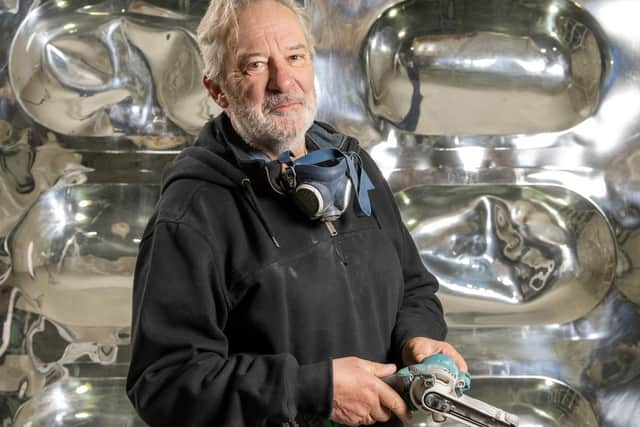
His studio is just outside Strensall. The voices of children from a nearby primary school provide an incidental chorus as Mackness explains how, at 69, he is finally doing as he wishes.
His words could fill many pages. He talks seriously and smartly, breaking off to laugh at himself. When it is pointed out he talks a lot, he says, yes, he’s been told that.


His studio had been a stoneyard and the transformation was far from easy.
“About 15 tons of machines had to come out,” says Mackness.
“It was a hell of an episode. It took about a year to get it anywhere near useable. It took me two weeks to vacuum all the stone dust off the walls.”
Mckness grew up in Acaster Malbis outside York, moving to Acomb when he was ten and he has spent his life making things.

As a child, he used river clay from the banks of the Ouse to form the Roman soldiers, animals and monsters of his imaginings. Precursors perhaps to the jet-engine sculptures that hang in his cavernous studio.
As a young sculpture lecturer, Mackness taught the artist Grayson Perry at Portsmouth Polytechnic. Not that Perry needed much tuition.
“He was probably the perfect art student that guy. He just turned up, and he was mad for it,” says Mackness. “I thought he was great. But I never really taught him anything he didn’t find out for himself.”
His time in New York began with spotting a sign in a window saying: ‘Sculptor Wanted’.

“You don’t see that very often. I rang the number, the job had already gone, but they said come and see us anyway.”
That led to a productive spell in New York, a rough and ready city at the time, where alongside his own art he made models for museums. He had a studio in the building where he lived with his wife, the American-born illustrator Liz Pyle.
He loved New York but was not able to stay.
“Our first child was three and a half and I thought I can’t bring up a child in New York on the money I’ve got.”
Back in England, he and Liz set up Urbis Design in East London. Eventually they left to live in York, moving the firm to an industrial estate at Full Sutton.
“We started out making bread bins, everything concrete, jars, furniture, tables, small plants pots, but you soon realise that you can’t compete with imported pots.
"People liked them and they won design awards, amazingly enough, but people wouldn’t pay what it cost to make them.”
The solution lay in upsizing to large pots and planters. More than 200 were ordered for King’s Cross station and Granary Square nearby.
“It’s a really nice development and I’m proud to be part of it, and it paid for this,” says Mackness, throwing out his arms in his studio.
After 20 years, he and Liz sold Urbis.

A piece he made ten years ago is on permanent loan to Holy Trinity Church in Micklegate, York. Deus Vorax is a golden idol in the shape of a car engine.
“It’s got a soft form, I modelled it out of clay, but it’s on polystyrene. The bottom I scraped away so you can see the little beads. It has the weird polystyrene stony texture, and you can feel the softness of the clay, which has been smoothed over so it looks like it’s melting, and the whole thing has been covered in golf leaf.”
Mackness says the piece raises questions.
“Do car engines melt; are they normally gold, not really. What’s the polystyrene doing there, why is it on an altar in a church?”
His jet engines are based on the notion that most phones have a picture of a jet engine, “with clouds and maybe a wing, it’s an irresistible image”.
One engine is silver and rusted and has a needle like a syringe.
“When you get in a jet you’re full of excitement, you’re going somewhere, maybe on holiday. There’s this feeling of foreplay and being aroused sitting in this bit of technology which we take for granted.
“You sit there, the whole thing starts to vibrate, the engine roars, you get this kick up the arse and suddenly you are shoved into the sky, and you look down a few minutes later and you’re in the clouds and it’s amazing.”
Another engine is a giant rubber bean bag with mechanical fan blades at one end, but it also has a mouth and resembles a stranded whale.
“Albrecht Durer did a beautiful print of a whale that got stuck on the Belgian coast in the 1500s. It’s a creature that lives somewhere else and has got stuck here – a bit like we have. Technology is wonderful. There is nothing wrong with technology it’s how we use it.”
The third engine, set on a horizontal pole, will be covered in concrete clay and set spinning.
“I will carve it with my fingers so that it looks like it’s been on a potters’ wheel,” says Mackness.
“Then I will break it and stick it back together, so it’s like a broken urn, a piece of Roman pottery, but if that’s a Greek or Roman urn why does it still look like a jet engine?”
Once again, he laughs at himself.
A sculpture resembling a large lilo was inspired by migrants washing up across Europe on anything that floated.
“An old canoe, a lilo, somebody risking their life floating across the sea on what’s basically a sunbed. Everybody in the country had an opinion about it, and it’s upsetting to see people pushed to those extremes.
“I started thinking about how that’s one kind of extreme experience. Also they’re coming here for refuge, but there are plenty of people in this country who also need refuge.”
Looked at another way, the lilo resembles a blister pack of pills or antidepressants.
“My mother was bipolar. She would go away to Naburn asylum. I grew up in a household with behaviours which weren’t normal.”
Mackness doesn’t mind if people touch his sculptures.
“Our eyes are gorging themselves and our hands go hungry. The hand to me is really important. I always use my hands, I don’t use machines, I don’t use anything with a microprocessor. I think they are causing so much trouble. To make a sculpture you have shape, scale, surface, and colour.”
Mackness has been invited to become a member of the Royal Society of Sculptors. He wasn’t sure, not being a ‘clubby person’, but decided it would be good to meet other artists.
“It can be quite lonely if you’re up here in North Yorkshire in a room on your own most of the time.”
Asked for a final word, Richard says he would love to see his jet engines in a gallery or sculpture park. High ceilings recommended.
To see more of Richard Mackness’s work visit richardmackness.com