
Sculpture exhibition showcases new body of work by contemporary artist Sagarika Sundaram
The latest exhibition at the Henry Moore Institute in Leeds, Reservoir, showcases the work of contemporary artist Sagarika Sundaram, born in Kolkata and now based in New York, and presents an entirely new body of work, made especially for the show, in her first museum exhibition.


All the works on display, exquisite large-scale sculptures made from wool and felt, were created in Kutch in north-west India, where Sundaram has been researching felt and dyeing techniques, and then completed on site in Leeds. “Through our programming we move from work that’s made historically through to work that’s very contemporary – it is part of our mission to show how artists are thinking of sculpture today,” says Laurence Sillars, head of the Henry Moore Institute. “And supporting artists to make new work is an important part of what we do. It is really interesting to see how Sundaram is using ancient processes of felt-making and using material that is soft and malleable to make these large-scale sculptures.”
Subscribe to the YP’s Lifestyle newsletter
It is an exhibition that pushes at the boundaries of what sculpture as an artform is and can be, certainly in terms of its materiality. Traditionally we might think of sculptures being constructed from hard materials – such as stone, wood, bronze – here the possibilities are opened up through Sundaram’s use of wool in different forms to create pieces, some on a monumental scale, that suggest an equally solid presence that is at the same time fluid and full of movement.
The first piece you encounter as you enter the gallery is Blue Mountain, a beautiful craggy structure of dyed wool placed over a steel frame. It looks like it could be rock, yet the azure and sandy colouring could also suggest the sea, while the void at the back of the piece creates cave-like spaces which also conveys the idea of a place of shelter. It is an incredibly complex and layered work. “You have this sense of a great mountain looming over you and it relates to the artist’s experience of growing up in India in a region between forests and mountains,” says Sillars. “It is a big impressive piece that looks like it could be stone or granite, and to do that with wool is amazing. It is very alchemical.”
In the second gallery space, the main high-ceilinged area, is another large-scale work, Dancer, an elegant spiral sculpture that is suspended from the ceiling, and which very slowly, almost imperceptibly, moves in a circular motion. “It is made from layered felt, and the spiral is created with one single cut,” says Sillars. “The piece is responding to what is happening in the room, as people walk past it creating air movement. The pattern is undyed wool and weaving it together you get this really interesting result. It is so full of texture and alludes to landscape and nature.” It is a beautiful, mediative piece, that forces the viewer to slow down, observe, be present and in the moment.
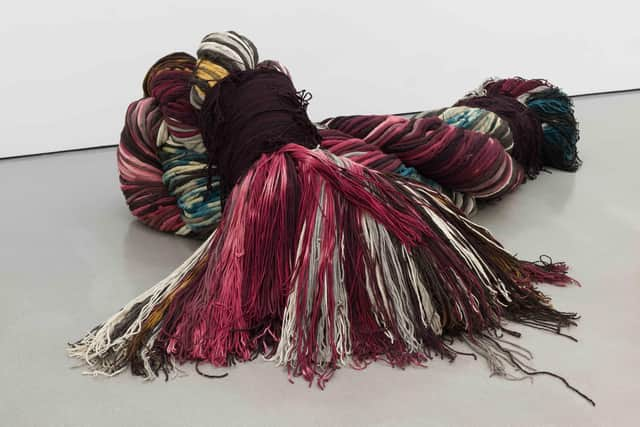
In the same room is Rope, a floor sculpture made from wool that has been hand-felted into lengths of string and then twisted and entwined, through a process of repetition and accumulation. “Rope making is such an ancient technique – it is one of the earliest forms of technology that allowed us to lift and pull,” says Sillars. “Sundaram said that she has wanted to make a sculpture of rope for some time. The history of material and fabric is also a constant feature of her work.” The resulting artwork is full of movement and flow, and warm, deep colours, predominantly red, brown and green, and a quiet strength.
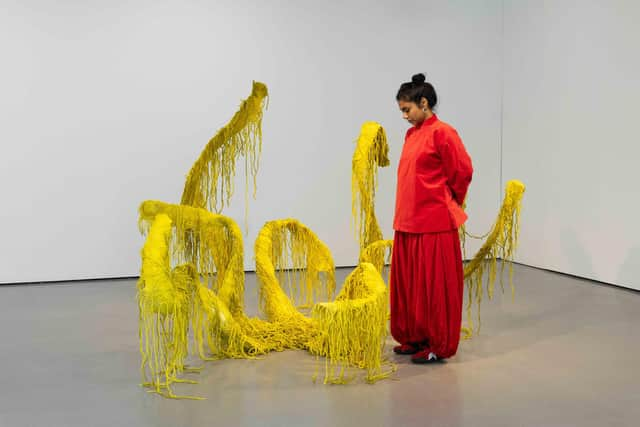
In the final gallery space, we find Glossolalia (which means ‘speaking in tongues’), a delicate bright yellow artwork of fine fronds of felted wool and silk draped from a multi-limbed frame. It could be botanical or some kind of sea creature – like the other pieces, it allows the viewer to bring their own imagination to the work. “It suggests that it could be gesturing, there is a lot of movement here,” says Sillars. “There are elements of plant life and nature, which you can see in much of Sundaram’s work, alongside a constant conversation with landscape.”
Wool, Sundaram’s principal material, has so many associations and resonances for us as human beings. Humanity has used it for centuries as an essential part of life providing warmth, clothing and shelter – it means that the whole exhibition is compelling and relatable and on so many levels.
Sagarika Sundaram: Reservoir is at the Henry Moore Institute, Leeds until January 10, 2027. Free entry. Open Tuesday-Sunday, 10am-5pm. henry-moore.org