
Wuthering Heights: How my wool sculptures ended up in the Hollywood blockbuster before heading to Yorkshire
If you've seen the new Wuthering Heights film with Margot Robbie and Jacob Elordi you may have noticed that the scenery was seen to grow as if nature was taking back the house. The dark woolen tumerous tendrils were the work of artist Nicola Turner. Turner, who has a history of being a theatre set designed before becoming a sculptor, was sworn to secrecy about her involvement after being asked personally to be part of the movie of 2026 by director Emerald Fennell.
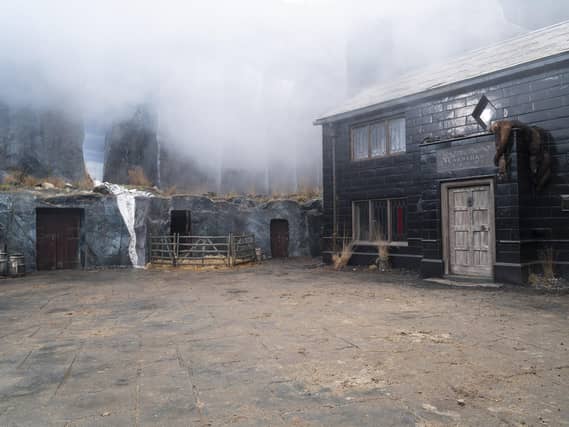


Turner’s work, which includes horsehair tendrils, was used to visually represent nature reclaiming the house, reflecting the film's gritty, and, "brutalist" aesthetic. “I received an email from Susie Davies the production designer who said Emerald (Fennell) had seen my work and wanted to talk to me about including it in Wuthering Heights. I had a Zoom with them both and they had images of my work behind them. She wanted an emotional response to the text and she felt that resonated with me work which has described since as tumerous tendril,” says Turner.
"She felt my just having my work growing throughout the film would create an emotional primal response. It was amazing to work on it and the fact that Emerald really understood my work. Iwas so pleased to be part of it.”
Turner was sworn to secrecy about her involvement in the film and now some of the tendrils that appear in Wuthering Heights will help create her installation in the Chapel at Yorkshire Sculpture Park next month.
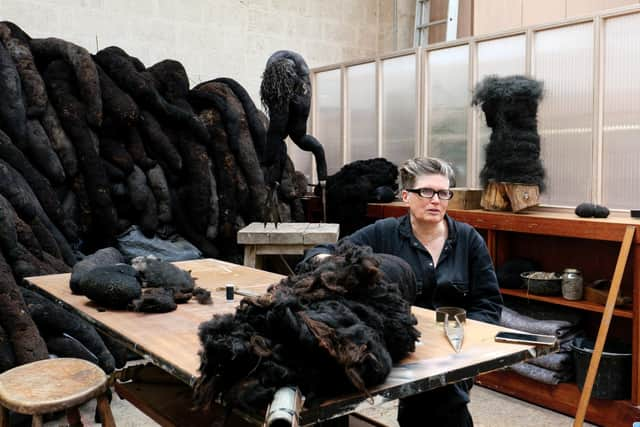
“I had career in theatre design doing sets and costumes – I worked at the West Yorkshire Playhouse very early on in my career. But I always thought something was missing so I went back to uni to do an MA in Fine Art and I graduated just before Covid,” says Turner.
As part of her MA she did large scale charcoal wax drawings, but she started to realise they were really more sculptural. "I decided to try to get them off the page and exploring different materials I could work with. I wanted to use organic materials. One day I was cycling past a skip and saw a chair and the seat had horsehair popping out of it and so I dissected the chair. My mother did upholstery when I was growing up so it was materials I was quite familiar with.
"The horsehair really excited me I realised that I could actually stich it into forms and use it as sculptural material. I started going to upholsterers and collecting all their waste and picking through it. It resonated me – you are drawn to it but also slightly repulsed. Also I loved all the stories – the embedded memory of the material.”
As the scale of her sculptures grew Turner needed more material and so went in search of horsehair mattresses. “Some come with amazing stories. I collected one from a castle in Scotland and it came from a fourposter bed that had moved from one castle to another but had been slept on by James the Pretender when he came to claim the thrown of England.
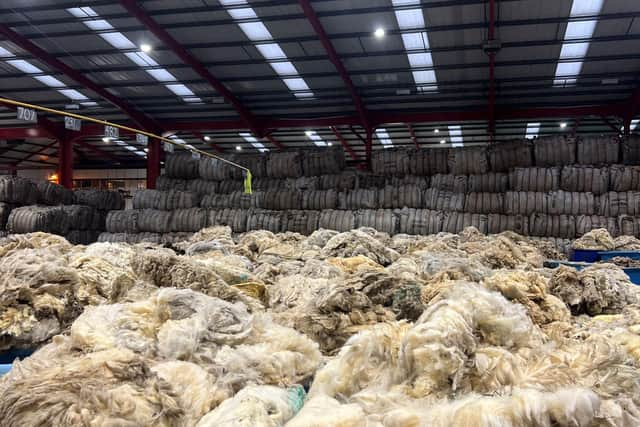
"I had somebody write to me saying that she suffered from PTSD and my work puts into visual images what she finds hard to express in words. She found they had the comfort of sheep’s wool which made me think that I could start working with sheep’s wool as I could get it in bulk. And I met a shepherd in Somerset and she gave me her sheerings every year.”
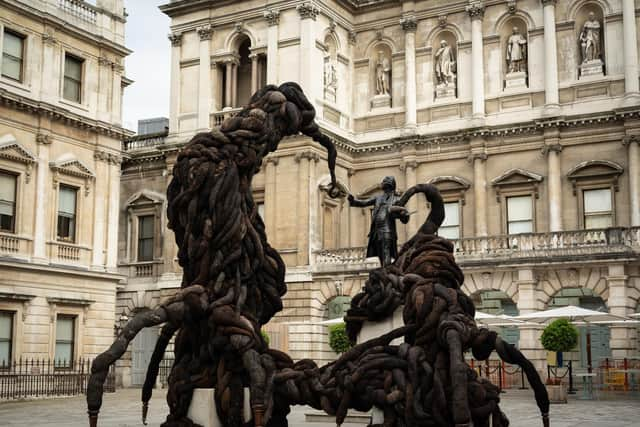
Most of Turner’s work is responsive to the environment she creates it in. “I was lucky enough to get a piece into the Well’s Chapter House which is the most amazing space with amazing history and it resonated with me. I got some good images and they were seen by someone from the Royal Academy and they asked if I would come and speak the committee about doing a site responsive piece in the Royal Academy for the Summer exhibition.
"They took me round and then took me into the courtyard and said we'd really like you to go is to respond to the statue of Sir Joshua Reynolds in the courtyard. My background in theatre means I can cope with scale and listed buildings planning applications. The tools I have picked up enable me to really go for it and respond.” Turner says the first thing she does is go and spend time in the space. “I work very intuitively but I did have to work with their structural engineers as it had to be safe.”
Turner makes a lot of the tendrils in her studio but then puts the final form together on site.
"With Sir Joshua Reynolds I was really taken y his paintbrush and then I researched him and in the latter part of his life he was becoming very ill and in some of his works you can see this dark cloud around which were his thoughts. And there also a painting called the Death of Cardinal Beaufort. Cardinal Beaufort was dying in med and there was this meddling fiend in the background it had only been recently found again because when Reynolds painted it there was uproar and over the years as it was revarnished they varnished over this meddling fiend. A conservation officer had taken the layers of varnish off and revealed the meddling fiend and so I thought that was a good name for the piece.”
Turner’s work grows out of the interplay between materials and the body, considering ideas around skin, the dissolution of boundaries, cycles of life and death, and the relationship between the human and non-human. She is fascinated by how objects hold memory and investigates our deep-rooted and often unconscious connections to our environment. Her work provokes visceral responses and walk a line between attraction and repulsion, familiarity and strangeness.
The YSP installation, Time’s Scythe will be the biggest of hers in pale wool and creates a different energy to her dark sculptures, moving away from their heavier, more melancholic character.
Encased in mesh, individual tendrils of raw wool and horsehair are entangled and stitched together to create the work’s bulbous masses. "There is something primal about the seeping movement of these bodily forms through the space,” she says.
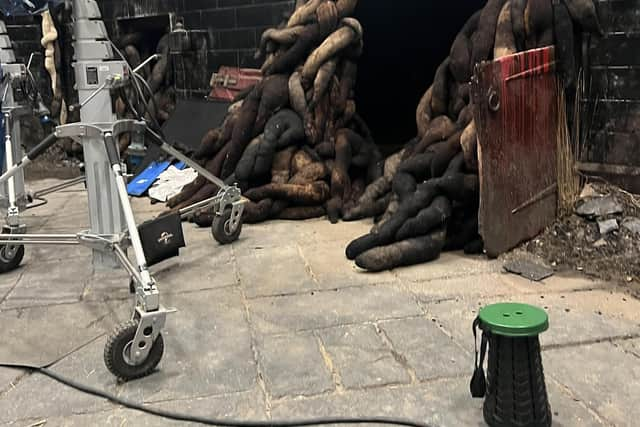
Turner describes the organic material she uses as “dead matter” that holds an inherent, latent energy. Her work often incorporates found historical objects, such as ornate furniture legs, that also represent an imprinted history of accumulated touch and use.
Pincer-like at the tips of the tendrils of Time’s Scythe, a multitude of traditional sheep shears, many with Made in Sheffield on them, reach towards the altar like claws. The shears also link to local historic traditions of manufacturing and industry, including toolmaking in Sheffield, where many of these examples were produced, and the making of woollen cloth in West Yorkshire. She uses one tonne of Yorkshire wool from the British Wool Board based in Bradford on the YSP works and making 1,200m of tendrils. The powerful sculptural presence made from wool and horsehair begins outdoors on the facade of the 18th century chapel, spilling from the bell tower and entering through an upper window, before cascading over the balcony to inhabit the nave. A cherry picker will be needed during its installation next month.
Visitors will be able to walk amongst its sinuous forms, with the earthy smell of wool heightening its sensory impact. Time’s Scythe, is drawn from Shakespeare’s Sonnet 12. Turner is interested in cutting as a metaphor for new beginnings and breaking free of the past. Connecting to this concept is the fact that the Chapel is dedicated to Saint Bartholomew, who was martyred by being flayed alive and is the patron saint of professions relating to skin and cutting, including leatherwork, tailoring and even farming.
“Spending time absorbing the energy and stillness of the magnificent Chapel and its surroundings was the starting point for my site-responsive installation Time’s Scythe,m” says Turner. “My material, which includes locally sourced wool, will pull, weave and grasp through the space with the final form emerging as I work in situ with the YSP team.”
Nicola Turner: Time’s Scythe at the YSP Chapel from March 28 – September 27