
Author Rob Cowen explores Britain's history and geography in new book The North Road
At some point most of us will have travelled along the A1, the name the road has been known by for the past 100 years or so. A 400-mile highway that stretches from London to Edinburgh, it is a combination of ancient trackway, Roman road, coaching route, pilgrim path and, latterly, dual carriageway and motorway. It runs like a backbone through Britain and has a long and fascinating history.
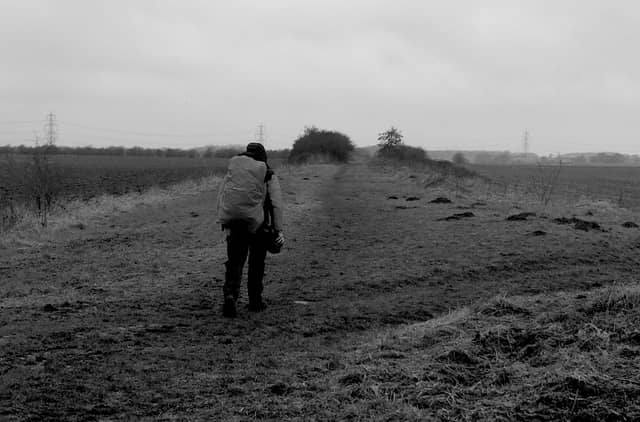


Previously known as the Great North Road before a nationwide road-numbering scheme was introduced in the early 1920s, the highway, which has been in existence for 2,000 years, has inspired a new book, The North Road, by Rob Cowen. The award-winning author, who is based in North Yorkshire, is widely considered to be one of the UK’s most original writers on nature, place and people and is probably best known for his acclaimed 2015 book Common Ground about a patch of edgeland near where he was living at the time, on the outskirts of Harrogate. The book was shortlisted for several prestigious prizes and was voted one of the nation’s favourite nature books of all time in a BBC poll.
Cowen’s work is often described as ‘genre-defying’ and The North Road, which combines history, travel-writing, memoir and short story, is certainly impossible to pigeonhole. Tracing the route of the road and delving deep into its past, through stories of the people, places and events that it has borne witness to, the book is a powerful, profound, personal and thought-provoking work that offers the reader a unique experience. The complex, layered nature of the road is reflected in the structure, scope and content of the book. It is ambitious, thoroughly researched, rich and textured, and Cowen skilfully interlaces its various elements. “All I have ever wanted to do as a writer is to take readers somewhere they are not expecting,” he says. “I think that books used to challenge us a lot more and sometimes asked more questions than they answered.”
Our Lifestyle newsletter is a great weekend read
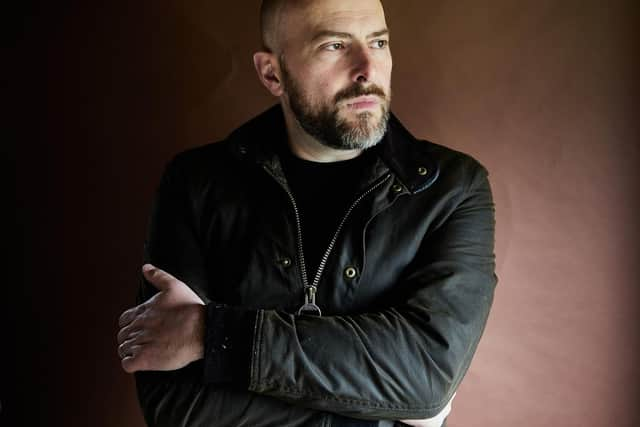
The North Road project began around ten years ago, when Cowen was musing on what to do next after Common Ground. “The way I had approached Common Ground was not just writing a non-fiction book but mixing genres to try and find something that was richer and truer to human experience,” he says. “So, I was thinking about doing that again but I was feeling a bit stuck and then my dad came to visit me and suggested that I take a look at an archaeological dig he had heard about near Catterick.” The idea was to see what was emerging on the site and perhaps write a feature about it.
The fact that it was close by appealed to Cowen because he didn’t want to be away from his wife and two young children for long. He thought he would go and see where it might take him, but was unprepared for what he found and the effect it had on him. “Then the next thing… I was kneeling there by the side of the A1 uncovering a human skull,” he says. “It was a bright spring day and there were cars rushing by at one side and on the other side you could see the revealed Roman road and there was this grave in front of me and a body that hadn’t seen light for 2,000 years. I had a moment of being caught between times – the past, present and future. And I had this dizzying sense of who am I, how did I get here and where was I going? When I walked away from there, the feeling followed me.”
It led him to consider a number of philosophical questions around what is handed down to us from previous generations, what we pass on and what endures. “It made me think that maybe I could explore this road that runs through the country as a kind of metaphor for life,” he says. “There was also a strange political landscape at that time –the Scottish Independence referendum had taken place and the EU referendum was coming up, both of which were forcing us as a nation to think about our identity, what Britain was and what it wanted to be.”
At around the same time, Cowen also received from a relative a bundle of photographs of his great grandfather John William ‘Bill’ Cowen that he had never seen before. He discovered that Bill, a hard-working second-generation Irish immigrant, had a connection with Doncaster where he had initially worked as a miner and later ran a series of small businesses – B&Bs, hardware stores and fish and chip shops. “Bill was the final element – a mine he had dug and one of the shops he owned were both on the Old North Road. All those things came together and it felt like it was a journey I had to make.” He began researching and walking sections of the road, which he continued to do intermittently over the course of ten years, in between other writing projects.
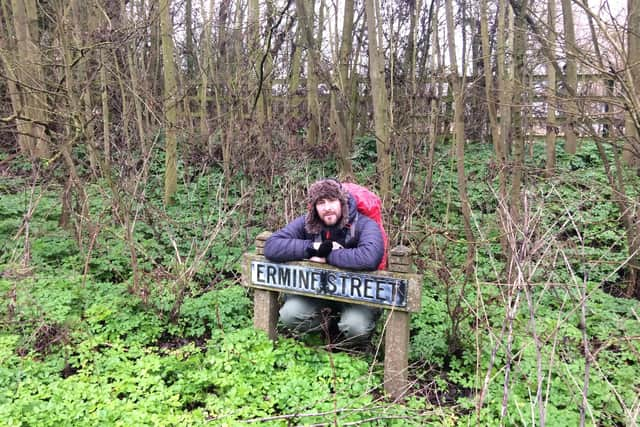
In the book, Cowen candidly confronts elements of his own past and he says he discovered much about himself as a result. “I was carrying a lot of stuff that had been buried for years,” he says. “You have to reckon with these things before you can move on.” That kind of honest reckoning, he argues, also applies to the nation as a whole – to examine the past truthfully, not some altered, idealised version of it. “We are seeing at the moment that some politicians are using a nostalgic mythic idea of Britain and weaponizing it for a new political agenda.”
Among the people we encounter and whose stories Cowen explores are historical figures who were born, lived in or had connections with various points along it – such as Margaret Thatcher with Grantham, Oliver Cromwell with Huntingdon, E M Forster with Stevenage and Isaac Newton with Woolsthorpe in Lincolnshire. It is not a political book but along the way Cowen makes some very astute state of the nation observations and finds connections between historical and current events. “There is so much from the past that has a direct echo with the present,” he says. “One especially interesting thing I discovered in my research was the overlapping maps between the English Civil Wars in the 17th century and the Brexit vote.” As he writes in the book: ‘the voting map showed regional support for Leave and Remain that uncannily mirrored support for King and Parliament.’
Having spent the past decade walking sections of the North Road and investigating aspects of Britain’s past and present, Cowen says that while there are undoubtedly challenges given the divisiveness of contemporary public discourse, the threat of AI, war and climate change, he remains optimistic. “For all of us life remains a line through unknown territories,” he says. “We can’t live honestly, fully, openly and lovingly without experiencing the good and the bad. We have to acknowledge the brutal briefness of being placed on this planet, but as long as there is still a road, the future is ours to shape. I think that is what this book is trying to do, to suggest paths that we might take.”
The North Road, published by Hutchinson Heinemann, is out now. Rob Cowen will be appearing at Farsley Litfest at the Old Woollen, Leeds on October 20 and at Whitby Litfest on November 8.