
Theakston Old Peculier Crime Writing Festival: Mark Billingham and Elly Griffiths on what makes a top thriller ahead of Harrogate event
Theakston Old Peculier Crime Writing Festival is coming back to Harrogate. Hannah Stephenson finds out how the thrillers keep us on the edge of our seats.
Does your summer reading include a good thriller?
Page-turning crime novels dominate airport bookshelves at this time of year – but what makes a really good thriller, a whodunnit or a why-dunnit, whether psychological or police procedural?
As crime writers and lovers of their books gather for this year’s Theakston Old Peculier Crime Writing Festival in Harrogate, two best-selling crime writers, Mark Billingham and Elly Griffiths, offer their take on how authors keep you on the edge of your seat.
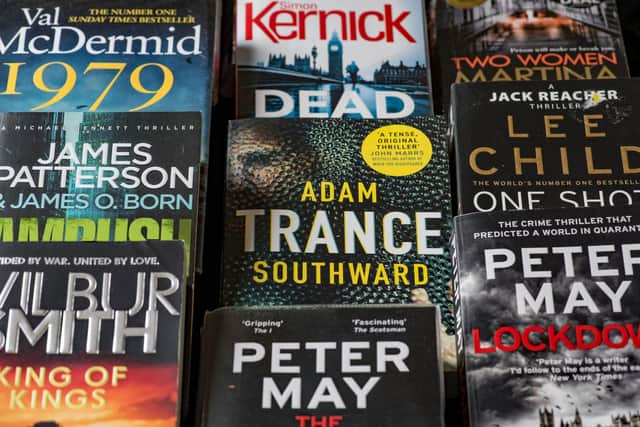

Settings don’t always have to be dark and creepy, says Billingham, who is also actor and stand-up comedian, and whose most famous policeman, Detective Inspector Tom Thorne, was played by David Morrissey in the eponymous TV series.
“Ten or 15 years ago Scandi noir was the big thing, with settings in Iceland, Sweden or Norway, bleak, cold and largely unfamiliar to readers in this country.
“It sounds like a flippant comment, but blood looks very good against snow, so they were trendy for a while, and there wasn’t that much darkness.
“But new fashions are creeping in. A couple of years ago almost every other thriller I read was set on an island and of course you’ve got an in-built problem there in that nobody can leave. The landscape becomes very important because you’ve trapped all your characters straight away.

“From what I’ve been reading and forthcoming thrillers, holidays are a thing, books where a group of people are in a holiday paradise and what can possibly go wrong?
“An idyllic setting can feel like paradise, but there is something very nasty lurking. That’s often more effective than a dark, forbidding moor. Sometimes the landscape has to work against the plot.”
Pace and character form the crux of a good thriller, he continues.
“Pace is obviously considered to be very important, but that doesn’t mean it needs to be 100 miles an hour for the whole book. I think that gets wearing quite quickly, it’s too exhausting,” says Billingham, whose latest book, The Shadow Step, is the third in the Declan Miller series.
To build tension or suspense the reader must care about the character, he continues. “For a long time I used to think the suspense was all about these tricks of the trade that we have as crime writers, the cliffhanger, the reveal and the twist. But they’re just weapons in our armoury and they can be overused. If I’m reading a book that has twist after twist after twist, I stop caring, and that’s when you don’t have any suspense at all.”
As far as explicit violence and gore is concerned, less is more if you want to create tension, he says. “I’ve learned that a reader’s imagination is far better at conjuring up horrific images than anything any writer can put on the page,” he says.
“A single spot of blood on a pristine kitchen floor is a far more powerful image than the message daubed in gore on the wall. Let the reader do the work.”
He agrees that male authors have a different take on crime novels to female writers. “I wasn’t really aware of this and then I spoke to the wonderful Val McDermid, a good friend of mine, who said most men write about what violence looks like, while women write about what it feels like because they’re used to being afraid. From the moment they are 14, 15, 16, walking home on their own, looking over their shoulder, it’s something they have to be aware of. Men don’t grow up with this.”
Meanwhile, “tension and suspense comes from caring what happens to a character,” says best-selling Elly Griffiths, who has been nominated for the eighth time for the Theakston Old Peculier Crime Novel of the Year award, with her book The Frozen People, a work featuring time travel.
“If readers relate to your characters, I think they’ll forgive some plot points that are slightly more fantastical,” says Griffiths, whose festive murder mystery novella The Case Of The Christmas Card is published in October.
Settings are also important. “Crime novels that have really stayed with me include Beulah Height by Reginald Hill (set against the backdrop of the North York Moors), and The Drowning Place by Sarah Hilary (featuring an inexplicable murder in the Peak District). A setting adds layers of tension and also sometimes layers of folklore and legend,” she says.
Humour is also important, Griffiths continues. “My favourite novels are ones where you have this really dark atmosphere and sense of dread, that something very sinister is going to happen, and then you have a bit of humour.
“Jokes are really important in crime novels because quite often, and I do this myself, writers hide a plot point behind a joke, so if you’re reading a crime novel – and this works for Agatha Christie – and something makes you laugh, go back because there’s a clue there, a place to hide a clue after a joke.”
Griffiths doesn’t write graphic descriptions of violence, but says it’s important that every crime writer acknowledges that murder is violent. “Murder is terrible. It has to be front and centre on the page that a murder is a terrible, violent thing, even if you don’t get descriptions of it.”
She agrees with Billingham about female authors’ approach compared with their male counterparts, adding that “women like justice, when justice is served. I don’t think it’s a coincidence that the two Agatha Christie books that sell best today are Murder On The Orient Express and And Then There Were None. They’re books in which justice is meted out in an unconventional way.”
Theakston Old Peculier Crime Writing Festival runs from July 23-26.