
The Dunblane Tapes and The Lady: TV highlights

Here are some of the TV highlights coming over the next seven days including The Lady, The Dunblane Tapes – a personal film from Leeds’s Anna Hall - and Big Cats 24/7.
The Walsh Sisters (Saturday 21/02/26, BBC1, 9.15pm)
Words by Rachael Popow
Irish writer Marian Keyes has published more than 20 books, which have sold over 30 million copies worldwide. Despite sometimes being dismissed as ‘chick lit’, her novels have never shied away from tackling difficult issues, while including a healthy helping of humour.

She’s also created plenty of complex, likeable female characters, including the five Walsh sisters.
The family were first introduced in Keyes’ 1995 debut novel Watermelon, via oldest sister and over the years, her siblings Rachel (Rachel’s Holiday and Again, Rachel), Maggie (Angels), Anna (Anybody Out There? and My Favourite Mistake), and Helen (The Mystery of Mercy Close) have taken their turn in the spotlight.
So, expectations are high for this new Dublin-based drama, which brings them all to the screen, along with their parents (played here by Carrie Crowley and Aidan Quinn), and follows them as they navigate love, loss and chaos.
Stefanie Preissner, who not only wrote the series but also takes the role of the seemingly sensible sister, Maggie, admits she felt the pressure of adapting such well-loved books.
She says: “I’m very concerned about the fans of the books. I really hope they like it. Marian likes it, and she speaks really highly of it, so I’m hoping that that endorsement is sufficient. These books are so beloved, and I think everybody knows where they were when they read Rachel’s Holiday for the first time.
“I think they’re almost like a coming-of-age necessity for Irish women in particular, and so I hope people love them, but I understand if they don’t quite get that raw emotional connection that they got with the book when they read it the first time.”
Stefanie can certainly understand why the books are so popular. She says: “I think the Walsh family are so compelling because they are so relatable. Everybody can identify with the things that they say, the things that they fight about, the things that concern them.
“These are not people who live in an ivory tower and have this aspirational life. These are people who have breakups and heartaches and addictions and arguments, mental health issues, and fertility issues that are so common. Yet, there’s this Irish humour where they never let the other stay too melancholic.”
Viewers get their first exposure to the family in this opening episode. Anna (Derry Girls star Louisa Harland) and Rachel (Caroline Menton) share a flat in Dublin, and make the most of the city’s night life. However, after a particularly wild night out, it becomes clear Rachel’s partying has become an addiction.
Meanwhile, Claire (Danielle Galligan) announces her divorce, Maggie is quietly focused on trying for a baby, and youngest sister Helen (Mairead Tyers) is taking it all in from the sidelines.
There’s good news for anyone wondering why more of Keyes’ books haven’t made it to the small screen – an adaptation of her non-Walsh novel, Grown Ups, is coming to Netflix with a cast that includes Adrian Dunbar and Aisling Bea.
The Lady (Sunday 22/02/26, ITV1, 9pm)
Sarah Morgan
Sarah Ferguson has rarely been out of the news since her marriage to, and subsequent divorce from, Andrew Mountbatten-Windsor. Most recently, her name has cropped up due to its inclusion in the Jeffrey Epstein Files.
Now she’s about to feature in a four-part drama about another scandal, albeit one in which she is merely a bystander on the periphery of it all.
The real focus is Jane Andrews; 5 aired a documentary entitled Crime of Passion? The Trial of Jane Andrews, about her on Valentine’s Day, a date that could be viewed as either fitting or horrifying, depending on how you view the case. Whatever your opinion, and no matter how shocking what happened was, it’s doubtful it would have hit the headlines around the world had Andrews never met any members of the royal family.
Andrews was born into a working-class Cleethorpes family in 1967, and grew up in nearby Grimsby. During her teens she suffered from depression, attempted suicide at the age of 15 and two years later underwent a traumatic abortion.
On leaving school, she studied fashion before landing a job at M&S. Then came the turning point in her life – after answering an anonymous advert for a personal dresser, she was hired by Fergie and began working for her just days later. Suddenly Andrews was mixing in different circles while living a relatively affluent lifestyle.
But trouble was brewing. A relationship collapsed, another suicide attempt took place and she lost her job. The one shining light seemed to be a new romance with wealthy businessman Thomas Cressman. She dreamed of marriage and children, but he, apparently did not. It’s believed that on discovering Cressman had no intention to propose, Andrews fatally stabbed him before fleeing the scene.
This four-part drama, written by Debbie O’Malley, whose CV also includes episodes of All Creatures Great and Small, Call the Midwife and Law & Order: UK, offers a fictionalised take on the story, with Mia McKenna-Bruce, Natalie Dormer and Ed Speleers taking on the roles of Andrews, Fergie and Cressman respectively.
“When Jane Andrews was tried for the murder of Thomas Cressman in 2001 it made headlines around the world,” says O’Malley. “But behind those headlines lay a much more complex, painful and thought-provoking story – an exploration of female ambition and human frailty and a devastating chain of events that ended in the taking of a man’s life.
“This story, tied up with our national preoccupation with class and our ongoing obsession with the Royal family, feels every bit as relevant now as it did 25 years ago.”
“Debbie’s compelling and brilliant scripts re-evaluate what we think we know of Jane Andrews and the events that led to the tragic end of Thomas Cressman’s life,” adds Helen Ziegler, who has overseen the production on ITV’s behalf.
“We are thrilled to bring this complex exploration of class, celebrity, ambition and identity to (the channel).”
The first two episodes show on consecutive nights, with the story continuing next week.
Dirty Business (Monday 23/02/26, Channel 4, 9pm)
Words by Sarah Morgan
Sometimes fact can be stranger – and more disturbing – than fiction.
Many viewers were left thoroughly shaken and angered by the real-life story played out in Mr Bates vs The Post Office two years ago, and there’s every chance they will be left up in arms by the events depicted in Dirty Business, Channel 4’s new three-part drama based on a real-life scandal.
Made by the team behind 2023’s Partygate, which told the story of the pandemic from inside 10 Downing Street, it’s written and directed by Bafta-nominee Joseph Buliman, who says of the project: “Channel 4 was the only broadcaster that could have made Partygate, and its decision to commission Dirty Business is just as brave because it explores corporate law breaking and a national scandal which, in terms of the amounts of money extracted from the British public, has the potential to dwarf other scandals which have come to light in recent years.”
David Thewlis and Jason Watkins head the cast as former police detective Ash and his neighbour, Professor of Computational Biology Peter, who join forces to investigate why the fish in the stream that runs through their Oxfordshire hamlet are dying off. Asim Chaudhry co-stars as Mickey, an employee at the local sewage plant who turns whistleblower; his conscience will no longer allow him to turn a blind eye to the shoddy work going on around him, so he willingly hands over what he knows to Ash and Peter.
Intertwined with the investigation are the tales of those whose lives are believed to have been devastated by sewage leaks, including the family of eight-year-old Heather Preen who, in 1999, died after contracting e-coli while playing on a beach during a family holiday in Devon, and a surfer who contracted the chronic Ménière’s disease while surfing in polluted water.
“What shocked me about this story was just how much has been allowed to go unchecked – two ordinary men uncovering negligence, illegal pollution, and corporate indifference that should never have been tolerated,” explains Thewlis. “Being a part of this series has been a chance to channel the anger and frustration so many feel about what’s been done to our rivers and communities, and to show the courage it takes to stand up and demand accountability.”
“I wanted to make this series because of how human and grounded the story is – it’s told through ordinary people who refuse to look away when something isn’t right,” adds Watkins, who’s no stranger to tackling injustice on-screen, having won a Bafta for his performance in The Lost Honour of Christopher Jefferies. “Dirty Business captures the quiet determination it takes to stand up to a system far bigger than the individual, and shining a light on the real human cost of environmental damage and corporate neglect felt both urgent and important to be part of.”
Posy Sterling, Jon Culshaw, Vicky Pepperdine, Craig Parkinson, Charlotte Ritchie and Alex Jennings are also among the impressive cast of a must-see programme whose episodes are being shown on consecutive evenings.
Great British Menu (Tuesday 24/02/26, BBC2, 7pm, BBC2 Wales, 8pm)
Words by Rachael Popow
The Great British Bake Off was recently in the news after it was revealed that Prue Leith was stepping down from the show – and Nigella Lawson was taking her place.
However, it’s not the only long-running cookery competition to make a change to its judging line-up. Last year, it was announced that Ed Gamble was leaving Great British Menu, and his fellow comedian Phil Wang was taking up the empty seat at the dining table.
Phil will be joining returning judges Tom Kerridge and Lorna McNee, who are both previous winners, not to mention Michelin-starred chefs. So, what qualifies Phil for his new job?
Well, the BBC describes him as ‘an enthusiastic eater with a talent for describing what he’s eating’, which definitely helps. He’s got some prior experience too, as he appeared as a guest judge in the 16th series.
Most importantly, he’s raring to go. Phil says: “I’m so excited to be the new judge on Great British Menu. I’ve been an avid food-lover all my life, and I’m thrilled about this opportunity to taste food from the most creative and skilled chefs in the country. Can’t wait to put decades of practice to work and put my mouth where my mouth is.”
Ed Gamble certainly endorses his replacement, saying: “I can think of no better person to pass the golden spoon to than my dear friend and frequent dining companion Phil Wang. He is hilarious, great company and crucially, matches my appetite more than anyone else I’ve met. I’ll miss everyone on the team but I know they’ll forget about me as soon as they start chomping with the Wang.”
Of course, this isn’t the first change to the show’s line-up. When Great British Menu began in 2006, Matthew Fort, Oliver Peyton and the aforementioned Prue Leith were the judges. We’ve since seen Rachel Khoo and Nisha Katona have stints in the chamber, while Andi Oliver began as a judge before taking on her current role as presenter.
However, as we reach the 21st series (yes, really) the concept behind Great British Menu remains the same as the best chefs from across the UK are invited to compete in regional heats for the chance to cook at least one course at a special banquet.
In the first series, the feast was celebrating Queen Elizabeth II’s 80th birthday. Since then, the chefs have been asked to create dishes inspired by everything from the London 2012 Olympics and the 70th anniversary of the NHS to Comic Relief and children’s literature.
This year, the theme is British movies and film-makers, and the banquet will be held at St George’s Hall in Liverpool, which some movie buffs may recognise as Gotham City Hall in The Batman.
That theme should spark the chef’s imaginations, and we’re told there will be dishes based on James Bond, Wallace and Gromit, Harry Potter, The Full Monty and Notting Hill among other classics.
In the first episode, hopefuls from the north-west of England serve up their canapes, starters and fish dishes.
The Stolen Girl (Wednesday 25/02/2025 ITV1, 9pm)
Words by Richard Jones
You may think the plot of this mystery thriller – a mother goes to pick up her child after a playdate only to find them not there – sounds vaguely familiar.
If so, perhaps you have recently watched Sky Atlantic’s All Her Fault, based on Andrea Mara’s 2021 novel.
That particular series saw Sarah Snook’s character Marissa Irvine and her dysfunctional family uncover dark secrets about each other as they frantically searched for their missing son after he is kidnapped in New York.
However, six months before that acclaimed American thriller premiered, Disney+ began streaming twisty British series The Stolen Girl.
Adapted from Alex Dahl’s bestselling 2020 book Playdate, it also follows a mother who experiences every parent’s worst nightmare.
Despite her initial reservations, flight attendant Elisa Blix (played by Andor’s Denise Gough), agrees to let her nine-year-old daughter Lucia go to a sleepover at her new best friend Josie’s house.
But when she goes to pick Lucia up from the home of Josie and her mum Rebecca Walsh (Holliday Grainger) the next day, she discovers the seemingly beautiful property is actually a short-let holiday rental that has been vacated.
The police are immediately called in, a press conference is organised, and an investigation commences.
In tonight’s first episode, it emerges that Elisa’s criminal lawyer husband Fred (Jim Sturgess) had commenced a brief intrigue with a woman he met online, who took things badly when he ended it, and that he was also defending a client accused of being involved in organised crime.
While all this is going on, journalist Selma Desai (Ambika Mod) decides to take a particular interest in the case after attending the press conference.
Across five episodes, The Stolen Girl follows a manhunt across Europe as Elisa and her family search for their child.
And we also discover that Rebecca isn’t who she initially says she is – her real name is Nina and she may have a very personal reason for taking Lucia.
In an interview with Radio Times last year, Strike and The Capture star Grainger said that she was drawn to the series as she was “interested in playing a damaged character who comes from a place of trauma and grief but doesn’t really show it”.
She adds: “You can’t play a character you think is flat out crazy. You’ve got to find the psychological realism in there, so I did speak to a psychotherapist to make sense of every act Nina does.”
While The Stolen Girl (and All My Fault) may make some parents think twice about agreeing to a playdate or sleepover, Grainger explains that Nina’s circumstances are very unique, and the series is not your average revenge thriller.
“Nina is not out for revenge – she’s out for her own survival,” the 37-year-old actress says.
“On the surface, it’s ostensibly a thriller, but each character comes from a place of some kind of trauma.
“You then see these huge events take place and everyone’s lives change irrevocably. “Nina and Elisa are such damaged women who have hurt each other so much.
“The fallout for the whole family and everyone involved is so huge.”
The Dunblane Tapes (Thursday 26/02/2026, Channel 4, 9pm)
Words by Richard Jones
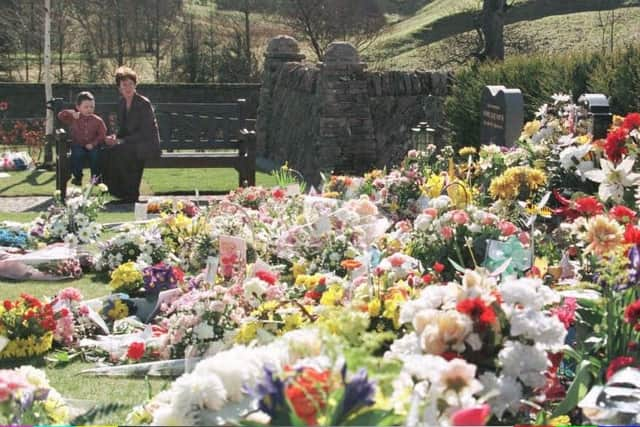
On March 13, 1996, on a beautiful but bitterly cold morning in the town of Dunblane, a lone gunman walked into a primary school, and shot dead 16 pupils and their teacher in a Primary 1 gym class.
The massacre also left 15 people injured and it remains the UK’s deadliest firearms atrocity.
Over the years, there have been a number of documentaries looking at the events of that fateful day in central Scotland.
Anna Hall’s Dunblane: Remembering Our Children, was broadcast by STV and ITV to mark the first anniversary.
The programme was nominated for numerous awards including the RTS Best Single Documentary, an Emmy and a Prix Italia.
Meanwhile, Channel 5 screened Dunblane – A Decade On, and BBC Scotland showed Remembering Dunblane to tie in with the 10th anniversary.
In 2016, relatives of the victims spoke in another BBC Scotland documentary, Dunblane: Our Story, while Kim A Snyder’s Lessons from a School Shooting: Notes from Dunblane premiered on Netflix in 2018.
In March 2021, ITV aired another special programme to mark the 25 years since the atrocity – Return to Dunblane with Lorraine Kelly.
Now, as the 30th anniversary approaches, British broadcasters are bringing out more new documentaries, with the BBC planning to air Dunblane: The Shooting that Changed Britain next month.
Before that, Channel 4 is showing another programme from Hall (who grew up in the Scottish town), and her production company Candour, who also filmed the broadcaster’s recent documentary about the death of Jay Slater.
The Dunblane Tapes takes a look at the events of that dark day in March 1996 from a slightly different angle, looking at how it led to a tightening of gun laws in this country – laws which have been held up as a model around the world.
Shortly after the shootings, one bereaved parent, John Crozier, picked up a camera and started filming.
He documented, from the inside, the story of one of the most successful grassroots campaigns in British history.
In the immediate aftermath of the tragedy, three mothers – outraged by the fact that the gunman Thomas Hamilton legally carried four handguns and over 1,000 rounds of ammunition – launched a nationwide campaign, known as the Snowdrop Petition, to lobby the government to ban the private use of handguns in Britain.
Bereaved parents in Dunblane joined the campaign, and over the course of a year, they fought an epic battle against a determined and resourceful gun lobby to bring in stricter gun legislation.
This eventually helped bring about legislation, specifically two new Firearms Acts, which prohibited the private ownership of most handguns in Great Britain.
Thirty years later, John’s intimate, emotionally powerful and unflinching tapes have been uncovered and The Dunblane Tapes uses intimate, never-seen-before footage to tell the story of the families’ journey.
It reveals the unwavering courage and resolve of bereaved parents and campaigners fighting for legislative reform, in the shadow of terrible tragedy.
Although their story is one of profound grief, it is also one of courage and resilience, showing that even in the darkest moments, positive change is possible.
Big Cats 24/7 (Friday 27/02/26, BBC2, 9pm)
Words by Rachael Popow
The BBC obviously knew they had something special on their hands with the nature series Big Cats 24/7 – the second run was commissioned before the first one even aired.
That was good news for wildlife cameraman and presenter Gordon Buchanan, who relished the chance to work in Botswana’s Okavango Delta.
Speaking ahead of the first series, he said: “I have filmed big cats all over the world for the past 30 years – it has become an obsession. I worked on the Big Cat Diary series for the BBC back in the early 2000s, so the opportunity to follow Lions in this Big Cat paradise was a dream come true and a chance to deepen my obsession!”
That doesn’t mean the assignment wasn’t tricky though. He says: “Lions may be big, bold and on occasions very loud but following their lives around the clock is incredibly tough. They can sleep for twelve hours straight and then move fast and far on their territorial patrols. I am really proud of how we have been able to tell their story. From epic battles with invading males to intimate moments with tiny cubs.”
He adds: “No two big cats are the same – their lives are one big power struggle between their own species and the animals they live along side. Not two days are the same. There is more drama here than in Game of Thrones.”
His fellow cinematographer Anna Dimitriadis agrees, saying: “The more time you spend with animals as intelligent, skilled and adaptable as big cats, the more you start to appreciate how each and every individual has its own character. Some can be shy, some are bold, some brave or funny – all these personality traits emerge over time.
“They become so much more than a subject for a documentary; they become a characterful individual that you develop a deep connection with.”
She adds: “Before Big Cats 24/7, I had no idea how adaptable big cats had to be to survive in the Okavango Delta. It’s an environment that’s in a constant state of flux, and the cats here are always shifting their behaviours according to the seasons and landscapes. “
Fans of the first series may spot some changes as the cameras return to follow the lion pride, which is now over 40-cats strong. That puts additional pressure on the mothers, who must hunt around the clock to feed their growing cubs.
However, while the lionesses are working hard, the pride males are missing, leaving the vulnerable cubs unprotected from dangerous intruder lions.
Meanwhile, leopardess Xudum has left her territory due to her due to an influx of aggressive males, so the team turn their attention to a new female, Lediba, who they think may already have cubs. Finally, cheetah Pobe, who was one of the stars of the first series, now has offspring of her own and faces new challenges as she tries to keep them safe.