
The Great British Bake Off, Shetland and The Making of Do They Know It’s Christmas?: TV this week
Here are some TV highlights coming up in the days ahead from Saturday, November 23, including The Great British Bake Off, Shetland and The Making of Do They Know It’s Christmas?

Boybands Forever (Saturday 23/11/24, BBC Two, 9.25pm)
Words by Sarah Morgan
Here’s a surprise – Simon Cowell on the BBC. He’s become an ITV stalwart since Pop Idol turned him into the man many viewers loved to hate thanks to his rather searing views on people’s talents, and apart from random appearances on Top Gear, that’s pretty much where he’s stayed – on British TV at any rate.
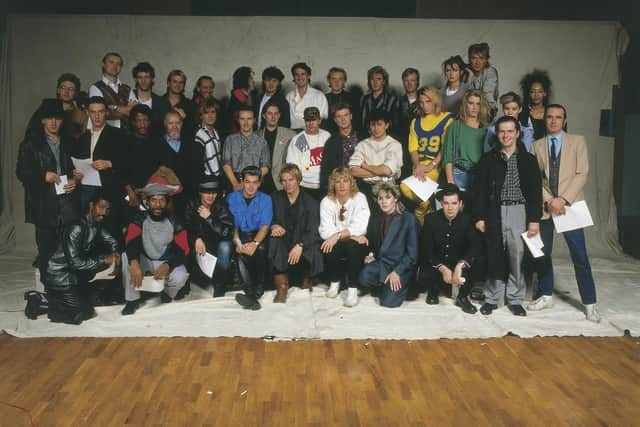

However, he’s one of the faces featured in this three-part documentary, which reaches its conclusion this week, discussing the rise and eventual fall (at least temporarily) of some of the biggest boybands to grace the charts during the 1990s and 2000s.
Last week, we were treated to the first two episodes back-to-back, which examined the battle for supremacy between East 17 and Take That before focusing on what happened in the aftermath of the latter group’s members’ decision to go their separate ways in 1996.
“It’s a gripping fable about getting everything you dreamed of, and it not being what you imagined, centred on a generation of young men, and their managers, who were wildly successful and also immensely vulnerable, having the times of their lives and also in some cases cracking up,” says executive producer Louis Theroux.
“Those boys we all watched singing and dancing in tight formation – Take That, East 17, Westlife, Blue, Five, Damage, 911 and so many others – are now middle aged men who have the time and the maturity to look back and reflect on what they went through. It’s taken us more than a year to make the series.”
“It feels like yesterday but the Brit boyband era began 35 years ago, and what a fascinating moment in time and pop culture it was,” adds Jonathan Rothery, head of BBC Popular Music TV. “The series will take us on a trip down memory lane but will also enlighten us, that behind the singing, dancing, double denim and bright smiles were a heck of a lot of blood, sweat and tears.”
If you missed them, the first two episodes can be found on the BBC iPlayer, and lead nicely into the third and final edition, which picks up where its predecessor left off.
The likes of Blue and, from across the Irish Sea, Westlife are about to appear and fill the void left by previous ensembles. Success comes quickly, but for some members, life in the limelight proves almost unbearable. Meanwhile, Take That, minus Robbie Williams, are thinking of making a glorious comeback…
If all this puts you in the mood for the music itself, you’re in luck. Preceding the episode is another chance to see clips from the archive of Gary Barlow and co in Take That at the BBC.
Then, at 11.15pm, after another edition of Later…with Jools Holland, comes Westlife: Radio 2 Live 2021, in which Zoe Ball introduces a performance by Nicky Byrne, Kian Egan, Mark Feehily and Shane Filan recorded at the Ulster Hall in Belfast during their first post-lockdown gig.
Asia (Sunday 24/11/24, BBC1, 6.20pm)
Words by Rachael Popow
When the BBC’s Natural History Unit made the series Seven Worlds, One Planet, which explored the wildlife on different continents, it seems there was one episode that stood out – Asia.
Roger Webb, who is the executive producer of the unit’s current series, Asia, says: “It became clear that there are so many stories there beyond what was possible to do in a single hour for Seven Worlds, One Planet.
“Everybody who was involved in that particular episode just kept talking about it and the riches that were on offer there. Then it came to light that no one’s really done an in-depth series about Asia and its wildlife, taking the continent as a whole. So, we started doing more work collating what other stories might be possible and realised we had such a rich list.”
It may now seem obvious that there would be a great series to make about Asia, but Roger can understand why it didn’t happen before.
Roger says: “When people think of wildlife or wild places, they don’t necessarily jump straight to Asia. But the animals you find in Asia are as big and as charismatic as any you might find in Africa. There are rhinos there, there are elephants, there are, of course, tigers. There are also lions, which I don’t think some people realise. So the riches on offer are on a par with anywhere else in the world.”
He adds: “No disrespect to any other continent on the planet, but as [narrator] Sir David Attenborough says at the top of the series, there’s nowhere with more untold stories. For us as wildlife filmmakers, there’s nothing more exciting than that.”
The latest episode explores the untold stories that lurk in the continent’s diverse jungles and woodlands.
Asia’s trillion trees provide shelter, food and opportunity, but there are also hidden threats among the leaves.
In the monsoon jungles of India and Nepal, the biggest of all cats, the Bengal tiger, certainly appears to be thriving. In the last decade, their numbers in Nepal have doubled. That doesn’t mean they don’t face challenges though, as we follow a mother trying to hunt down food for her three almost full-grown cubs.
Two hundred miles to the east, we meet a beast that even the tigers rarely dare to attack – the greater one-horned rhino. At over two tonnes with skin an inch thick, it may seem like they are impervious to predators, but a third of male rhinos die in fights over territory. Cameras show how the wounded animals find solace in leisurely mud baths.
We also travel to the tropical rainforests of southeast Asia, and the island of Borneo, where a female orangutan is in search of a mate, but the males seem more focused on feeding.
Borneo is also home to the world’s smallest elephants. Their habitat is changing all the time due to the proliferation of oil palm plantations, many of which are hemmed in by electric fences. However, some farms are welcoming the elephants, allowing them to feast on chopped down trees – and showing just how adaptable the continent’s wildlife can be.
Irresistible: Why We Can’t Stop Eating (Monday 25/11/2024, BBC Two, 9pm)
Words by Richard Jones
The global food industry has changed beyond all recognition over the past few decades.
We now eat an extraordinary range of ultra-processed foods (UPFs), which are the product of brilliant advances in industrial chemistry and research.
Created by ingenious scientists and sold to us by clever marketeers, there’s a lot to love about them – they’re super tasty, very convenient, have long shelf-lives and are extremely cheap.
As our consumption of these foods, which include sausages, crisps, mass-produced bread, breakfast cereals, biscuits, yoghurts and instant soups, have soared, so have producers’ profits.
Food companies can go to extraordinary lengths to ensure their products connect with consumers, from using brain scans to assess the deliciousness of ice cream to carefully engineering the sound of a crunch in advertisements.
However, there is a dark side to our changing eating habits.
UPFs tend to include many additives and ingredients that are not typically used in home cooking, such as preservatives, emulsifiers, sweeteners, artificial colours and flavours.
They also often contain high levels of saturated fat, salt and sugar, and when we eat them, it leaves less room in our diets for more nutritious foods.
As a result, there is a growing body of evidence linking these convenience products to our declining health.
Pre-prepared, industrially-produced foods are linked to some cancers, hypertension, dementia, inflammatory bowel disease and early death.
Tonight’s one-hour documentary, Irresistible: Why We Can’t Stop Eating, explores why they are so irresistible and how they have come to dominate late 20th and early 21st-century food culture.
It is presented by medical doctor and academic Dr Chris van Tulleken, who wrote Sunday Times best-seller Ultra-Processed People.
For the book, Chris travelled the world, looking at food science and our UPF diet to discover what’s really going on.
He found out what UPFs are really doing to our bodies, our health, our weight and the planet.
It’s no surprise that his conclusions were that they are not doing any good, and that exercise and willpower can’t save us from their effects – we need to start being educated and told more about what we are eating.
“Poor diet has overtaken tobacco as the leading cause of early death,” Chris says. “This documentary explains why and what to do about it with astounding insider interviews that expose the darker side of our food industry.”
The doctor and presenter hears from food industry insiders who talk openly about the way in which popular foods have been designed to be irresistible.
This documentary also uncovers how just a handful of huge corporations make most of the UPFs we eat, and that there’s now a growing movement demanding controls over them.
For example, some Latin American countries have been successful in introducing more stringent regulation of these popular goods.
Chris also asks, if we happen to find ultra-processed foods irresistible, is it really our fault?
And, perhaps more importantly, is it possible for us to change our eating habits for the better and improve our health?
The Great British Bake Off (Tuesday 26/11/24, Channel 4, 8pm)
Words by Sarah Morgan
Unusual flavours, a few extraordinary characters and the odd soggy bottom along the way.
Yes, it’s been a classic Great British Bake Off series so far. Sadly, it all comes to an end this week as judges Prue Leith and Paul Hollywood prepare to name this year’s winner.
After nine weeks of competition, only three contestants remain – which means the tent will feel pretty empty.
Some of the biggest characters have already been knocked out, sadly. We barely got to know retired nail technician Hazel and American-born former university lecturer Jeff before they left. The latter was particularly unlucky, having been forced to pull out due to ill health.
It came as a huge surprise, however, when John, who had previously looked as if he had the skills to make it all the way to the final, became the third person to leave – bread week just wasn’t for him.
“Because everyone is so talented you drop the ball and then it is your time to go,” he said, after receiving the news. “From being the first star baker of this season, then to having a really good week last week…. The tears are tears of pride.”
Effervescent farmer Mike was next, followed by London mechanic Andy, who said on his departure: “I had so much more to give and I felt I let myself down by not executing my bakes as well as I have previously. I was very emotional doing the showstopper and I couldn’t get my mind focused. The tent can emotionally affect you without realising.”
Then, at the midway point, perhaps the biggest blow occurred when Nelly got the boot. She really was a bright spark during her tenure, and the one competitor you imagine has what it takes to launch her own media career. The series certainly lost a little something when she hung up her apron and returned home.
“It’s not commiseration, it is a positive, I am so ready to leave,” she said at the time. “I never ever thought I would get to round six! I know my children are so proud. It’s not to teach them to win it is to teach them to enjoy. Don’t cry! Everyone is crying… Of course I am happy – in each of your heart is a piece of Nelly and you are never going to forget me.”
And she’s probably right. Will we be saying the same of whoever lifts the cake stand trophy?
Whatever the case, the winner will have surely earned it – this year has seen one of the finest cohorts in the show’s history take part.
Now, all that stands between the finalists and baking glory are three challenges – a Signature involving the creation of delicate scones, a Technical set by Prue in which a quintessential afternoon tea must be prepared, followed in the Showstopper by a hanging tiered celebration cake fit to be the centrepiece of a summer garden party.
Let the battle commence!
Shetland (Wednesday 27/11/24, BBC1, 9pm)
Words by Rachael Popow
If you’ve been trying to avoid spoilers for the ninth series of Shetland, then you’re not alone. Even Ashley Jensen, who plays DI Ruth Calder, tried to put off finding out whodunit.
She explains: “It’s a very complex web this series. In fact, I decided that I wasn’t going to find out who the murderer was.
“So, for the first three episodes I felt like I was really in Calder’s shoes. I was looking at people through the character’s eyes thinking, ‘What are you giving me?’ Then I would leave a scene and quickly look back around again, just to see if somebody was doing something they shouldn’t have been behind the coppers’ backs after we’d gone!”
The actress adds: “It added another element of fun for me. When I was playing the part, I wanted to be really present in every scene, to make myself look and listen to what people were saying, to see if I could solve the puzzle and ultimately, the crime.”
But would her character approve of the actress’s approach? Although Calder was only introduced in series eight as the replacement for original lead detective Jimmy Perez, viewers already know she takes a somewhat no-nonsense approach to crime-solving.
Ashley says: “[Calder’s] very instinctive and she doesn’t waste time. I think that in a situation when things are very time sensitive, particularly in a murder case, you have to make these decisions very quickly and Calder has a wealth of experience from having worked at the Met for 25 years.
“There’s very little that shocks her. She’s a DI and she’s done very well, so she trusts her instincts, which are often right – but not always – but at least she makes a decision and I think that complements Tosh, who is, as you know, much more of an empath.”
We’re now on to episode four, which may mean that Ashley is fully caught up on the scripts and knows the killer, but for the cops and the viewers, the mystery is deepening.
In the aftermath of the recent tragedy, Calder questions Patrick about Annie before getting a search warrant for the facility, where she and Tosh make a sinister discovery. However, before they can dig deeper into a possible connection between the lab and the murders, they must go in search of vulnerable Astrid Jakobson, who’s suddenly gone missing.
Not only is the teen a potentially important witness, the cops are also concerned that Astrid’s elaborate efforts to escape the island will put her in grave danger.
Meanwhile, at the Bett house, Ian is stunned to find Rossi in the garden, and Calder is also concerned about what exactly has brough Euan Rossi to Shetland.
As Ashley says: “There is definitely a little mistrust of Rossi with Calder. I think she knows he’s smart, they’re a kind of intellectual equal. She knows there’s more to him than he’s giving away because quite often there’s more to Calder than she ever gives away.”
But will the cop get the answers she’s been looking for?
Cheap Flights: What They Really Mean for You (Thursday 28/11/2024, BBC One, 9pm)
Words by Richard Jones
Earlier this month, climate scientists published a report, saying the mega-rich are using private jets “like taxis”.
Researchers traced all private flights globally between 2019 and 2023, and found that flights to Ibiza and Nice peaked during the summer.
The 2022 FIFA World Cup coincided with 1,846 jets arriving in Qatar, and 291 private planes landed in Dubai in the UAE, at the time of the UN climate conference in 2023.
Flying in a private jet for a single hour can release more carbon dioxide into the atmosphere than the average person produces in a year, and it was calculated that the CO2 emissions from private jets rose by 46 per cent in the four-year period that was studied.
However, it’s not just the ultra-wealthy who adding to the world’s environmental aviation problems.
Travelling abroad, especially by plane, used to be seen as a luxury and privilege.
But the growing popularity of low-cost airlines such as Ryanair, EasyJet and Wizz Air from the 1990s onwards provided some people, who may not have been able to afford it otherwise, with the opportunity to fly to a broader range of places.
Nowadays, more than 200 million holidaymakers fly in and out of the UK every year, and all their flights produce greenhouse gases which contribute to climate change.
Although the demand for short and long haul flights is now higher than ever, the world’s airline industry says it has a plan to cut emissions and help reach its net zero targets.
At the 77th IATA Annual General Meeting in Boston in 2021, a resolution was passed by committing airlines to achieve net-zero carbon emissions from their operations by 2050.
To succeed, it will require the coordinated efforts of airlines, airports, navigation service providers, manufacturers and governments around the world. But is that realistic?
And what does it all this mean for UK holidaymakers who are just keen to travel to the Eurozone, which can often be cheaper than staying in Britain?
The BBC’s Climate Editor, Justin Rowlatt, looks at whether the UK is on track to meet its ‘Jet Zero’ targets by 2050, and investigates if the decarbonisation goals will really revolutionise air travel and what it will mean for the price of our flights.
Air fares have already jumped in recent years as a result of higher prices for conventional fossil-based jet fuel, so when you factor in the increased demand for scarce greener sustainable aviation fuel, they could go up even higher.
With all this in mind, presenter Michelle Ackerley asks if it is possible for travellers to make an environmentally responsible decision on a budget.
She talks to aviation bosses at the UK’s second largest airport, Gatwick, to see how decisions made about the future of sustainable air travel could affect holidaymakers.
And finally, science reporter Fran Scott investigates if new technology could be the answer, looking at how the next generation of engines, which will be used in both private and commercial planes, could be made more efficient.
The Making of Do They Know It’s Christmas? (Friday 29/11/24, BBC4, 9pm)
Words by Rachael Popow
On October 23, 1984, the BBC 10 O’Clock News aired a report by Michael Buerk on the Ethiopian famine.
The images shocked people around Britain, including Irish singer-songwriter Bob Geldof, then best known as the frontman of the Boomtown Rats – and he decided to take action.
With Midge Ure, the lead singer of Ultravox, he wrote the song Do They Know It’s Christmas? Then on November 25, 1984, they gathered some of the biggest names in UK and Irish pop to form the charity supergroup, Band Aid, and recorded it in the course of just one day.
The plan was to raise money for the victims of the famine, but Do They Know It’s Christmas? exceeded everyone’s expectations.
It went to number one, would hold the record as the UK’s the fastest-selling single for well over a decade, and is still heard on the radio and festive playlists every December.
Although no one involved knew quite how historic that recording session would be, cameras were there at SARM Studios in Notting Hill to document it. Some of the footage was used for the iconic video, but some of it has never been seen – until now.
The Making of Do They Know It’s Christmas? unearths 75 minutes of that original footage, shot on 16mm film and newly restored and digitised.
It features rare and unseen moments in which stars, including Bananarama, Boy George, Glenn Gregory of Heaven 17, Paul Young, Phil Collins, Spandau Ballet, Sting and more, rehearsed and recorded their parts.
There are also interviews that were shot on the day with Bono, Gary Kemp, George Michael, John Taylor, Simon Le Bon and Trevor Horn.
For Bob Geldof, the fact that no one realised just how momentous an occasion it was all is part of the documentary’s charm.
He says: “That Sunday morning when a bunch of young spotty English pop stars who were (more or less) just out of school and had taken over the pop culture of the world, ambled up a Ladbroke Grove street in London to make a song their friends had written for the starving people of Ethiopia, they could never have understood the enormous consequences of that day…
“This then is the ‘fly on the wall’ story of that day from found footage that no one had thought to look for before, but is now an integral part of British pop history. I love it because it is so… English. So guileless, so charming and yes so innocent.”
The song would inspire other charity singles – including the USA for Africa song We Are the World, as well as later remakes of Do They Know It’s Christmas?, but the magic of the original is hard to replicate.
As Bob says: “Compare and contrast with the American follow up and it’s hyper-sophisticated, hyper super-talent, hyper-organised and professional and our lot, basically a bunch of bouffanted oiks giving it large and being quite brilliant.
“What wonderful people they were. And largely still are. Great film.”