
Innovative theatre company's latest production is a timely adaptation of sci-fi classic War of the Worlds
For the past 27 years imitating the dog theatre company have been making original, innovative, immersive work for the stage and other spaces – their eye-catching productions make use of ground-breaking storytelling techniques, combining live performance with digital technology. Much of their work has been inspired by literary classics – their acclaimed adaptations include Heart of Darkness (2018), Dracula (2021), Macbeth (2023) and Frankenstein (2024) – and their latest production is a bold new version of H G Wells’s science-fiction classic The War of the Worlds.
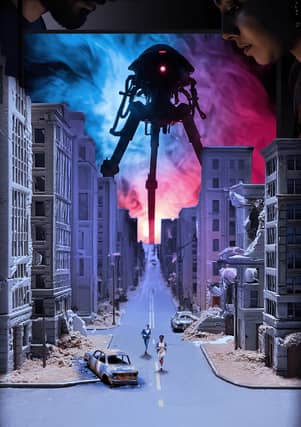


Andrew Quick, co-artistic director of the company with Simon Wainwright and Pete Brooks, explains that the story of an alien invasion of the Earth by beings from Mars, first published in 1898, had been of interest to them for some time. “It’s been on our radar for a while as a text and we looked at possibly adapting it back in around 2015, then we put it on the back burner. What we liked about the original novel is that it was already a metaphor when it was written, dealing with paranoia and invasion. Wells was very aware of what was called ‘invasion literature’ which was popular at the time – it was often about Germany invading Britain. With everything that has been happening recently with small boats and the rhetoric around that, we felt that now it was something that we could explore and think about what that metaphor is in terms of now?”
It certainly feels like a very timely retelling of the story, full of contemporary resonances. Sadly, the novel’s themes of paranoia, prejudice towards and fear of outsiders, perceived threat of ‘invasion’ and social breakdown are as relevant now as they were in the Victorian era. The production, which opens next month at Cast in Doncaster before going on tour, is set not in the 19th century or the present day, but transposed to 1968, the year that British Conservative MP Enoch Powell gave his infamous ‘rivers of blood’ speech. “In the original novel there are lots of references to blood and Powell’s speech appears in our version,” says Quick. “By setting the play in the 1960s rather than now, it creates a bit of distance, but still allows the audience to make the connection with today. History plays are never about the past; they are about the present – and the parallels are clear with the Trumpian universe where war and power are valued rather than truth and co-operation.” There is also a nostalgia value about the 1960s setting. “It means we can play with old brands and musical references of the time,” says Quick. “And we don’t have the complication of mobile phones.”
Our Lifestyle newsletter is a great weekend read
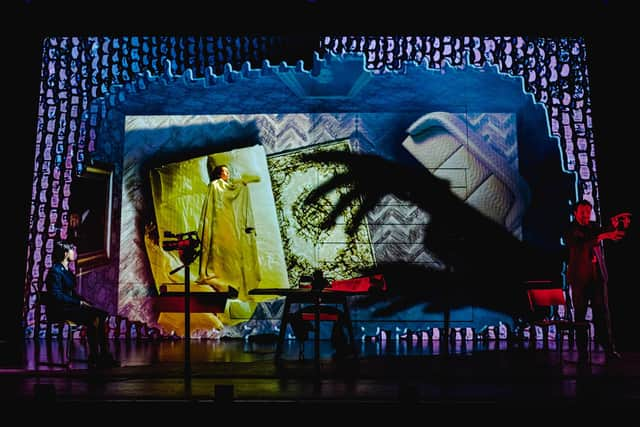
The narrative structure of the production, written and directed by Quick and Brooks, follows the structure of the book in terms of the panicked flight of people from suburban areas of southern England following the Martian invasion. “Our protagonist is caught up in a protest and ends up in hospital, coming out he finds that the Martians have invaded; he tries to get back home and then heads to Dover, along with many other people, and tries to cross over into France, because he thinks he will be safe there.”
Logistically the production is quite demanding and exacting – Quick describes it as “the most ambitious and technologically challenging work that we have made.” Essentially the creative team, with a cast of four, are taking the audience on an epic journey and making a movie at the same time. “We have a set with three large screens and in front of those screens are model tables featuring a detailed miniature recreation of a destroyed city. We can shoot through the streets, film the protagonist and place him in those model worlds. We are also employing a Victorian trick technique called Pepper’s Ghost using mirrors, so we have this old and new technology that we are playing around with.” Performers on stage will be operating cameras that move through the model world, while simultaneously on another part of the stage a live performer is filmed and their image projected onto the landscape of the city. “This interlacing of the live and the miniature, the real and the model, is a new direction for us, but it creates some stunning effects.”
The end result promises to be as visually spectacular as it is thought-provoking. “I don’t think when we started planning this over a year ago, we could imagine quite how resonant it would be,” says Quick. “Ultimately it is a great story told thrillingly but one that means the audience thinks about the moral turmoil being explored.”
Imitating the dog’s production of War of the Worlds is at Cast Doncaster, February 5-7 and at Leeds Playhouse, March 25-28.