
Julian Lloyd Webber: 'I can't wait to come back to Harrogate - it's a beautiful town that has kept its soul'
Julian Lloyd Webber returns to Yorkshire this month. The legendary cellist talks to Chris Bond about his remarkable music career and why Harrogate holds a special place in his heart.

To the outside world, it might appear that Julian Lloyd Webber has lived a charmed life – feted as the “doyen of British cellists” in his heyday, his musical prowess has seen him work with such luminaries as Yehudi Menuhin, Stéphane Grappelli and Sir Elton John, and perform alongside some of the world’s leading orchestras.
But it hasn’t all been plain sailing.
In 2014, a serious neck injury forced him to give up performing, and he recently revealed he was being treated for prostate cancer, telling The Yorkshire Post “at the moment everything seems to be alright”.

Not that he’s been taking things easy. In April, he made a triumphant return to the stage for the first time in 12 years, performing Gabriel Fauré’s Élégie at a Wigmore Hall concert celebrating his 75th birthday.
The same month saw the publication of his no holds barred autobiography Bows and Arrows, which lifts the lid on his life and the world of classical music.
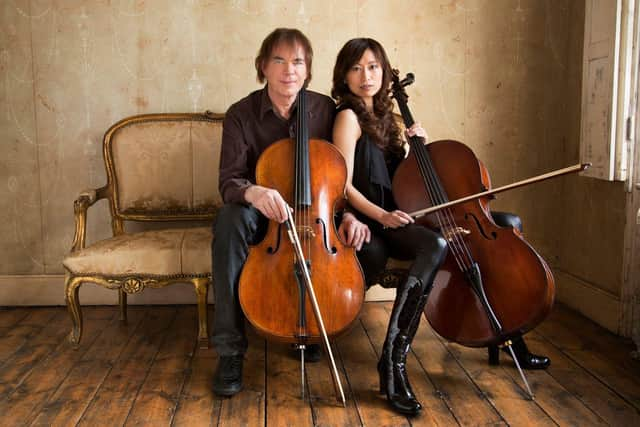
This month he and his wife Jiaxin, a renowned cellist in her own right, are heading to North Yorkshire for a special ‘evening with’ event at the Wesley Centre in Harrogate.
The legendary cellist is among the stellar names at this year’s HACS Harrogate Music Festival (June 6 to July 5) – which is celebrating its 60th anniversary – part of a line-up that includes Abel Selaocoe, Davóne Tines, Aurora Orchestra and the BBC Philharmonic.
For Julian, it’s a welcome return to a town he has great affection for.
"“It’s been very central to my career. I played the Elgar Cello Concerto with Yehudi Menuhin there, and at one time in the ’80s I was the featured festival artist, so I did a lot of concerts then.
"It’s a beautiful town that has kept its soul,” he says.
He first performed in Harrogate way back in 1970 when he was just 19-years-old, playing to a packed-out Royal Hall in a concert celebrating Beethoven’s bicentenary.
“It was my first really big concert because it was with the pianist John Lill, who a few months earlier had won the International Tchaikovsky Competition, which at that time was by far the biggest piano competition.”
He returned the following summer for the Young Musicians Series.
“That was a big thing for me because in those days there were so many music clubs and they all used to come to Harrogate to hear the different young musicians.
"I did a lot of concerts up North playing places like Ilkley, Skipton and Harrogate, of course, and that’s all huge experience for someone starting out.”
Music was part of his life from an early age. His mother was a children’s piano teacher, though it wasn’t an instrument he warmed to.
“I was four or five years old, and I just couldn’t get on with the piano.
"But then she took me to a children’s concert at the Festival Hall and I spotted the cello and just thought it was a much more interesting-looking instrument.
“It wasn’t so much the sound, because it was playing within an orchestra, but the way it looked seemed to me a completely natural instrument.
"You could see how the notes were made and how the sound was produced, and I asked if I could play it with a sneaking suspicion that then I’d be allowed to give up the piano.”
He found he had a natural aptitude for the cello. Then when he was 13 he was taken to see the great Russian cellist Mstislav Rostropovich, his “cello hero” in London.
“At the age of 13 I made the decision that this is what I wanted to do.”
He left school at 16 and spent a year at home practicing before earning a scholarship to the Royal College of Music where he studied for four years.
It was the springboard for a glittering career that has taken him around the world and seen him perform on some of the greatest stages.
One of his most famous performances came in Harrogate under the baton of the great Yehudi Menuhin in 1986, when he performed the Elgar Cello Concerto with the Royal Philharmonic Orchestra (it’s worth seeking out on YouTube).
“I recorded the work with him and that won a Brit Award and was probably my most successful classical recording.”
So when it came to the Harrogate concert, he wanted Menuhin there, too.
“I had wanted Menuhin as the conductor from the very beginning because he had worked with Elgar. Can you imagine that? I wanted that connection and it worked like a dream.
"As a string player, and he was one of the greatest violinists, I felt totally free under him. I felt I could do whatever I liked and he would follow my bow. I really loved working with him.”
Julian is, of course, the younger brother of another music icon, the composer and musical theatre impresario Andrew Lloyd-Webber.
Given their fame, has this caused any sibling rivalry? “People have tried to stir it up, but it’s really not been there because we were doing such different things,” says Julian.
They collaborated in 1978 on Variations – an experimental classical and rock fusion album.
“There had never been a piece for cello in a rock band. He said he wanted to write me a piece, and I thought he’d try and write something with an orchestra or a piano, something more traditional.
"But no, he wanted to write a piece for cello and a rock band. I was worried at the beginning and of course a lot of people in classical music said, ‘you can’t do that you’ll ruin your career’.
"It was really stuffy at that point. Back then there was this divide between classical and rock which has largely gone now,” he says.
“It was a risk and neither of us thought it was going to be as successful as it was.”
In the end the album confounded expectations by reaching number two in the charts, only kept off the top spot by an Abba compilation.
Julian has seen music trends come and go, but he admits he’s concerned about access to classical music in Britain today.
“The reason it’s not as mainstream as it used to be is that it sits so far out of the school curriculum.
"So young people, unless they come from a background where parents can afford to pay for lessons and buy expensive instruments, don’t have access to classical music, and they can leave school without having heard a note of it,” he says.
“The music shouldn’t be given this elitist tag, it’s how we’ve reacted in this country to it.”
Despite such concerns, his passion for classical music remains undimmed and he’s delighted to be heading back to Harrogate.
In the first half, which will include a live performance from Jiaxin, the pair will discuss the extraordinary story behind Bach’s Cello Suites.
They will then take the audience on an illustrated musical journey through Julian’s remarkable career.
“It’s always nice going back there and the audiences are very warm. So we’re really up for this one.”
Julian and Jiaxin Lloyd Webber present: Bach, Bows and Arrows! – Wesley Centre, Harrogate, June 16. Tickets £28. To book, visit the Harrogate International Festivals website, harrogateinternationalfestivals.com or call the Box Office on 01423 562 303.