
'Music is very much alive in Yorkshire': York Opera celebrates 60 years
York Opera is approaching 60 years and still going strong. Phil Penfold went along to meet the key players including Maggie Soper, who is the head of the costume team.

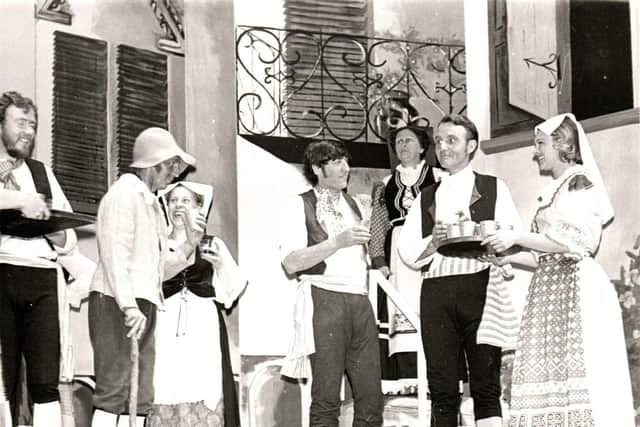
It reads like a handbook guide to opera. In their 60 years – which the renowned York Opera celebrate this year – they’ve done everything from Puccini to Britten, from Verdi to Offenbach, Sullivan to Smetana. It’s an impressive list, and they haven’t been afraid to take chances.
They are one of Yorkshire’s longest-established arts and entertainment groups, they have a large and loyal following from across the county, and they currently have some 80 or so paid-up members – although the number can change, as their ranks are made up of long-term residents of the city, as well as students at university, some of who inevitably have to move on. But it is possible that this fluidity and flexibility make York Opera what it is – adaptable, highly professional, and always worth watching.
It all started life as The York Youth Operatic and Drama Society in the days when the city council provided all the funds. Times have changed. Now it is kept alive with the cash at the box office, members’ subscriptions, donations and grants. The group are held in high esteem – not for nothing is their honorary President Sir Thomas Allen, who always makes an effort to attend a performance at some point. “He’s amazingly supportive,” says Wendy Jackson, a staunch YO member.
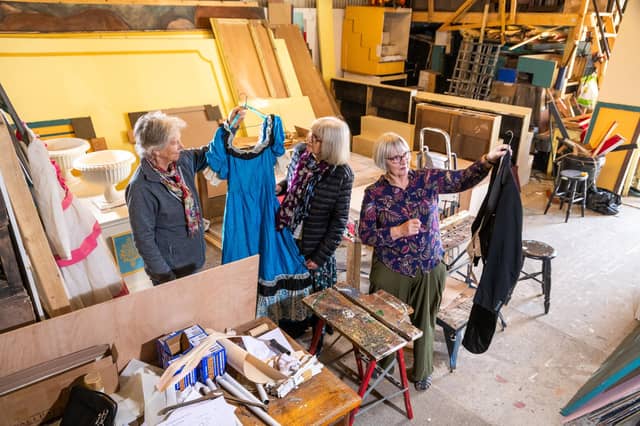
One of the people who is a constant of their ranks is their Head of the Costume Team, Maggie Soper. Maggie is also a singer with the group – as well the designer of most of their costumes. And there are plenty of costumes. Many, many hundreds of them, of all shapes and sizes, of all periods and styles, and all stored in a secure space just outside the city, in a converted barn. One of the most endearing – and enduring – things about the company is that just about anyone turns their hands to just about anything. Maggie cites her colleague Bill Ankers, a veteran of the group who started his association with them as a young man, found that his work demanded more of his time, reluctantly gave way and then returned in later years to sing, direct productions, and “involve himself in any way that he can. I don’t think that he’s ever lifted a paintbrush in anger, but that’s about all that he doesn’t put his hand to. There is still time.” Bill, it appears, is the “problem solver” when it comes to a tricky prop or piece of scenery.
The strange thing is, perhaps, is that York Opera isn’t really inclined to performing the smaller productions, which are – of course – well within their capability. The reason is simple – they want to involve their vast and exceptionally talented chorus. They want to have 60 on stage, and not six. And, of course, if you multiply that 60 by a few family and friends each, that also happens to fill an auditorium very nicely. Maggie remembers a production of Puccini’s masterpiece Turandot, a few years ago, at the Jospeh Rowntree Theatre. “In that space,” she remembers with a smile, “that one pinned the audience to the back wall with the sound levels alone.”
If you have a large chorus, and principals who may also have at least two changes of costume, where do all the costumes come from? “Remember when even every small town had a market, and in that market there was at least one stall with dozens of bolts of relatively inexpensive cloth? Remnants, ends of rolls, patterned, plain, you name it? There are so few of them now, and they are really rare. That’s where my ‘happy hunting grounds’ used to be, but now it’s a far wider search for materials,” says Maggie
"Quite a few costumes can be made from someone’s old curtains, if the pattern on them suits the show. Measured, cut and sewn properly, no-one would ever guess. There are few bargains to be discovered these days, people are a lot more ‘savvy’”.
Maggie has “always sewn, and always made my own clothes, and for the family”, and she still has that little sewing aid that is becoming more and more rare in homes these days – the button box where spare buttons are kept, just waiting to be re-discovered and re-purposed in months or years to come. She has, her friends at York Opera all agree, an amazing eye for creating costumes. Maggie is a little embarrassed at the praise she has for her skills, but does recall adapting streetwear clothes into a costume worn by a Chinese Mandarin – and much else besides. “It’s just knowing the right basic shape,” she says, “and getting the right basic cut. The structure. And knowing what a particular fabric can do…..well, you just learn that naturally, over the years.”
Organisation also plays a huge part. Adapting or making, for example three dozen uniforms for the soldiers in Carmen, and others for the matadors. And then there are the dozens of wigs, as well. “Then there are all the bodices, and all the underskirts.” Some accessories are more difficult than others. “Who wears formal white waistcoats these days?” laughs Maggie. “And no-one ever donates them to the charity shops I go to!” Sometimes there’s a production that comes along which makes Maggie sigh with relief. “Beggar’s Opera is one,” she reveals, “because most of the cast have to look unbelievably scruffy and unkempt, no-one has to look glamorous, and as if they were off to a Viennese society ball!”
There have been occasions when a York Opera performer has observed that the colour or pattern of a costume has been “not quite them.” They’ve been quietly reminded that they must look at the show overall, and not the individual.
After so many “amateur” companies had disappeared over the years, York Opera sails on, specialising in what it does best. “Music is very much alive in Yorkshire,” says Wendy, “and we’re so pleased that there are now so many companies which concentrate on musicals. There’s a crossover, and we do share a lot of membership. It’s just a distinctive style of singing.”
“Orchestras do not come cheap,” says Maggie, “they and the director are the only people who get paid. And they are worth every penny. What are we presenting next year? Carmen, which we know will be exceptionally popular. Wendy’s already looking through the racks in our costume stores, and checking out how many Toreador costumes there are, hanging there, and which will have to be altered to fit whom…..”
York Opera’s Die Fledermaus (The Bat’s Revenge) York Theatre Royal, June 3 – June 6.