
'People are unrelentingly supportive' - Artistic director of Sheffield Theatres on working in the city
Elizabeth Newman is the artistic director of Sheffield Theatres, a role that she relishes. She spoke to Phi Penfold about her ambition to keep the city at the forefront of national theatre.

The reaction of your nearest and dearest to great news is not always what you might like to expect.
When Elizabeth Newman told her partner Russell that she had been approached to become the artistic director of Sheffield Theatres, a job that is widely acknowledged by many as being the best outside London, he replied: “Sheffield? The Crucible? Great city. I went to university there – can’t wait to get back.”
Newman’s father, however, confined his comments to one word. “He looked at me with delight, and said ‘snooker!’ That’s all. One word. Just ‘snooker’!”
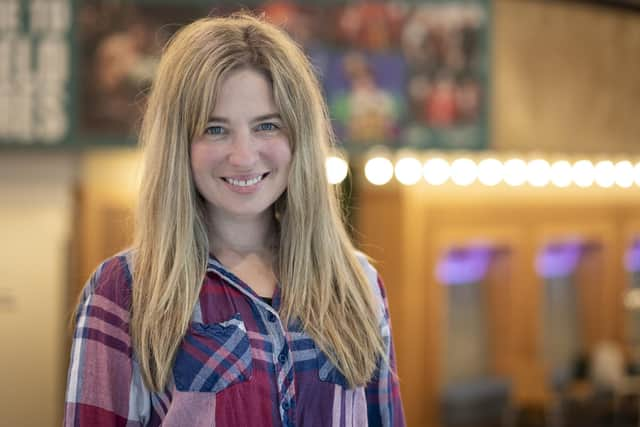

It is two years since it was announced that she would be taking over from Rob Hastie as Sheffield Theatres’ artistic director and 18 months since she took over the post.
Sheffield Theatres is one of the major players in this country’s theatre. Nowhere else will you find four quite different venues in one community.
There’s the Crucible, with its two spaces, the historic Lyceum, one of the most beautiful theatres in Europe, and the Montgomery.
And 2028 looks set to be a landmark in the history of the famous Crucible. The Crucible has one of the few ‘thrust’ stages in the UK – that means that audiences sit on three sides of the action.
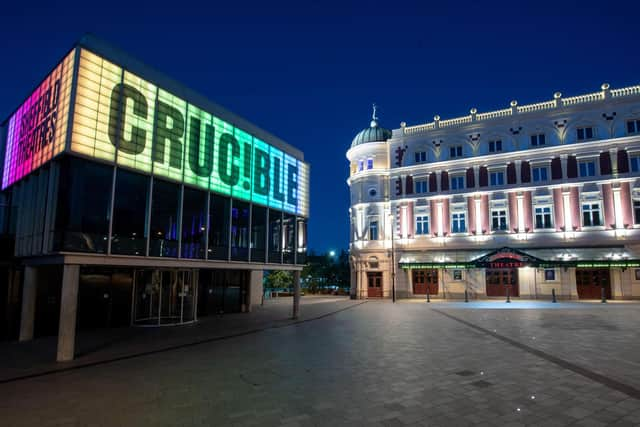
In 2028, it will be able to adapt to being a full ‘in the round’ set-up, meaning that audiences for the snooker tournament will sit on all four sides of the central action and it will see audience numbers heading toward the 2,000 mark.
Newman is protecting her detailed plans, but what is certain is that Yorkshire is about to get a second major theatre with the capabilities of in the round as and when a production needs it – the Stephen Joseph in Scarborough, of course, on a smaller scale, got there first.
And Newman is rubbing her hands with joy, just thinking about all the opportunities that it offers.
You sense, she just can’t believe her good fortune in being in the right place at precisely the right time.
She didn’t come from a theatrical family, she says, and neither was she being taken regularly to the theatre as a child.
Her family comes from Croydon, on the outskirts of London and, she says with a smile: “I think the nearest thing we got to drama was watching soap operas on TV. There was the occasional pantomime, but that was about it. And, a little later, like a lot of little girls, I was sent off to do ballet classes.”
But then, she became seriously ill with a brain infection, and she was hospitalised at Great Ormond Street Children’s Hospital for some time.
She was in a wheelchair when she emerged, “very poorly, with no energy”, and back then, the very idea of having someone disabled on the stage was unheard of.
“I can always remember a teacher, called Miss Docherty (we all called her ‘Miss D’) telling me that being an actor was going to be impossible, so why didn’t I have a think about being a director?”
She laughs again, and observes, “so, in a lot of ways, I’m back where I started. But, seriously, thank heavens that the attitudes to disability of all kinds have now changed, and for the better.”
It perhaps tells you a bit more about the determination of Newman that one of the first productions she brought to life was Antigone.
Most would agree that Sophocles’ key work is not the easiest or most accessible of the dramatic canon.
Her own directorial attitude, she thinks, “is making sure that the actor is alright, that they have found all their own actions and moves.
2And I never, ever read reviews, never until the show is well over, and the production has closed.
"Yes, I want to know if an actor has been criticised in some way, but not my work – until later. Of course, there are times when you think to yourself ‘Just why am I doing this?’ but, well, they always pass.”
She was one of the founders of the Shared Property theatre company, so she knew from the very beginning that it was always a tortuous path to getting grants for new works – and organisations, and accepts the fact that “we achieved a lot”.
Then it was off, up and away to helm the Bolton Octagon, and after that the famed Pitlochry theatre, which she handed over to the irrepressible Alan Cummings.
It turns out that it was she who suggested the actor and presenter for the role, and it was he who rang her up to ask if she really thought that he could make the grade, and take over the reins?
“I told him that I wouldn’t have mentioned his name if I hadn’t thought that he was more than capable,” she says. I left it in very capable hands.”
She also left the venue enlarged from a single space into something a lot more complex, and accessible.
It’s what Elizabeth Newman does.
But she says she does have self- doubt and admits that one of her recurring thoughts is “am I doing good enough? For me, it’s all about doing the best of the best of the best, and wanting to get even better.
"And you must get better, you know. But then I do admit that I am a strongly self-critical, and that I tend to evaluate everything in detail.”
It tells you a lot about her passion and determination that a recent publicity release about the Crucible itself was headed by one of her statements, and that it was printed in bold black capital letters.
It read: “This is a theatre that belongs to everyone: audiences, artists, and anyone who has sat in the dark and felt less alone.”
She was delighted when a completely fresh production of A Christmas Carol was such a festive hit, with the audiences and the critics alike, and that the famed Lyceum panto was, once again, packed to the back of the gallery.
She remembers that one day, she saw queues for all four venues all eager with anticipation, “and that filled me with real joy, and hope for the future”.
It’s at this point that she also reveals delight at this year’s queues and audiences for the snooker matches, and keen anticipation for that bigger arena in not-so-long a time.
Two of the many highlights in the months to come are back-to-back productions of a pair of Shakespeare’s classics.
One is King Lear (August 29 to September 19), and the other is Twelfth Night (October 10 to 13).
She is especially delighted that Ian McDiarmid, one of the finest Shakespearian actors of his generation, will play Lear, with Titas Halder directing. Mathew Horne has been cast as Malvolio.
Newman is quick to point out that the rest of this year will also offer much new work, adaptations and revivals.
It’s very much a something for everyone season, and she says that “making new work, especially that written or directed by people from this part of Yorkshire, and ensuring that we achieve artistic excellence, is vital.
“We must make certain that Sheffield Theatres remain right on the forefront of British – not regional – British, theatre.”
Then she laughs again and observes that “Sheffield is, and has been for centuries past, a city of non-conformists, and brilliantly so.
“That explains perhaps why it has produced so many great musicians, performers and writers. People here are unrelentingly supportive. And I can tell you that I speak to my own experience.”