
ABP looking ‘really hard’ at business case for further investment in Humber
Associated British Ports (ABP) is looking “really hard” at the business case for further investment into the Humber, the firm’s head of offshore wind has said.

Speaking at the Offshore Wind Connections 2026 conference, Andy Reay, head of offshore wind at ABP, hailed major opportunities in the region, but said that the company would need to see ”longevity” in the business case for further investment.
ABP is the UK’s largest port operator. The company owns and operates 21 ports in the UK, four of which are on the Humber.
Speaking at the Hull conference, Mr Reay said: “We're looking really hard around what the business case is for further investment, either in Green Port Hull or maybe other assets on the Humber.
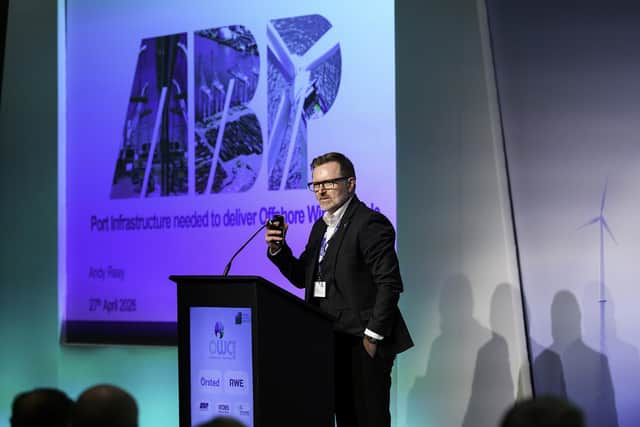

“Port investment is not cheap. It's not a low-cost activity, and we need to see what the longevity of the business case for that asset is going forward.”
Green Port Hull refers to collaboration between Hull City Council, East Riding of Yorkshire Council and ABP, designed to promote investment and development of the renewable energy sector in the Humber.
Mr Reay also flagged a string of headwinds affecting the UK’s offshore wind sector, but said that further port investment was likely needed to deliver some of the major offshore schemes planned around the UK.
He said: “We need to have a real, tangible pipeline going forward in order to make the significant investments in port infrastructure that are needed in the UK.
“But probably we're going to need that in the Humber region as well, to deliver the opportunities around the expansion of Hornsey, the Hornsey zone, various projects, even potentially up to Dogger Bank.”
The Hornsey wind farms are a string of four schemes off the east coast of England. Two of the wind farms are in operation, with a third under construction.
In May last year, developer Ørsted announced that it would discontinue the Hornsea Four project “in its current form”, adding that it would “evaluate options for future development” of the scheme.
Ørsted at the time cited “several adverse developments” amongst the reasons for its decision, including increasing supply chain costs and higher interest rates.
It comes amid a string of setbacks for the sector across the globe in recent years, including in the US, where President Donald Trump’s administration has frequently shunned green energy projects in favour of oil and gas.
Earlier this week, the administration also blocked two permitted US wind energy projects from development, arguing that it was aiming to “promote US energy security and affordability” by favouring “proven, conventional solutions”.
Speaking at the Hull conference, Mr Reay also cited geopolitical issues amongst the pressures facing the offshore wind industry.
He said: “There are challenges. I'm sure we've all experienced those challenges in the UK. We've seen projects being canceled and postponed in the UK market. We've seen projects being canceled globally.
“We've seen stories in the press around factory closures, predominantly in Europe. That is basically the pressure that has come about as a result of the inflation and as a result of the Ukraine war, the cost of capital, and increasing challenges around getting projects over the line.”
Despite these headwinds, offshore wind generated a record 17.9 per cent of the UK’s electricity in 2025, according to Government statistics, up from 17 per cent a year prior.
Wind generation more broadly also contributed a record 30 per cent of the UK’s power last year.
Elsewhere at the Offshore Wind Connections conference, Tor Arne Johnsen, business development manager with the Norwegian Wind Cluster, called for more collaboration between the Humber and Norway.
Mr Johnsen described the Humber as “probably born of the most attractive regions in Europe when it comes to investment and activities in offshore wind”, adding: “Very few regions in Europe have the same capabilities today or the plans for the future as you do.”
His comments came as he called for the UK and Norway to work together on offshore wind supply chains, adding: “What we see is that the supply chain in offshore wind, it's not regional, it's not national, it's international.”
Also speaking at the conference, Finbarr Dowling, chair of Humber Freeport, described the Humber region as “unbeatable” as a place for companies to invest.
Calling for UK investors to consider the region, Mr Dowling pointed towards major projects including the Siemens Gamesa turbine factory, in Hull, and the planned Metsä Tissue paper mill, in Goole.
He also noted the recent announcement that ABP had let a substantial unit in Hull to Mitsubishi Chemical UK Limited.
Mr Dowling said the region was “getting some traction now”, adding: “This is my message. We’re ready.”
He said: “All of the data and research we see is that for big institutions across the globe, the UK is a very, very attractive market
“People are wanting to invest in the UK, and what we’re saying to them is, ‘the Humber is ready’.
“This is the place to invest. It's unbeatable.”