
AI and Education: How The University of Sheffield became an early adopter of ‘AI-positivity’
Over the last two years, institutions of all kinds have been forced into a scramble of decision making on if, or how, to use generative AI.

The release of tools such as ChatGPT, DeepSeek, and Google’s Gemini have meant answers to detailed questions are now available in seconds, while a 1,000 word essay can easily be created by an AI model with a simple, one sentence request.
For universities, this poses a string of complicated issues.
Cases of students submitting AI-generated work as their own are rising, while complex, nuanced texts which lecturers set as reading are easily turned into simplistic bullet points by AI tools.


Such issues have seen universities react with varying degrees of rigidity. Though many such measures have now been lifted, 2023 saw eight out of the UK’s 24 Russell Group universities tell students that using ChatGPT for assignments would be seen as academic misconduct – effectively banning its use.
One University in Yorkshire, however, acted quickly to distinguish itself from the crowd, positioning itself early on as an adopter of what has now been described as an “AI-positive” approach to learning.
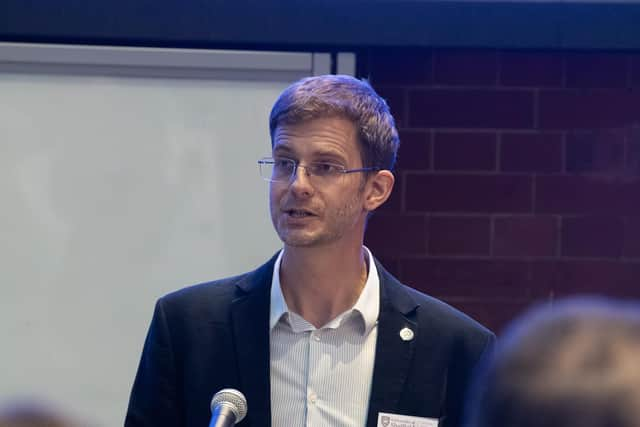
“The way that we frame it is that we’re taking an AI-positive approach,” says Dr Denis Newman-Griffis, senior lecturer & theme lead in AI for health at the University of Sheffield.
“That means that we recognise these technologies are here to stay, and that they're being used right now by both students and by staff. We’re not the only university doing this, but I think we’re leading in terms of how we’re putting it into practice.”
Though its use is often still banned for certain assignments, many universities are now switching to helping students to use AI in the right way, rather than trying to dissuade them from using it entirely.
Amongst the University of Sheffield’s measures aimed at helping students and staff to use AI responsibly are a string of online resources, introductory videos and workshops. One of the many benefits to this, according to staff, is improving accessibility.
“Tools like ChatGPT can be really useful for dyslexic students, or students with other kinds of specific learning needs,” says Dr Newman-Griffis.
“If they have any communication issues, or students with English as a second language, generative AI can be a really powerful accessibility tool.
“Where we’re trying to strike the balance is in providing an education that says, ‘this is where it can be useful,and this is where it's not going to work for you.’”
The technology, however, still raises a number of challenges. AI hallucinations, where generative AI fabricates information and false sources, have been widely documented, while human biases in inputting prompts and questions can also drastically change what information an AI model will come back with.
While the University of Sheffield’s measures are designed to circumvent such issues, researchers still see dangers in other areas.
One of the major challenges of AI is also its impact on the environment. Datacentres, which provide the backbone of how AI systems operate, require huge amounts of energy to run as well as water to cool.
This is also something the University of Sheffield has taken into account in its approach to the technology.
“Theres a number of ways of tackling this,” says Professor James Marshall, professor of theoretical and computational biology at the University of Sheffield, who is also director of the university’s Centre for Machine Intelligence.
“We have an AI research engineering team, and a big focus of what they're doing is trying to standardise things, so reducing the number of times you have to run an algorithm, for example.
“We can also look at different materials for running AI, building processors to make them more energy efficient. We also have people looking at AI for sustainability. You can actually use AI to understand things like climate change. Obviously it's a huge energy consumer, but you can also use AI to build better climate models to better inform policy.”
Over recent months, speculation has been growing about the idea of an AI “bubble”, wherein companies involved in the technology have been significantly overvalued, leading to huge amounts of money being put behind them on the promise of future growth.
The fears are that this could lead to a huge market correction, leading to a sharp and sudden decline in stock prices.
According to Professor Marshall, the result this would have on academic study is hard to predict.
“AI has gone through a number of what you would call AI winters, where the promise of AI technology were never realised,” he says.
“That would ultimately impact academia and research before, because it led to cuts in research funding, but it didn't have much of a knock on effect on the industry. Now, an awful lot of international research is funded by industry, and lots of people are going to work in big tech companies instead of universities.
“There is probably a risk of a big correction in the markets. That will lead to a knock-on for sure in industry funded research for example, but I think it's really hard to predict exactly how that will work out.
“What I do think we’ll see is that we've seen enough of the promise of AI being demonstrated this time around that the full AI winter is very unlikely. While it could be a very significant economic event, I think people will still see that AI, and the successive technologies, will still be very valuable in a number of areas.
“The overreach might turn out to be around the question of ‘is AI going to replace rank and file workers in all these different industries?’ And I think the answer is, not with the current technologies.”