
Amazon: 'I went to America to see first-hand the new technology Amazon is bringing to Yorkshire'
New technology which will help continue to change the way we shop is shown off in America but it will be coming to depots in Yorkshire soon. Steve Teale reports from California.

One of the world’s leading experts in artificial intelligence has told The Yorkshire Post that no-one should fear these technological developments.
Aaron Parness, a director of Amazon, said he and his team had worked hard for years to make major breakthroughs in the way the business operates.
But asked if there was a danger that robots might take over the world, he smiled and said: “The answer why I say it won’t happen is salt water. Robots don’t like salt water.

“The optimist in me says the reason why that won’t ever happen is because people are the ones designing them and people are the ones giving the signal that this is a useful thing or this is not a useful thing.
“Robots that are enslaving us are going to give an early signal that this is not useful.
"I think there is a lot of overblown concern about those Terminator-like scenarios and people who work in robotics know how clumsy they still are and how far away from those sci-fi scenarios they are.”
Asked about dangers associated with robots lifting, for example, heavy items, he said there had not been any serious accidents and in any event robots operate in caged areas away from people which minimised the risks even more.
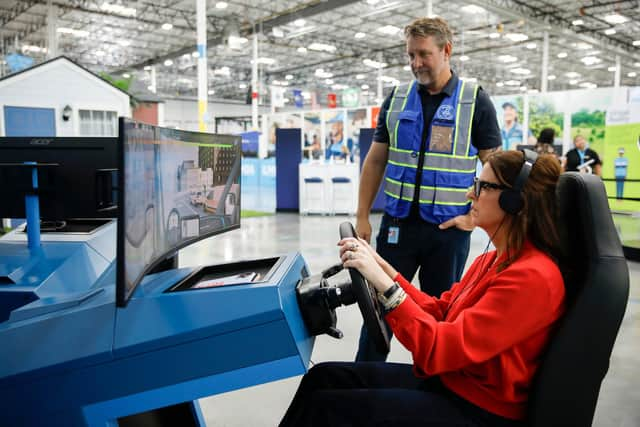
He said he had been to the UK and Ireland to visit fulfilment centres (warehouses) to see technology in action and was happy with feedback he received.
But he said while massive progress had been made there was still a vast amount of work to be done.
He said that while people often thought the human was brain was key to success, it was actually a seemingly more mundane feature of people which was proving hard to replicate.
He said: “The biggest thing that we have not solved in robotics is manipulation. We have not got a good solve for manipulation.
“For mobility, where robots are moving stuff around and navigating, we have made a tonne of progress.
“The hardest part in getting a computer to beat a Grand Master at chess is getting the computer to move the pieces.
“We still struggle to get anywhere close to what you have with your hands in terms of sensor density, the kind of information and your ability to process that information. We are still at the very early stages of that.
“There is 30 years of development ahead for us. Everyone gives the brain all the credit but it’s really hands which are absolutely amazing because of their dexterity.
"We, people, have great contact-based judgment. Where AI is good is sifting through tonnes of data and pulling the relevant information out.
“One of the tasks is how can we use humans for judgment and technology for the heavy lifting or time-consuming tasks and handling large amounts of data.”
Mr Parness made his comments at a conference in San Francisco called Delivering The Future where he spoke to journalists from the international media about the latest developments at Amazon.
The company is based in Seattle but has a massive UK operation where it employs 75,000 people, many of which are in fulfilment centres in Yorkshire.
Thousands more run the delivery service in vans across the region and the company is keen to make the business more efficient and more advanced.
He said the conference was about what happens when “intelligence leaves the cloud and enters the physical world – when our robots learn to grasp and execute tasks in real workplaces and when our AI is trained to adapt and assist the people in our workplace”.
He added the aim was to help the workforce: “How can you take the most painful parts of their job and add robotics to those parts and free them, those are the parts of the job we target.
“If you go back 10 years the role of walking 15 or 20 miles per day down those long aisles, we changed the nature of the work (with robots) from doing that walking to handling the items by using your hands rather than your legs and I think the same will be true of the next wave of technology.
"AI automates some of the mundane jobs and frees the employees to do the problem solving, a little more cognitive.”
He said there are some situations in which computers struggle, for example with tennis balls on conveyor belts or shiny black plastic bags which computers struggle to “see” well.
There is a “long history” of things which have failed in the computer world, where some systems have slowed things down rather than made them faster.
“You can learn so much in a lab but you learn from the operators who are in effect our customers,” he said.
The company recently passed a key milestone when it introduced the one millionth robot in its network.
They are co-ordinated by what it calls DeepFleet, a generative AI foundation model which acts as a global traffic controller.
DeepFleet continuously learns how to move thousands of mobile robots in harmony cutting travel time by 10 per cent so the flow of goods and people’s work is smoother.
In one site in the US, which will act as a model for others, it uses robotics, AI and computer vision in a site where every movement has been redesigned around people. It has led to less reaching and lifting and more time on higher value tasks.
The company says this site in Louisiana is a blueprint for what the next decade of fulfilment will look like.
And rather than simply cutting jobs, Amazon says it has created new kinds of roles in maintenance, reliability and engineering – about 30 per cent more skilled positions than in previous traditional sites.
Amazon has grown massively since its launch in 1994 as an online marketplace for books.
It has grown to become known as ‘the everything store’ and is now described as a multinational technology company engaged in e-commerce, cloud computing, digital streaming and artificial intelligence.