
Amazon was once written off - now analysts are making same mistakes about 'AI bubble': David Richards
The year was 2001, and I was driving north on Highway 101 after another long day in Palo Alto. To my right, I passed the glass-fronted offices of Cisco, Oracle and countless dotcom hopefuls whose logos adorned Silicon Valley.
The radio was tuned to KQED, broadcasting Marketplace, and the talk was grim. The dotcom bubble had burst. Commentators queued up to declare the internet finished.
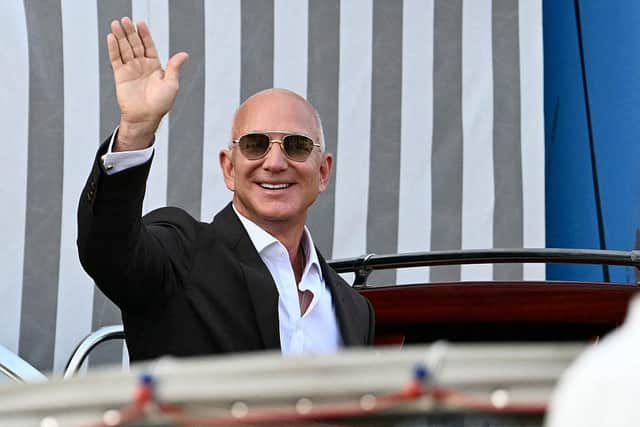
“Amazon.bomb” screamed the cover of Barron’s. Analysts were certain that Jeff Bezos was simply a bookseller with big warehouses and was going to be crushed by Walmart and Barnes & Noble.
I clenched the wheel, irritated by the smug certainty of the analysts. They could not see beyond quarterly losses and warehouses. Amazon’s ambition was never just about selling books. Like BT laying mile upon mile of fibre-optic cables across Britain, the company was making steep upfront investments that would only pay off later.

Frustrated by the chorus of sceptics, I went home and bought 50 shares of Amazon at around £6 each. I was running my first Silicon Valley start-up at the time and did not have much spare cash, so it was not the fortune-making punt it could have been.
That period is worth recalling because of the headlines we are reading today. “AI bubble” has become a favoured phrase of industry analysts and newspaper columnists.
The Economist recently asked what would happen if the AI stockmarket blows up, pointing out that $21 trillion has been added to US equity values since ChatGPT’s release in 2022, much of it concentrated in just ten firms. UBS highlights that revenues remain modest compared with the vast sums being poured into infrastructure. Even Sam Altman, the chief executive of OpenAI, admits investors may be “overexcited”.
The sceptics sound very much like their counterparts of the early 2000s. Yes, valuations can run ahead of reality. Yes, history shows bubbles are common companions of breakthrough technologies, from railways to electricity. But bubbles do not invalidate the underlying revolution. No one looks back at the railway manias of the 1840s and concludes we should have stopped laying track.

The dotcom bust did not kill the internet. On the contrary, it accelerated its spread. The millions of miles of fibre installed in the 1990s still carry our Netflix streams and Zoom calls today.
Which brings us to Sequoia’s case for AI. Sequoia Capital is one of Silicon Valley’s most influential venture capital firms, backing companies such as Apple, Google and Airbnb. The firm argues this is not simply another wave of innovation but a transformation on the scale of the Industrial Revolution.
The general-purpose AI models now being trained are the steam engines of our era. What matters is the specialisation imperative, the process of turning these engines into factories and assembly lines that reshape industries. In the Industrial Revolution, that process of specialisation took well over a century. With AI, the timeline is collapsing into years.
Why does it matter? Because the service economy in the United States alone is worth around $10 trillion, and most of it is still unautomated. AI can shift entire categories of work from low leverage to high leverage, where one skilled professional is augmented by AI agents capable of managing hundreds of cases or accounts at once.
The prize is not incremental efficiency but wholesale transformation of how value is created. It is this scale of change that leads Sequoia to argue AI will be bigger than the Industrial Revolution itself.
Those who scoff at today’s valuations should remember Amazon. The analysts of 2001 could not see beyond losses and warehouses. They missed the future taking shape in front of them.
The same mistake is being made today with AI.
As for my $300 punt? I sold those shares at $25, pleased with a small gain. Had I held on, the stock splits since would have turned that modest flutter into around 1,000 shares worth more than $235,000 today. A costly lesson in patience.
David Richards is managing partner of Yorkshire AI Labs