
AMRC’s Kimberley Butterfield is helping to power the future of nuclear engineering

Kimberley Butterfield has wasted no time making her mark at the University of Sheffield AMRC, working on groundbreaking nuclear manufacturing technology just months after graduating. Lucy Hilton discovers what drives the young project engineer.
Kim Butterfield joined the AMRC at a sprint.
In the span of just one year, she completed a one-week work placement, a summer placement, and stepped into a full-time role as a project engineer, all during and immediately following the final year of her degree.
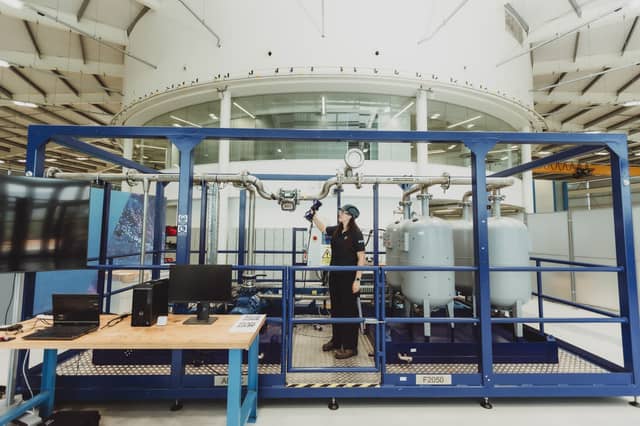
Soon after starting her full-time role, Kim worked on the Rolls-Royce Small Modular Reactor (SMR) project, EXPERI – Rolls-Royce SMR’s prototype module manufacture and test facility housed in the AMRC’s Factory 2050.
To meet demand, Rolls-Royce SMR nuclear plants will be built in parts, constructed using transportable modules that are manufactured and tested in off-site factories – modularisation. This allows the plants to become operational quicker than conventional nuclear plants, as well as reducing cost and uncertainty for developers.
Working alongside the automated assembly team, Kim supported the build process by aligning component placement and verifying that components were manufactured precisely to design specifications. By proving out these manufacturing methods, the team’s work directly de-risks delivery—helping transition Rolls-Royce SMR from design and prototype stages to full modular assembly and power plant delivery.
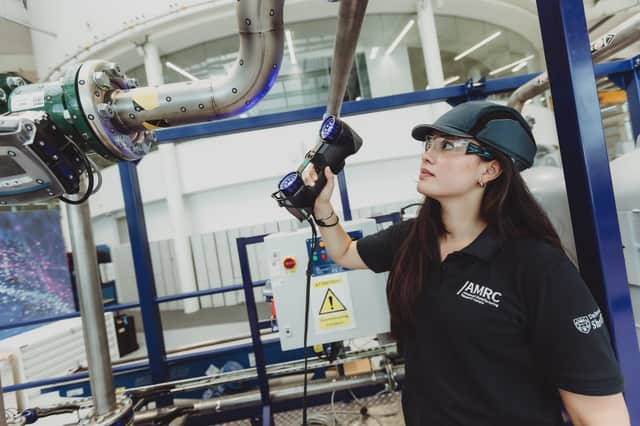
“The nature of the assembly task is challenging; it requires multiple engineers working together to align multiple parts, over a large working volume, to tight tolerances,” said Kim.
“When metrology — the scientific study of measurement accuracy, precision, and repeatability — is used to guide the process, the metrologist needs to understand every aspect of the task before the system starts capturing data. It requires planning, data processing and clear communication with the assembly team.”
“It was great for me because I already had awareness and interest in nuclear manufacturing from the modules I completed at university.
“The impact SMR work could have on society is fascinating. It was a great opportunity to get into large volume metrology; to start to understand what it takes to produce a nuclear power site, and how metrology fits into that as a critical component.”
Kim’s journey into engineering wasn’t a straight path.
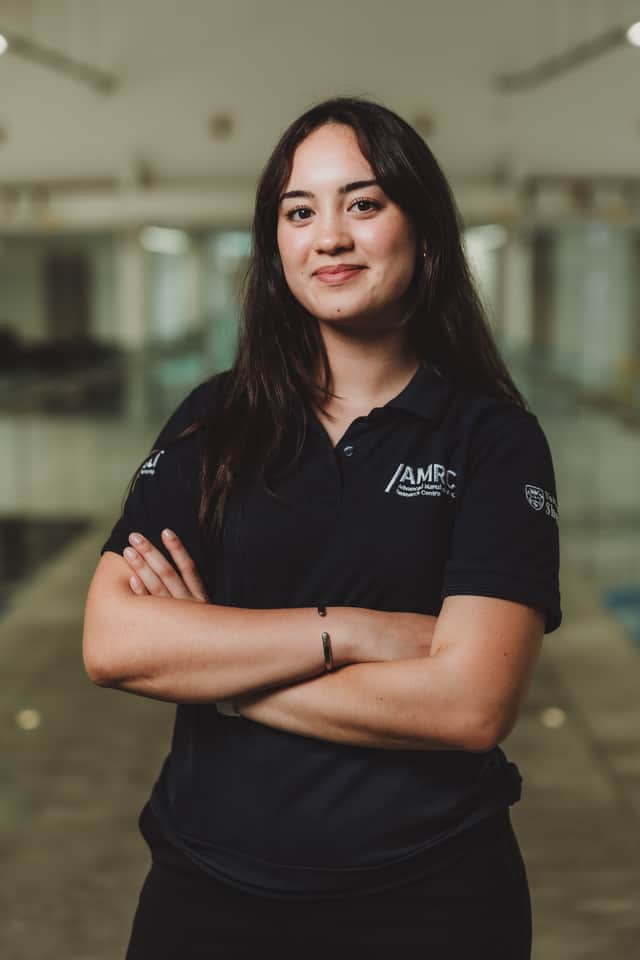
Growing up in the Middle East with an architect father and a cake business owner mother, she was raised in a household situated at the intersection of STEAM (science, technology, engineering, arts, and mathematics). Choosing between artistic creativity and mathematical problem-solving, Kim initially chose physics at University.
Her SMR project work aligned perfectly with her academic background. Having studied modules in nuclear operations alongside her physics degree at the University of Leeds, she was eager to apply her knowledge to real-world challenges.
“I wanted to take modules that had some impact, or could lead me to somewhere with significant change, so I took a few offered by the school of chemical engineering around nuclear operations, from how the physical reaction works, to decommissioning nuclear power sites.”
Her route to the AMRC began at the White Rose Industrial Physics Academy (WRIPA) careers fair, where a conversation with AMRC representative James Moore sparked her interest in manufacturing research. That initial chat led to her first week-long placement, which quickly evolved into a summer internship and, ultimately, a full-time position.
“I didn’t quite appreciate what manufacturing research was until I spoke to James at the fair, and I didn’t understand the extent of what it meant until I came in for my placements,” said Kim.
Towards the end of the Rolls-Royce SMR project, Kim conducted exploratory work on various metrology systems used for assisted module assembly. Her research brought her to AMRC Cymru to collaborate with Richard James, head of technology capability for assurance. Richard was working on the Metralis project, evaluating a novel prototype metrology system developed by K3Metrology (K3M), a spinout from the National Physical Laboratory (NPL).
Unlike conventional measurement equipment that relies on periodic calibration, the Metralis system continuously monitors its own accuracy during operation. By providing real-time estimates of measurement uncertainty, the self-monitoring system unlocks automated decision-making on live data and enables brand-new manufacturing processes.
Whether collaborating with innovative SMEs like K3M or industrial giants like Rolls-Royce SMR, Kim remains motivated by the opportunity to deliver a positive societal impact.
“Even if it’s years ahead, it’s rewarding to know that the work you’re doing is driving something that’s going to make an impact,” Kim said.
Looking to the future, Kim plans to continue following her interests into large-volume metrology. “Where I want to go is back into large volume metrology,” she added. “There are massive opportunities for metrology work in SMR that would answer questions raised by other projects. It would be great to pursue those answers and apply the learning across various packages of work at the AMRC.”
READ SPECIAL ANNIVERSARY SUPPLEMENT: View our 16-page AMRC 25th anniversary e-supplement below – or open it in a new window, in full screen – click here.
Find out more - visit the AMRC’s 25th anniversary page on its website at www.amrc.co.uk.
READ MORE:
READ AMRC's LATEST JOURNAL:
The journal features all of the latest developments from the AMRC and its partner companies, as well as the latest hot topics from across industry.
CONTACT:
The University of Sheffield AMRC Advanced Manufacturing Park, Wallis Way, Catcliffe, Rotherham, South Yorkshire S60 5TZ
How to find us: See contact page
LINKS:
LinkedIn: AMRC
Facebook: @TheAMRC
YouTube: AMRC
Instagram: the_AMRC