
Backtracking on climate action would be 'utter madness', minister tells Yorkshire Post summit
Backtracking on climate action would be “utter madness” as Yorkshire and the UK prepares to benefit financially from decarbonisation efforts, a Government Minister has said.
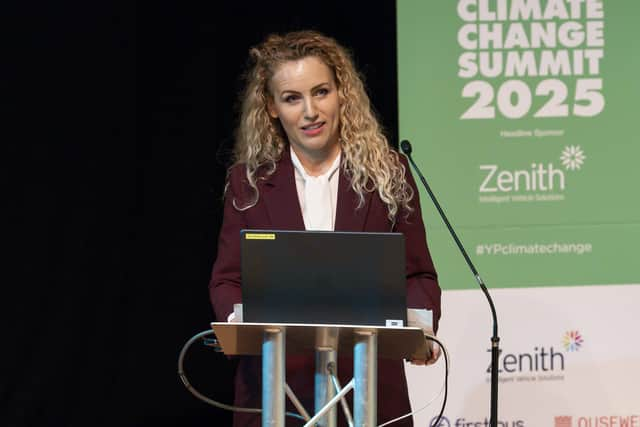
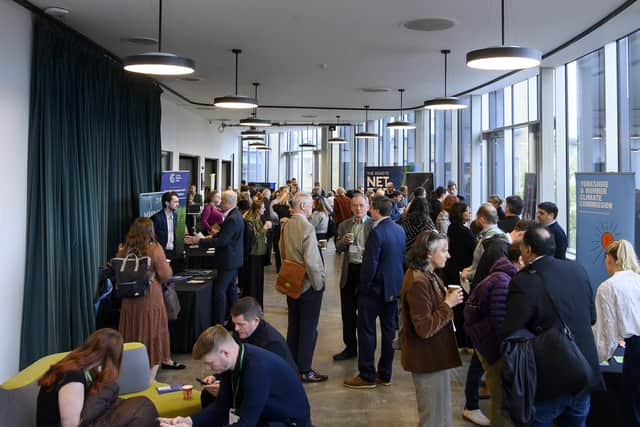
Climate Minister Katie White, who is also Labour MP for Leeds North West, made the remarks as she spoke to an audience at the Yorkshire Post Climate Change Summit at the Leeds Conservatoire.
During a speech, Ms White described net zero as “the economic opportunity of the 21st Century”.
When asked by an audience member about the need to get across the importance of net zero to the public more effectively, Ms White replied: “The wider point you are making is that we haven’t done a good enough communications job.

“I agree with you, I don’t think we have.
“This is an argument that goes up and down in terms of public consciousness.
“We’ve had lots of support over time. [Then] people have been like, ‘Hold on a second, life is tricky – is this something we can delay for future generations?’
“I would say, ‘No, because of what the science is telling us’. Also, we should be really proud of what we have done in Britain and we are about to reap some of the rewards of investing for the last 20 years.
“The idea that at this stage, when Britain has been leading on some of these areas, that we would backtrack is utter madness to me. We are just about to reap some of those rewards.
“Some people say, ‘other countries aren’t doing their bit’. I’ll tell you what, some of them are going flipping fast.
“Look at what’s happening in China, they’re winning some of those races.
“I’m quite competitive for Britain in this; I want us to reap the rewards at the same time as playing our part in this and I would also like some of those rewards for Yorkshire.”
Ms White has previously been awarded an MBE for her successful campaigning for the introduction of the Climate Change Act 2008 while working for Friends of the Earth.
She told the summit: “I got involved in co-chairing the campaign for the Climate Change Act.
“It is fair to say that at the time people might have said that goal belonged to fruitcakes and dreamers.
“I was convinced it was not just a nice idea but it was a step to fight climate change and preserve our way of life and future generations. More importantly, I thought it was possible.
“One of my mottos is GSD – Get Stuff Done. It was clear to me that unless we had an actual management system in place that measured us against a legally-binding commitment that meaningful climate action could never happen.
“We turned that campaign into the fourth-most supported motion in Parliamentary history and in 2008 under the leadership of an up-and-coming Energy Secretary called Ed Miliband the Climate Change Act entered the statute books.
“The following year, I joined Ed’s department to prepare for the UN Climate Change Conference in Copenhagen which was a pivotal moment in the history of climate diplomacy.
“Since then, not only has the UK decarbonised quicker than any other wealthy nation, our Climate Change Act has become a benchmark in a world where billions of people live in countries that are committed to binding climate targets.”
The summit was chaired by Asif Husain-Naviatti, a former UN diplomat originally from Rotherham and the current chair of the Yorkshire and Humber Climate Commission.
He said that Yorkshire can play a leading role in delivering on the UK’s climate ambitions.
“Yorkshire has everything – areas of outstanding natural beauty, woodlands and forest, an industrial heritage and is home to many businesses, large and small.
“Let’s not forget some of our more deprived communities are right here in this region.
“Yorkshire has a sizeable population of around 5.5 million people, Yorkshire could be a mini-Britain. What we do here is going to have an impact for sure.
“That makes this summit even more interesting and important.”
Speaking in advance of Ms White, he also highlighted the economic case for climate action.
He said climate change impacts are increasingly causing risks to businesses through supply chain disruptions and the potential of issues like flooding affecting their buildings.
“If there is one thing that benefits businesses, it is an environment of stability, certainty and a level playing field.
“If there is one thing we know about climate change, it brings disruption to that stability. For solid business reasons, we absolutely need to act.”
Ian Hughes, CEO of the corporate and consumer division of Leeds-based vehicle leasing company Zenith, also spoke at the opening of the event.
Mr Hughes, whose company was the headline sponsor for the summit, said the Labour Government “now appears to be making strides to achieve its 2050 target and set Britain up as a clean energy superpower”.
He said Zenith, which has 160,000 vehicles under management and works with the likes of Coca-Cola and Santander on managing their fleets, is committed to doing its part and helping customers reduce emissions by transitioning to electric vehicles.
It is seeking to reach net zero for its own emissions and also runs a carbon literacy training programme.
He said pursuing climate action projects in this region can “help make a better future for Yorkshire and make it one of the most attractive places for investment”.
“Now is the time to make a difference. We can’t afford to wait with climate change. We can work together on creating a greener future for Yorkshire.”
Nature ‘can be gateway drug’
A closer bond with nature could be the ‘gateway drug’ for getting people involved in climate change solutions, according to the deputy leader of Calderdale Council.
Coun Scott Patient said that more needed to be done to amplify positive voices around efforts to solve environmental issues. He said: “I think that nature is the gateway drug for climate action. I believe most people care about nature where they live.
“Access to green spaces, being able to interact with the outdoors, I think focussing on that kind of stuff is really important.”
Coun Patient also said that more needed to be done to show people the positive personal benefits when undertaking action to mitigate climate risk. He said: “I think trust is a big theme.
“The co-benefits and health determinants and outcomes are things we’re increasingly having to talk about in our community.
“Making sure that we’ve got a big knowledge base on positive air quality, more money in your pocket, a warmer home, is really important, and a shift we need at the moment
“We need to amplify those voices or net zero can be a run-off. We know the public is still overwhelmingly supportive of climate action, but we have to get better at selling it in these uncertain times. We have to think about those that suffer the most, whether that’s people in the global south or the people in the communities we represent or are working for. I do believe that the lens of climate justice must continue to be the guiding light for everything that we do.”