
Bank of England holds interest rates but reveals 'worst-case scenario' inflation prediction
The Bank of England has held interest rates at 3.75 per cent but warned that the Middle East energy shock could drive up inflation and lead to a hike in rates.
It said that in a worst-case scenario where oil and gas prices stay higher for a longer amount of time, UK inflation could rise to as much as 6.2 per cent.
The Bank considered several ways that events could unfold but a worst-case scenario could lead to multiple rate rises and an increased risk of recession.
Eight members of the Bank’s nine-person Monetary Policy Committee (MPC) voted to hold interest rates steady, while one member opted for a hike to 4 per cent.
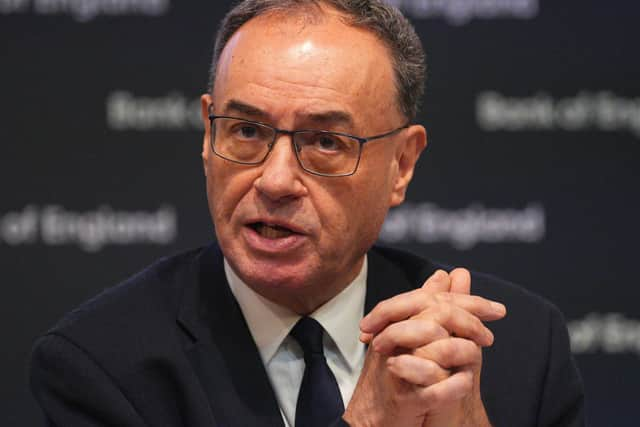

Andrew Bailey, the Bank’s governor, said he felt borrowing costs were at a “reasonable place given the situation of the economy and the unpredictability of events in the Middle East”.
But he said the Bank was monitoring the war’s “impact on the UK economy very closely”.
The US-Israel war with Iran and the closure of the Strait of Hormuz has sent oil prices soaring, to highs of about 126 dollars a barrel on Thursday, which has already driven up UK inflation.
The rate of Consumer Prices Index (CPI) inflation rose to a three-month high of 3.3 per cent in March, the latest official data showed, on the back of accelerating fuel prices.
The central bank has predicted that inflation is likely to slow slightly to 3.1 per cent over the second quarter of this year, driven by a lower energy price cap for households.
The April report, which uses three potential scenarios for the impact of the crisis, said inflation is set to increase even if there is a resolution to the conflict and oil and gas prices cool.
The most benign predictions would see inflation peak at 3.6 per cent by the end of this year.
However, it said a significant worsening of the crisis – which would lead oil prices to stay above 130 US dollars a barrel for months and spark a jump in gas prices – would see inflation jump to 6.2 per cent.
It indicated that inflation would not drop back to the Bank’s target rate of 2 per cent in the next four years in this scenario.
The Bank said that each scenario would also result in a slowdown in economic growth. It said the economy is likely to grow by 0.8 per cent in 2026 and 1 per cent in 2027, in its more benign projections, while this could be 0.7 per cent this year and 0.8 per cent next year if the situation worsens. In its previous forecast in February, the Bank pointed to 0.9 per cent growth this year and 1.5 per cent growth next year.
The Bank’s most positive forecast indicated that unemployment would hit 5.5 per cent for 2027, with this increasing to 5.6 per cent in a more extreme scenario.
Despite only one member of the MPC, Huw Pill, voting in favour of an interest rate increase on Thursday, a number of others indicated they could move for an increase at a future vote.
Governor Andrew Bailey said in the meeting that places “some weight” on the most extreme predictions, which “would require a stronger monetary policy response”.
Following the vote, Chancellor Rachel Reeves said: “The war in the Middle East is not our war, but it is one we have to respond to. Every choice I make will be about keeping costs down for families and businesses, without repeating the mistakes we’ve seen in the past that resulted in higher inflation and higher interest rates.”