
Boulby Lab: Funding for ‘world leading’ dark matter experiment ‘prioritised’ after cuts at underground Yorkshire lab
The group behind North Yorkshire’s Boulby Underground Lab said it has ‘prioritised’ funding to support a major research project looking into ‘dark matter’, after MPs and scientists warned that recent funding cuts could threaten the facility’s position as a front runner to host the scheme.

Boulby is currently seen as the leading contender of four competing underground labs across the world which are hoping to host the XLZD experiment – a collaboration between around 500 scientists and engineers which is attempting to search for 'dark matter'.
Described by NASA as the “invisible glue that holds the universe together”, dark matter has never been directly observed by scientists, but makes up around 85 per cent of the material in the universe.
Dan Tovey, a professor and leader of the XLZD team at the University of Sheffield, said should the scheme go ahead at Boulby and successfully discover dark matter, the project would "undoubtedly" bring a Nobel Prize to the UK.
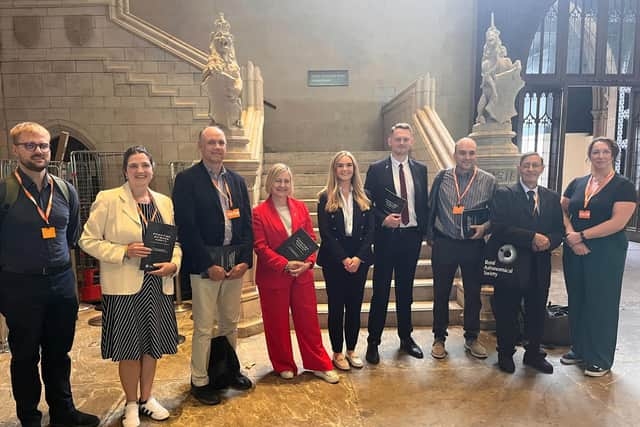

But the Boulby lab is now facing a 40 per cent cut to its operational budget, after the UK Research and Innovation Agency (UKRI) announced that it had to make savings of over £160m over the next four years.
A number of other research labs across the UK have also seen cuts to their funding due to the move.
Local MPs and scientists said this week that the funding cuts at Boulby could significantly lessen the chances of the XLZD experiment being hosted at the North Yorkshire site.
A decision on where the XLZD experiment will take place is expected in the next two years.
Mr Tovey added: “This is a tremendous opportunity for the UK to host a world-leading experiment that could revolutionise our understanding of the universe. We must not throw this golden opportunity away on account of the current financial challenges facing STFC and UKRI.”
STFC – the group behind Boulby – said it had “prioritised funding to support the UK’s continued engagement in the international XLZD consortium beyond its current Infrastructure Fund grant.”
Boulby’s engagement with the XLZD scheme is currently supported by a £7.8m Infrastructure Grant, which ends in 2027. The prioritised STFC funding maintains the possibility that XLZD could secure further substantial funding in the future.
STFC is part of UKRI, which is ultimately funded by the UK Government.
A UKRI spokesperson said: “Boulby is a unique national asset and the UK’s deepest underground science facility, with around £30m invested in the last decade.
“As one of UKRI’s national laboratories, Boulby has an important role in the UK science landscape providing a deep underground science environment which supports world-class research.
“As part of STFC’s prioritisation programme to return it to a balanced financial position, difficult decisions have been required across all its activities. For Boulby, this means reshaping its operating model, delivering efficiencies, and accelerating efforts to secure additional income from industry, commercial users and research partners. These changes will help place the facility on a more sustainable footing while protecting its long-term scientific value.”
As part of the programme, Boulby will need to reach a balanced position by the end of this Spending Review period in 2030.
It comes after earlier this week, Labour MP for Scarborough and Whitby, Alison Hume, and Labour MP for Middlesbrough South and East Cleveland, Luke Myer, raised theBoulby funding cuts in a Westminster Hall debate.
Mr Myer said the budget cuts risk “throwing away a huge opportunity for our region and for British science”.
A Government spokesperson said: "We are backing UK science with the largest ever R&D investment, a record £86bn over this Spending Review, including £38.6bn for UK Research and Innovation.
"While UKRI has had to take difficult decisions to put STFC on a sustainable footing, Boulby will remain an internationally significant research facility, supporting world-leading underground science and highly skilled jobs in the region.”