
BP to sell off stakes in Net Zero Teesside and Northern Endurance Partnership carbon capture schemes
Oil and gas giant BP has confirmed that it plans to sell off stakes in two major carbon capture and storage projects close to the Yorkshire border.

BP said that it plans to sell off “a portion” of its equity in Net Zero Teesside (NZT) and the Northern Endurance Partnership (NEP) schemes, in a move aimed at bringing in additional partners to the projects.
The company has previously positioned itself as the leader of a consortium of firms involved in the schemes, stating that when complete, the combined projects could cut the UK’s industrial emissions in half.
The NZT scheme is aiming to build what develoipers have described as the world’s first major gas-fired power station fitted with carbon capture and storage technology.
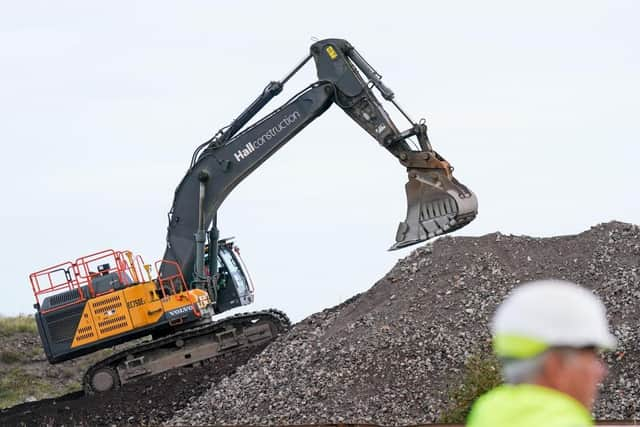

The NEP group is aiming to develop the UK’s first commercial-scale carbon transport and storage network, designed to transport and store millions of tonnes of carbon dioxide emissions in the UK North Sea.
BP has previously been named as the operator of the scheme.
Neither NZT nor NEP responded to requests for comment from this newspaper when asked if or how the schemes could be affected.
A spokesperson for BP said in a statement: “As the Net Zero Teesside Power and Northern Endurance Partnership projects have reached major milestones, including financial close and the start of construction, BP considers this the right time to sell a portion of its equity in both projects and bring in additional partners to support long-term value creation.”
The company has not confirmed what percentage of its stake in the schemes it may seek to sell off.
Carbon capture and storage schemes aim to capture the emissions from energy and industrial sources, separating the co2 from them and transporting it to be stored permanently underground.
The NEP scheme will see these emissions stored underneath the North Sea, off the coast of the Humber region.
Both the NEP and NZT schemes were previously aiming to start up by 2026, with this now expected in 2028.
The projects both reached financial close in December 2024 and are now in the construction phase.
BP was joined by partners Eni, Equinor, National Grid, Shell and Total when the NEP scheme was first launched.
In 2023, both National Grid and Shell announced that they would leave the partnership.
As part of the changes, National Grid Ventures (NGV) and Shell relinquished their equity holdings in NEP.
Existing NEP partners BP and Equinor at the time acquired the equity holdings of both firms, leaving NEP consisting of BP, Equinor and Total Energies.
Shell at the time said it had withdrawn from NEP to focus its efforts on the Acorn Project, a carbon capture and storage scheme in Scotland.
The latest move from BP comes as the company continues in its shift away from the green energy agenda.
In February last year, the company announced that it was cutting previously planned funding for renewables by over $5bn (£3.9bn).
The firm’s then chief executive, Murray Auchincloss, said at the time that the firm had gone "too far, too fast" in its transition away from fossil fuels, adding that it would be “very selective” in green energy investments going forward.
The company reduced its funding in such schemes to between $1.5bn and $2bn per year.
BP was one of several firms at the time to revert its focus to oil and gas over green energy, including Shell.
The latest announcement comes at a testing time for UK carbon capture and storage projects.
In December last year, Yorkshire power station operator Drax announced that it was cutting more than half of its global carbon capture division.
The move was expected to result in around 100 jobs being cut in Drax group and its carbon capture business Elimini.
It came after Drax postponed long-standing £2bn plans for a bioenergy with carbon capture and storage (BECCS) scheme in 2023, citing a lack of certainty over Government support for the plan.
In the company’s latest results, it posted a £48m impairment on its carbon capture plans, which appear to be stalled at its Yorkshire site.