
Creative Growth scheme aims to reach more businesses across Hull and East Yorkshire
A SUPPORT programme which has helped more than 70 businesses in Hull and East Yorkshire turn their creativity into commercial success is set to target a wider range of participants by broadening the criteria for its final round.

Creative Growth Hull & East Yorkshire will launch its seventh and final cohort on Tuesday 13 January at the University of Hull Business School.
The initiative aims to give business owners and their leadership teams the opportunity to learn from experts and from each other about how to use ideas to generate increased investment and business expansion.
HEY Business, Growth and Skills Hub, which is delivering the programme in partnership with Hull City Council, East Riding of Yorkshire Council, and the University of Hull, has introduced more flexible criteria for the last round in response to feedback from people who have completed the sessions.
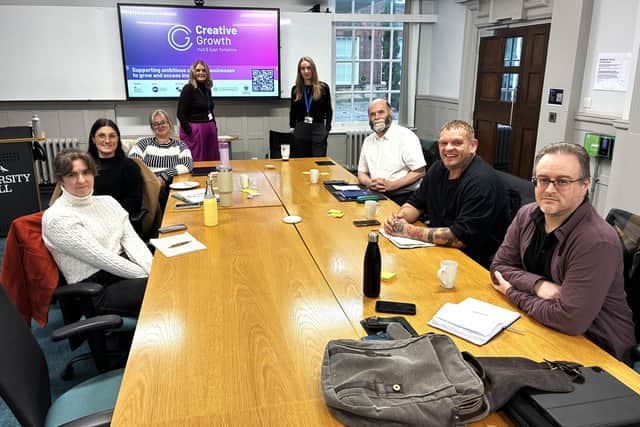

Andrew Richardson, the Creative Growth Programme manager at the HEY Business, Growth and Skills Hub, said: “The programme helps creative businesses reconsider their growth plans, with a view to helping firms become investment ready and geared up for growth.
“It’s specifically tailored for local business founders who are looking to grow their creative businesses, and it recognises that businesses often have to manage conflicting business commitments and daily operational pressures, whilst at the same time engaging with the process of business growth.
“By using the advice, resources and learnings provided via the programme, and by sharing business experiences with other business leaders via peer learning, local creative business founders are supported to reexamine how they can develop their capacity and confidence to grow.”
As before, the Creative Growth Programme is only open to candidates operating profitably in a recognised creative industry sector, with a trading address in Hull or East Yorkshire.
However, as part of the latest changes, the previous requirement of having traded for two years has now been reduced to one year and the condition of supporting at least two full-time equivalent jobs has been lowered to one, coupled with a commitment to create a further post within 12 months.
The programme will close on Tuesday 31 March 2026, and is open to freelancers and businesses working in advertising, marketing and PR, architecture, crafts, design and fashion and film.
It is also open to companies and freelancers working in sectors including TV, video and photography, radio, IT, software, apps and video games, museums, galleries and libraries, music, visual and performing arts, and publishing and translation services.
Among the people who took part in the recently concluded cohort six were business owners operating in photography, web design, textiles, museums, music and software development.
Speaking on her experience as part of a recent cohort, Chloe Lammiman, owner of Luminous Photography & Events Ltd, said: “It helped that everybody in the room knows people and when I hear their feedback it’s almost like hearing the client’s perspective.”
Steve Plater, owner of the Dinostar Museum, an interactive dinosaur-themed museum in Hull, said: “It’s interesting to take a step back because you tend to stagnate after a while.
“You tend to do what you have always done so it’s good to look at things from a different angle.”
Businesses that enrol in the final cohort will be offered the opportunity to exhibit at a regional creative showcase event in March 2026.
In addition, they will be able to apply for an exclusive and fully funded exhibitor package at the Creative UK “Big Creative UK Summit in London in February 2026.
Supported by Government, the 41 Growth Hubs across England aim to provide local businesses with access to advice and support via an impartial, free to access, single point of contact. They also aim to bring together national and local support from across the public and private sectors to help businesses find the right support for their needs.
Growth Hubs are led and delivered by each area’s Local Enterprise Partnership, Mayoral Combined Authority or County Council, with services shaped around local business needs.