
Demand side of AI and defence sector growth are boosting UK's economy, says RSM's Tom Pugh
The UK is likely to face slowing growth rather than a recession over the next few months as consumers are hit by rising inflation, according to a leading economist.

Tom Pugh, professional services firm RSM UK’s chief economist, also said the UK has the type of economy that should be able to take advantage of AI very quickly, which should feed through to productivity.
He added: “We should be at the forefront of seeing the benefits of AI as it gets implemented through the economy.”
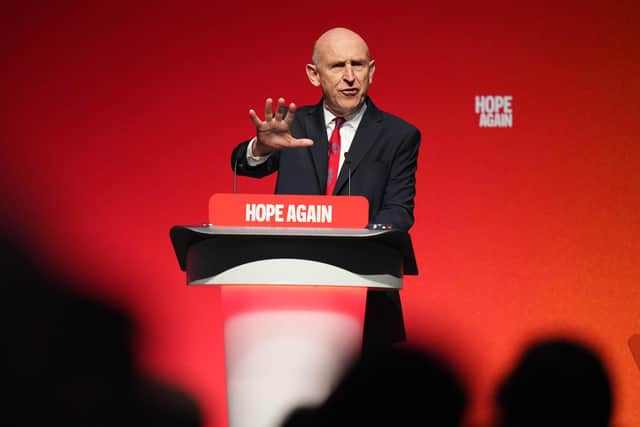
The UK economy reported surprise growth in August on the back of strong factory production, which provided a boost to the Chancellor John Healey ahead of the autumn Budget.

However, it represented a slowdown after stronger activity earlier in the summer.
The Office for National Statistics reported that gross domestic product (GDP) increased by 0.1% in August, following 0.4% growth in July.
The statistics body also said the economy grew by 0.4% in June, revising its previous prediction of 0.3% upwards.
The August reading surpassed the expectations of economists, who had pointed to a 0.1% fall for the month.
Mr Pugh told The Yorkshire Post that resilience “has been the word of the year” with regards to the performance of the UK economy.
"At some point, we're going to have to stop talking about resilience and start talking about it being a pretty good year; we could be talking about 0.7 per cent growth in the third quarter,’’ he added.
"Given that the Bank of England was expecting Q3 (third quarter) growth of 0.1 per cent a couple of months ago that's a pretty solid outcome.
"This is even more surprising given everything that's been going on.’’ he said.
"If we hadn't had the war in Iran would we now be looking at plus two per cent growth? There are good reasons to think that we would be.
"The resilience is probably supported by three strands; one is that there is a psychological component here.
"As a country, we don't seem as responsive to these kinds of geopolitical volatilities as we were previously,’’ he said.
When Russia attacked Ukraine lots of businesses also took on much longer energy contracts and made a conscious effort to ensure they were insulated from geopolitical volatility, Mr Pugh said.
"Perhaps factors like the good weather and England's decent run in the world cup, might have masked these issues over the summer,’’ he added.
"That kind of psychological component is a big factor in this.
"There were falls in consumer confidence, and business sentiment dropped, but both were relatively small compared to previous drops, and they rebounded quickly.
"The second factor is the demand side of AI; that's the build out of AI infrastructure helping firms integrate AI into workflows.
"We're not building huge amounts of data centres but part of the strength of businesses like professional services and manufacturing is related to AI build out because you're seeing demand for all those kinds of ancillary services around it.
"Even though we're not physically building data centres, we are still benefitting from all of that associated increase in demand all over the world.
"The third factor is defence,’’ he said. “This is playing a part in the manufacturing sector, where you're seeing a real ramp up of spending in the US and Germany and other places.
"That's helping to reinforce the manufacturing swing that we've seen.”
However, looking forward, the conditions look much tougher, he added.
"Inflation is going to be probably 4.5 per cent, utility bills could be up 20 per cent, and we will realistically get a couple of rate hikes; that is not a great outlook for consumers,'’ he said.
"Consumer spending is something like 70 per cent of the economy. If consumer spending is not doing well, it will drag the rest of the economy down.
"It's inevitable we're going to see a slowdown in growth during the first quarter of next year. But those other two trends - AI and defence sector growth - will carry on unimpeded.
"We're probably looking at slowing growth, rather than falling into a recession."