
Doncaster Sheffield Airport: Why turnover rent clause negotiations are so vital to reopening project
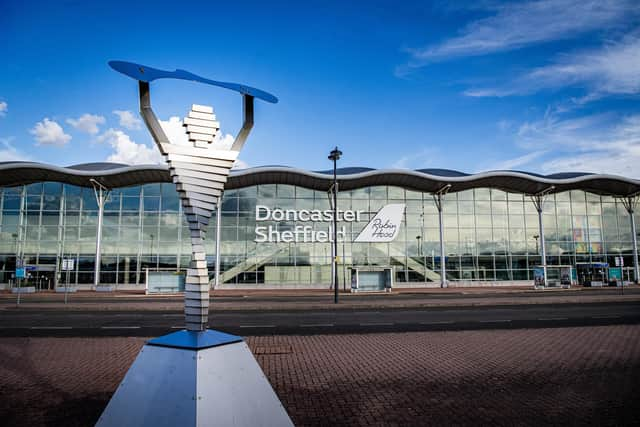
The Doncaster Sheffield Airport reopening project is progressing after Reform councillors backed down from plans to cancel a £57m council loan. But the future of the scheme is still dependent on changing the controversial airport lease with landowner Peel. Chris Burn reports.
Officials behind plans to reopen Doncaster Sheffield Airport were breathing a sigh of relief earlier this week after Reform councillors opted not to go through with a threat to cancel a £57m council loan which would have “killed” the project.
But there is a still a major hurdle to overcome for the scheme, with renegotiations taking place with Peel on changing the lease for the airport land – and in particular securing confirmation that a turnover rent clause entitling Peel to 20 per cent of future airport revenues above annual base rent repayments does not apply to tens of millions in taxpayer funding.
This matters because the business case for releasing £160m of devolution funding – money which is due to repay the £57m loan and associated estimated interest of £39.4m – was built on the assumption that Peel would receive nothing of it from the turnover rent clause.

Even with that assumption, official reports have previously made clear the project is only affordable if it can deliver the most optimistic scenarios for passenger and freight numbers.
Oliver Coppard’s South Yorkshire Mayoral Combined Authority will only release the £160m funding when the lease is changed but have yet to be able to secure agreement from Peel.
As talks with Peel restart, this is where things stand...
Unlocking devolution funding
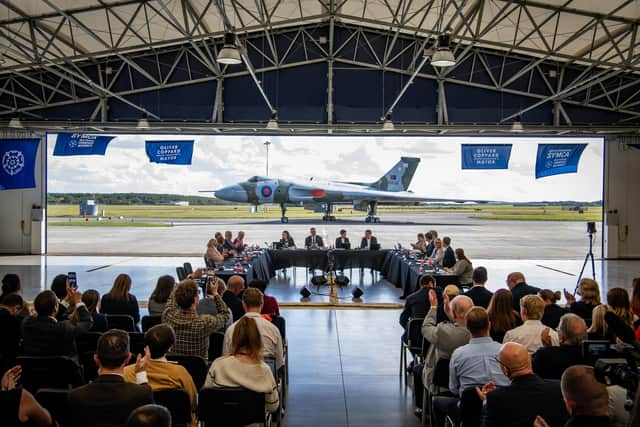
City of Doncaster Council intends to borrow £57m to frontload spending on the reopening project, with the current aim being for passenger flights to restart by Easter 2028. The money, and associated interest costs estimated to be almost £40m, will be repaid out of a £160m devolution funding package controlled by the office of South Yorkshire mayor Oliver Coppard.
Mr Coppard has told Reform councillors: “The money comes from the funds given to South Yorkshire by the government in London. Doncaster may have to take out the loan but it will be repaid by the government, via the Mayoral Combined Authority.”
However, a condition of releasing the £160m is that a series of changes are agreed to the lease which was signed between CDC and Peel back in March 2024.
Several changes have been agreed but there is no current agreement over whether whether millions in taxpayer funding can be excluded from payments to landowner Peel.
The issue of whether a ‘turnover rent’ clause applies to devolution funding due to support the project remains unresolved.
The Yorkshire Post revealed in January that the lease included a clause that 20 per cent of DSA’s annual turnover above annual base rent payments would potentially be paid to Peel - including taxpayer-funded grants from local and national government.
Under the lease, base rent is currently £3.3m a year, rising to £5m in 2029 and becoming subject to inflation increases. In DSA’s last year of operation before Covid under Peel, it recorded turnover of £11.7m – should similar revenue figures be recorded in future years, it would potentially entitle Peel to millions of pounds of the devolution funding. That funding is due to be delivered mainly delivered in annual instalments of around £5.3m a year but a larger lump sum is expected to be released immediately should a deal be concluded.
Under the current lease, the turnover rent clause only applies to sums received by the council and not any third-party operator. However, the lease also prevents the council having any shareholding in the airport operator. At the moment, it has sole ownership of FlyDoncaster – the company due to operate the airport.
Officials have repeatedly attempted to downplay the turnover rent issue since The Yorkshire Post revealed the existence of the clause. But it has now been revealed that a sticking point for lease renegotiations is an attempt to ensure that money from Oliver Coppard’s office is not deemed as turnover and also that the clause does not apply to FlyDoncaster.
A recently-published council paper has admitted the issue has been a “heavily debated point” but claimed discussions are progressing in a “positive and constructive manner”.
The report states: “Schedule 5 of the Lease contains provisions relating to the turnover rent mechanism. The financial modelling assumes no turnover rent would be paid, and this is the basis which fed into the MCA board decision making in September 2025.
“To protect this position the MCA incorporated the following precedent funding condition ‘Turnover rent will not apply to any sub-lease to an operator controlled by CDC and confirmation that MCA funding to CDC will not be deemed as Turnover’.
“As part of developing the sublease to FlyDoncaster this matter has been a heavily debated point, in part to establish the legal interpretation and then to find a workable solution. At the point of report drafting these commercial discussions are progressing in a positive and constructive manner with SYMCA and the landowner.”
Impact on the financial case for DSA
A council report has confirmed that financial modelling for DSA – which was the basis for Mr Coppard’s South Yorkshire Mayoral Combined Authority (SYMCA) backing the conditional release of £160m in September – “assumes no turnover rent would be paid and this is the basis which fed into the MCA board decision making in September 2025.”.
Even with that assumption in place, SYMCA reports in September made the clear the case for providing funding for the reopening was finely balanced and affordable only on the basis of achieving record-breaking passenger numbers.
When the airport was operated by Peel, it was regularly handling around 1.2 million passengers per year.
A SYMCA paper revealed that under high case traffic forecasts annual passenger numbers are expected to surpass 1.4m by 2032, reach two million by 2038 and 2.6m by 2050.
In the base case scenario, numbers are expected to hit 1.26m by 2032, 1.5m by 2038 and two million by 2050.
SYMCA warned the forecasts reveal that the base case scenarios are “unaffordable” within the current funding plan. “The review concludes that in all scenarios where base-case traffic variables are modelled the proposal is unaffordable within the funding envelope,” states the report, which was written by two senior directors from the office of Mayor Oliver Coppard.
“That is, over the appraisal period, available funding does not meet the cumulative net operating costs, capital investment requirement, and associated financing costs.” It adds: “The review notes that this position is exacerbated in the low property income scenarios, reflecting sensitivity to this income stream.
“The review does, however, conclude that in the higher traffic scenarios the project is affordable within the current funding envelope. The review notes that after a period of losses, a net operating profit would be generated that would over the appraisal period be sufficient to fund future capital expenditure and financing costs and repay some – but not all – of the initial public subsidy required.
“Forecasting suggests that in the high-case the business would – in the long run – be cash generative, raising the possibility that private finance could be achieved.
“Accordingly, the high case forecasting represents the target for the project. In this scenario public investment is required to support initial losses and capital investment, but cash generation from operations could enable repayment of some debt directly whilst the stabilised financial position could enable private investment to swap out public debt.”
The report adds that advisors have suggested the high case targets are “achievable” if the airport runs on “best practice” principles.
Doncaster Council had initially suggested the airport reopening could generate £9 of economic benefit for every £1 of public money spent but SYMCA’s own analysis downgraded this to £2 for every £1 spent following “overly-optimistic assumptions” by the council about how quickly commercial flights could be returned and the pace of revenue growth after that point.
But SYMCA’s financial modelling did not include one potentially “significant” future revenue stream from business rates generated by a planned sustainable aviation and advanced manufacturing hub next to a reopened DSA
The wider ‘South Yorkshire Airport City’ development plan includes an ambition for a neighbouring logistics park called Gateway East to be developed into a world-leading home for companies specialising in aviation-related industries and technologies. Uncertainities around what might be generated meant any potential income was not included in the current business plan.
Can agreement be reached?
Mayor of Doncaster Ros Jones said on Monday she is “very hopeful” the turnover rent issue can be resolved and allow devolution funding to be released.
“We are in negotiations. I haven’t got a crystal ball. I believe it could because they [Peel] realise that this is the right thing for them as a business and the right thing to grow. The airport is a catalyst because [neighbouring development site] Gateway East will grow and grow and grow. They will benefit wholeheartedly.
“I’m very hopeful we are going to be able to get through and get a lease that is satisfactory for us all.”
When asked whether she could give a timeline for when the matter can be resolved, she said: “We’ve just delayed it two months waiting for this meeting to take place. We’ll have to see what the timeline is.
“One month is crucial, two months is a long time. We need to get it done, dusted and over the line so we can plough on and get airborne.”
South Yorkshire mayor Oliver Coppard also refused to put a timeline on when negotiations may be completed when asked by The Yorkshire Post.
He said: “We are doing this as quickly as we can. This is a long-term project and we will protect taxpayers’ money.”
Mr Coppard said the latest negotiations are a continuation of a “twin track” approach involving renegotiating the lease while pushing with the reopening process.
He said Reform’s threat to cancel the loan had been “unhelpful”.
Mr Coppard added: “I’m pleased that the outcome is we are able to move forward with the project. After weeks of disruption and questions, we are essentially back where we started. We have been working to reopen the airport for three-and-a-half years since Peel launched their review and this process is complex, difficult and challenging but I have always said the benefits outweigh the risks.”
In February, council chief executive Damian Allen said of the turnover rent issue: “What we want to do is avoid any consequences of that in terms of any subsidy that comes in.
“If you are SYMCA, you are going to be very concerned about that because any grants that come through, you don’t want them being subject to turnover. The reality is the practicalities of that turnover rent clause aren’t going to happen.
“We’ve got to be in a position where we could be earning money off it first to get the uplift. Also if you are an operator, which is why we’ve gone down the wholly-owned commercial company route, you insulate yourself from the direct cost because it is a third party incurring those costs, not the council.”
Peel has been keeping its cards close to its chest in regards to the lease renegotiation. A spokesperson said on Friday: “We continue to work closely with the City of Doncaster Council and the South Yorkshire Mayoral Combined Authority to deliver the significant economic opportunity of the wider Gateway East initiative and to realise the benefits for both Doncaster and South Yorkshire more widely.”
Following the £57m loan issued being resolved on Monday, a Peel spokesperson said: “We remain focussed and committed to driving economic growth in Doncaster for the long term.”
What happens if talks fail
Should negotiations fail and mean devolution funding is not released, there would be major consequences for both the project and Doncaster Council’s finances.
CDC has already warned the cancelling the project at this stage – as Reform had effectively threatened to do – would have left the authority facing costs of £48.6m due to already-committed spending.
The £57m loan facility is not due to be drawn by the council until March 2027, with an initial £15.9m of borrowing earmarked for the first year. The council had warned that without the loan – which is due to be repaid by the yet-to-be-guaranteed devolution funding – the reopening programme “would be unable to continue beyond the immediate period unless alternative funding could be identified at pace”.
The council report said devolution funding could not be used to cover closure costs under the current approval terms. It acknowledged that allowing the loan to progress – as happened – would see the council “continue to be exposed to the financial, delivery and operational risks associated with the programme”.
Conservative councillor Nick Allen warned on Monday that the council is “up a gum tree” over the project as it is unable to afford to cancel it but is likely to require further spending beyond the currently-projected £193m overall cost should progress continue.
A recent report by the council’s auditor Grant Thornton gave a ‘red’ rating – signalling concerns about ‘significant weaknesses in arrangements’ – in regards to both the governance arrangements for FlyDoncaster and the broader financial case for the airport reopening project.