
How AI can help cut waste in the fashion industry: Laura Fish
I love the fashion industry, its creativity, innovation and constant invention. I’ll be looking at the garments being modelled at next month’s fashion weeks in London, New York and Milan with a forensic eye. I’ll be studying the design and construction, choice and drape of fabric, shape and fit. It’s fascinating stuff when you know that every piece, from high fashion to High Street, goes through a rigorous process of product development to achieve the final cut.
But here’s the uncomfortable truth: for most fashion businesses, the traditional development process creates a colossal amount of waste. Each adjustment often means another physical sample, another shipment, another round of revisions, sometimes across multiple teams and time zones. The pile of waste samples tossed aside is huge. The journey from concept to finished garment is expensive, slow, and increasingly hard to justify in a world where we’re all being asked to reduce our carbon footprint.
This, as an educator in the use of 3D digital design software, I find incredibly frustrating. We have the digital AI technology to manage early workflows in design in a much more sustainable and cost-effective way which has been proven to reduce waste - material, water, energy - by up to 90 per cent.
McKinsey and Company reported years ago that generative AI has the potential to help fashion businesses become more productive, get to market faster and serve customers better. But, whilst some well-known brands have adopted digital 3D tools in their workflows, -Tommy Hilfiger, Hugo Boss, Nike, Adidas, Burberry and H&M - across the industry, it still isn’t standard practice. A stubborn resistance to changing the established analogue ‘ways we’ve always done things’; an aversion to digital tech, and a huge skills gap in the industry is holding it back from embracing the potential of some excellent software.
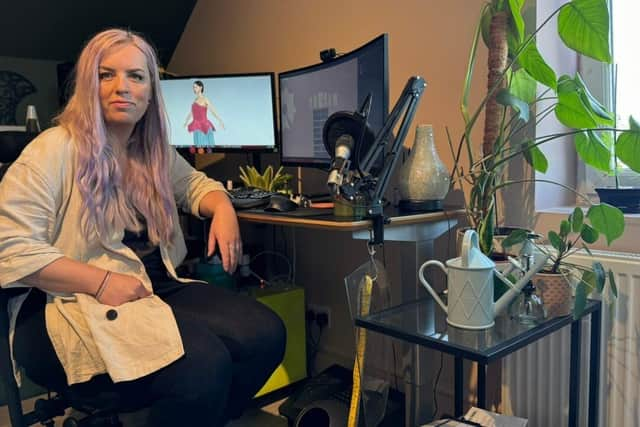

Often, it’s the smaller more agile creators who are pioneering the progress. I recently worked with Harrogate-based designer and artist Rosie Madison on a collection for her sustainable, size inclusive label Dorothy and Rose. We used CLO3D photorealistic 3D modelling on screen to perfect all her designs. I’ve also worked with several forward-thinking companies and universities to help their teams and students gain confidence in the use of fashion design software. Although, I think it’s important not to treat digital fashion training as ‘software’ training alone.
New recruits to the industry need to know why seam allowance, grading logic and fabric behaviour matter as well as knowing how to use the program. They need to understand their role in the complex handover chain every garment is passed through. Digital is a wonderful tool, but the skill and creativity still lies in the whole
process.
Digital doesn’t replace the touch and feel of fabric either of course – we still need to cherish that. But it cuts out so much waste in perfecting the technical pattern, and in the end, it delivers the garment in all its beautiful tactile glory. It’s time for the global fashion industry to move forwards more boldly with 3D digital technology. To learn the skills and make the shift change. The sewing machine as a ‘tool’ disrupted the industry in a much more colossal way in the 1850s, and look at the impact of that on innovation, sheer joy and market growth.
Laura Fish, founder of Fashion Toolbox, based in Barnsley