
Keir Starmer says cross-party backing for climate change action has 'broken down'
Keir Starmer says he hopes delivering a transition to renewable energy can be part of his political legacy as he pledged that the Government remains committed to addressing climate change – but admitted that cross-party consensus on the issue “has broken down”.
The Prime Minister was interviewed at Chequers by National Trust director-general Hilary McGrady with their conversation published in the new edition of the National Trust Magazine with the issue of climate change policies one of the wide-ranging areas they covered.
The 2008 Climate Change Act originally legislated for an 80 per cent reduction in carbon emissions by 2050 but under Theresa May’s Conservative Government it was strengthened to a ‘net zero’ target of a 100 per cent reduction.
That target remains the Labour Government’s ambition but under Kemi Badenoch, the Conservatives have recently said they intend to scrap the Climate Change Act while Reform are also opposed to net zero targets. US president Donald Trump has also repeatedly criticised the UK’s net zero policies.
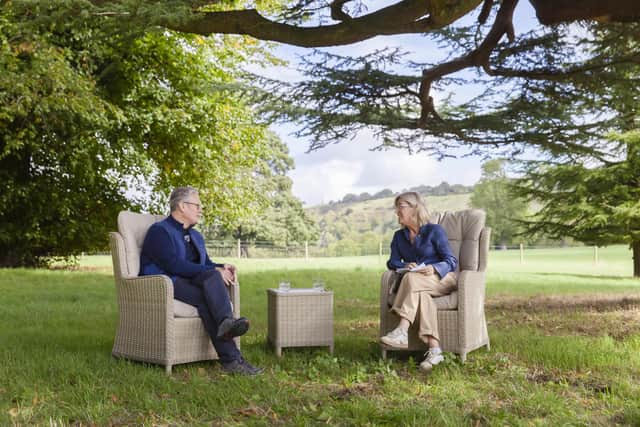

Ms McGrady asked whether Sir Keir remained committed to previously-announced intentions on addressing climate change, which include ambitions to make the UK a ‘clean energy superpower’, given the “strong forces pushing back at the moment”.
Sir Keir said: “We will stay committed to it.
"It’s really important for the planet, for the next generation. It is also, when you look at things like clean power and renewables, a massive opportunity for the next generation of jobs, for energy independence.
"Look at what Putin has done, putting his boot on our throat, which has sent energy prices through the roof.
"We can get off that if we go to renewable energy. I have to say, the environment is more challenging because the global leadership is still needed. And I do think that is sad. "The best way of getting chnage quickly and a long-term commitment is cross-party support. That has broken down and that makes it more difficult.”
Sir Keir said that in addition to the creation of new forests in national parks and Areas of Outstanding Natural Beauty, he hopes his political legacy on nature will be the role played in the renewable energy transition.
"Pushing forward to the next generation of renewable energy and ensuring that we get our energy from the sun, from the wind, from the tides, is an incredible ambition of this government. It will be enduring, it will be transformational, it will give us energy independence and lower prices, but also – what a fantastic thing, to turn the wind, the sun and tides into energy.”
Sir Keir was also asked about the Government’s decision to overhaul planning rules, which it has positioned as ‘builders versus blockers’. The Government said in early 2025: “The new common-sense approach doesn’t allow newts or bats to be more important than the homes hardworking people need, or the roads and hospitals this country needs.”
Ms McGrady told the Prime Minister: “That rhetoric has been deeply unhelpful in terms of pitting nature against growth – which sets nature up to be the problem.
"I would challenge, nature surely has to be part of our growth, because people need nature to thrive as well as be part of the economic revival we’re all looking for.”
Sir Keir replied: “I think we can have both. I think we do need growth. One of the great challenges of our time is having enough houses for young people to be able to have a home of their own.
"Homes are communities and we don’t have enough and we musn’t underestimate how important that is.
"Of course we want to preserve nature and the beauty of this country. We need to get the balance right between the two.
"But when projects are held up for a very long time because planning and regulation simply take so long, then we run into a problem.
"For example, to get more quickly to renewable energy, which is very important, or with water infrastructure, by which I mean the terrible damage that’s been done through the neglect of our water system over many years. We need to get the balance right but the current system is too slow and cumbersome. It does not mean that we simply rip it down or that we don’t have proper checks and balances. But I think we can have both of them together.”
Read the full interview in the National Trust Magazine Spring 2026 edition, which is out now.