
Making the cases for either CHAOS or CALM in the markets in 2026: Richard Hunter
Last year we asked, in our annual acronym, if the future would be DIGITAL. We noted the factors of the Dollar, Inflation, Growth, Interest rates, Tariff, Trump and trade wars, AI and Large caps versus small caps as potentially being the year’s main drivers.
And, indeed, most of those factors had a large part to play. This was achieved despite increasing Liberation Day, AI valuation and investment fears, and central banks’ relative inertia on interest rates.
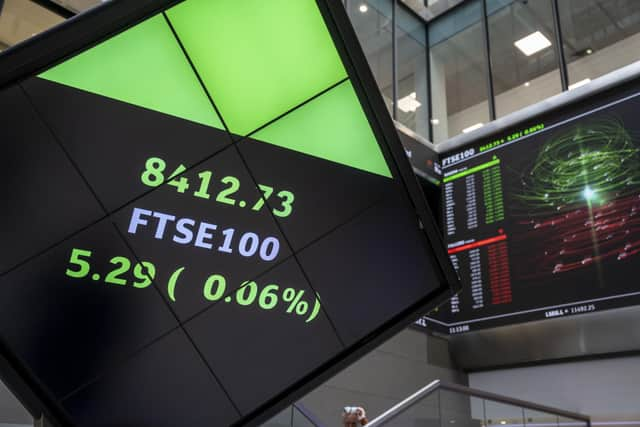
By the start of December, the Dow Jones Industrial Average in the US has risen by 11.2 per cent in the year to date, the S&P500 by 15.8 per cent and the Nasdaq by 20.5 per cent, with each having tested record highs on many occasions during the year. Similarly, in the UK the FTSE100 broke through the record high ceiling several times and has added 18.9 per cent.
This year we ask - will 2026 bring CHAOS (Concentration risk, Hard Landing, Asian uncertainty, Overvaluation and Shift in investment behaviour) to the markets or could there actually be some CALM (Currency weakness, AI-powered innovation, Lower interest rates and Magnificent Seven growth continuing)?

Concentration risk is something which has lingered in the minds of investors and recently showed itself when AI investment began to be questioned.
It is currently estimated that the “Magnificent Seven” stocks account for 35 per cent of the entire market capitalisation of the S&P500, compared to around 12 per cent in 2015. As such, a downward rerating of the mega cap tech sector would have a damaging effect on the market as a whole.
In terms of a Hard landing, the barbs directed at the Federal Reserve Chair by the President relate to whether the central bank has been too slow in lowering interest rates.
The labour market is weakening, consumer confidence is low and there is an increasing level of debt which could overburden individuals and the government alike. While the situation appears under control for the moment, any lurch towards recession would inevitably cast a long shadow over the market’s ability to grow.
In regards to Asian uncertainty, the relationship between the US and China, the world’s two largest economies, is fractious at best. In addition, and of late, geopolitical relations between China and Japan have worsened following a growing dispute over Taiwan.
When it comes to Overvaluation, for some, the speculative phase in the US market has peaked, meaning that attention naturally turns to the level of profit growth against ever-increasing expectations.
The S&P500 currently trades at around 30 times earnings, almost double its historic average. The cyclically adjusted PE, or CAPE ratio, which uses a 10-year, inflation-adjusted average to smooth out peaks and troughs, is even higher at 39 times.
Of themselves, these ratios do not signal an inevitable correction to come, although such odds are increasing. That arguably the world’s greatest and soon to retire investor Warren Buffett had been trimming some of his holdings and sitting on an uninvested cash pile of more than $340 billion also raised eyebrows throughout the year.
On a possible Shift in investment behaviour, should the landscape change for the worse, markets could see momentum in reverse, with the herd mentality kicking in as investors rush for the exit at the same time.
Now it is the turn to assess the more positive potential of CALM (Currency weakness, AI-powered innovation, Lower interest rates and Magnificent Seven growth continuing).
Currency weakness
Of itself, currency weakness is, of course, not a positive although perversely it can act to the benefit of the FTSE100 as has been seen in more recent times.
This is due to the fact that around 70 per cent of earnings are derived from overseas, and much of that from the US. A weaker sterling should, in theory, benefit dollar-earnings companies whose profits become more valuable on repatriation.
In addition, at undemanding valuation levels (the FTSE100 trades on around 14 times earnings compared to the S&P500’s 30 times), the raft of strong, stable companies with relatively high dividend yields could yet be further recognised.
AI-powered innovation – and payback?
In much the same way that investors have fretted around the hundreds of billions of dollars which have been invested in AI to date and over what time period they may be repaid (if at all), any early signs of payback for this financial faith would be extremely well-received.
Although the general term AI is used in everyday language, there are already applications which are less well-publicised, but which are revolutionary.
These can range from detecting cancer or heart disease through reading medical scans and genetic sequences at a level of speed and accuracy previously unknown, to removing language barriers – an eternal human divide – by instant translation based on deep knowledge of various tongues.
Lower interest rates
Even if central banks in the US and UK have been too cautious in easing monetary policy given lingering inflation, the tide seems to be turning, not least of which is due to labour markets which are beginning to suffer on both sides of the pond.
Whereas higher interest rates make it more difficult to justify higher valuations, since they reduce the present value of future profits, they may also limit smaller companies’ propensity to borrow and thus grow their businesses.
Magnificent Seven growth continues
On the flipside of overvaluation concerns is the possibility that the major drivers of growth over recent years continue to deliver, even against the elevated levels of expectation which have now become the norm.
It is estimated that big tech earnings’ expectations rose by 12 per cent this year, compared to a 6 per cent decline for the rest of the market. ‘Magnificent Seven’” annual earnings growth of 15 per cent is now expected for the next two years and of 10 per cent for the rest. If this compelling growth continues to be delivered, prices will be marked up accordingly, notwithstanding the occasional shock or disappointment.
Richard Hunter is head of markets for interactive investor