
Meet the founder of Lincoln & York - the 'secret' force behind your favourite high street coffee
There’s often a ‘what have I done?’ moment for entrepreneurs when they begin a new venture. For James Sweeting, it was in February 1994 in Princes Quay Shopping Centre in Hull.

He had just started his coffee manufacturing business with co-founder Simon Herring – well before the early 2000s UK coffee boom which saw the likes of Costa Coffee and Starbucks kickstart a national espresso obsession - and they needed customers.
"I was trying to sell coffee to cafe owners and they were all telling me to get stuffed,” he remembers. “One particular guy said ‘look mate, just go away will you’, but less politely.”
“I remember thinking what have I done? I’ve left a good job in London that was well paid, where I was taken out for lunch most weeks, and now I’m in Hull trying to sell coffee to someone who doesn’t want it.”
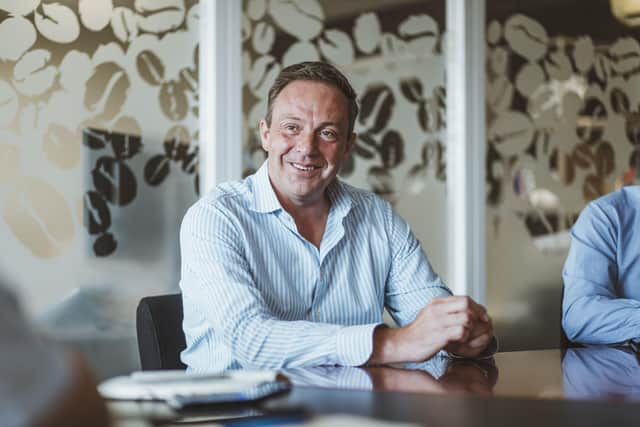

Coffee buyer Sweeting and coffee trader Herring first met on a course in 1989. Herring later supplied Sweeting with green (raw) coffee when he worked at Lyons Tetley, part of the Allied Lyons Group.
When Herring moved to Lincolnshire in the early nineties to start up his own coffee roasting business, they kept in touch and 18 months later, when Sweeting moved back to his family farm in East Yorkshire, they joined forces at the fledgling business.
Fast forward 30 years and Lincoln & York – named after the counties they both lived in – is approaching £50m turnover and employs 90 people at its factory in Brigg, North Lincolnshire.
The private label coffee roasting business makes products for retailers, coffee shops, restaurants, bars and hotels in the UK and abroad, buying its coffee via traders from predominantly South America, Central America, East Africa and Asia.
Its customers are a closely-guarded secret. “If you look down a typical high street at the places that sell coffee, we sell to a high proportion of them,” Sweeting says. “They all know that we supply other firms but we don’t talk about it.”
Historically, Sweeting travelled a lot to meet coffee growers but these days he leaves the majority of travelling to his buying team. “Every month there’s somebody on a plane somewhere,” he says.
While the countries he buys coffee from have remained the same over the last 30 years, it’s the interest from consumers that has changed.
"There was always traceability but there was never the demand to show it to customers,” says Sweeting.
"Thirty years ago people were only really interested in which country it came from, the strength of the coffee and whether it would go into their filter machine or cafetiere.
"Now they want to know what hillside it’s grown on, who the farmer is, how much they get paid and the whole supply chain in between.
"You've also sadly got a lot of bureacracy with that now which just adds cost for very little benefit.”
Lincoln & York buys about 8,000 tonnes of coffee beans a year, almost twice as much as a decade ago. Over the last 30 years the business has ridden the wave as coffee culture exploded in the UK.
"When I started, Costa was still a family business with 17 shops, Starbucks wasn’t in the UK and Cafe Nero didn’t exist,” says Sweeting.
The UK retail coffee market is now worth £1.3bn, growing by 3.9 per cent year on year, according to Nielsen figures, driven by price inflation of 3.8 per cent.
Lincoln & York took a hit when the hospitality industry was forced to shut down during the pandemic and there has been a very gradual reversion to normal, according to Sweeting.
However, he says consumption is now above where it was pre-covid and the company is back on an upward trajectory.
“People now realise that working at home is actually a pretty rubbish idea if you want a life and there are more people going back to the office than there were even six months ago,” says Sweeting. “To be honest, I think it won’t be long before it’s probably where it was pre-covid in that sense.”
One of the things that makes Lincoln & York stand out from its competitors is that it’s a well-invested business that can operate at scale.
"There are hundreds of coffee roasters now in the UK but most of them are very small,” says Sweeting. “We have a national and international footprint so as long as the market is growing and the bigger chains are confident of expansion then we can target that business and try and work with them.”
Sweeting dismisses the notion that consumers’ coffee buying habits have changed as prices escalated during the cost of living crisis.
“For sure people have felt the pinch during the period of high inflation but coffee is a habit that people don’t change very easily.
“Coffee prices have gone up over the years but it’s still one of the cheapest experiences you can have,” he says.
He adds: “The cost of living crisis is a bit overdone in many ways. I’m not minimising it but you’ve got to look at the data to understand where the money is.
"Some people have been huge beneficiaries from the rise in interest rates but if you listen to the media, they tell you it’s all a disaster.”
The key to Lincoln & York’s success, according to Sweeting, is its single minded goal to reach the top of its industry. “We wanted to have a big business and make money,” he says.
Looking ahead to the next 30 years, Sweeting believes coffee will continue to play a prominent role in people’s lives and there will be more interaction between consumers and coffee growers. “At the moment you can find out about the grower but it’s a static display of information. In the future they’ll be able to see, live on the pack, the grower in Columbia talking to them,” he says. “The whole supply chain will look very short from beginning to end.”