
'My battle with a system that feels like it’s making things harder’
Karen Hargrave’s husband James was a civil servant who had been living a healthy, active life until the pandemic struck in 2020. Today, he cannot hold Karen’s hand or engage in conversation. James contracted Covid for a second time in 2022, when he was in his mid 30s, which later developed into long Covid.

Ms Hargave recalled: “As part of that he developed very severe ME, a condition that is often not well understood. He has extremely limited energy; tasks like swallowing or moving slightly in bed can involve too much energy for him to manage. He deteriorated very quickly and one year later, he was totally bed-bound. He was unable to speak or chew, and he had difficulty swallowing. He was on a liquid diet and needed full time care.
“I’ve been going through a long process to gain funding for the care that James needs. He needs 24/7 support. It was a lot more than I could handle on my own,’’ she said.
“We owned a flat but we couldn’t live in it because it wasn’t accessible for James, so this was treated as an asset and meant James didn’t meet the financial criteria for social care funding. We came across CHC support which seemed to be exactly what we needed.
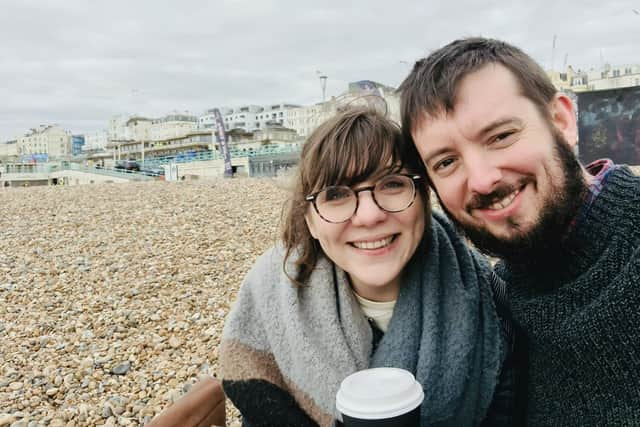

“We had a full assessment in April 2025 and it’s been a nightmare since then. The assessment concluded that James was eligible for CHC. It was carried out by a nurse and a social worker who was already familiar with our case. However, the process at the local Integrated Care Board (Surrey Heartlands) resulted in him not receiving the funding despite the assessment finding him eligible. That blew my mind.
“I was astounded. The board has now also rejected our appeal. We’ve never really been told what was wrong with the conclusion of the initial assessment. I think another layer of difficulty for us is that James suffers from ME which isn’t well understood by the NHS; there can be some quite dismissive attitudes.
“One of the biggest challenges was financial; we sold our flat to help cover care costs and we’re now in a position where the local authority has stepped in a year after the assessment.
“In the last month we have received a care package from the local authority (Surrey County Council) to help meet James’s needs.
“We just want someone to explain to us what was wrong with the initial assessment. I’m now a full time carer to my husband at the age of 36 and dealing with the fact that, because of his debilitating symptoms, he is too sick for me to hold his hand, give him a hug or have a conversation with him. I can’t lead a normal life with my husband. There’s a grief that comes with watching him suffer every single day.
Ms Hargrave added: “The last few years have been a nightmare, and on top of that, you’re having to fight this battle with a system that feels like it’s actively making things harder.”
A spokesperson for NHS Surrey and Sussex Integrated Care Board said: “We are very sorry that Karen and James found their NHS Continuing Healthcare process confusing.
“NHS Continuing Healthcare assessments follow a nationally prescribed process to determine whether an individual has a primary health need and is therefore eligible for NHS-funded Continuing Healthcare.
“We understand that James has a range of needs but following completion of the full assessment process in this case, it was determined that James did not meet the national eligibility criteria for NHS Continuing Healthcare because they were not assessed as having a primary health need. In some cases, an initial position may be shared with a family, however this would always be subject to review once all relevant information has been gathered and a multidisciplinary assessment takes place.
“In James’s case, his assessment identified that his needs were more appropriately met through social care support, and we understand that the local council is providing a package of care to meet his needs.
“We understand that decisions about ongoing care and support can be difficult for individuals and their families. We are committed to ensuring that assessments are carried out fairly, consistently and in line with the national NHS Continuing Healthcare Framework.”