
Schoolchildren to be inspired to become fusion scientists of future as £20bn plant planned in region
A University of Sheffield-led programme to inspire schoolchildren to consider careers in fusion energy ahead of the region becoming home to a £20bn plant is being launched today.
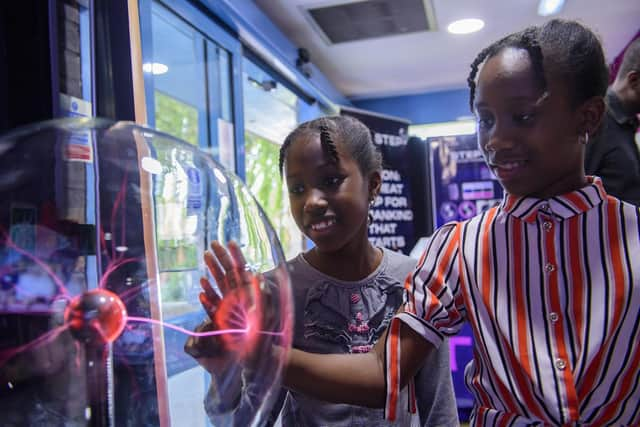
The programme, ‘STEP Forward’, has been developed by the University of Sheffield’s Maker {Futures} team to enable and support primary school teachers to deliver sessions across a range of topics which underpin the cutting-edge science and engineering required to develop the UK’s infrastructure for fusion energy.
Fusion has been described as the ‘holy grail of energy’ and there are plans in place for the world's first commercial fusion power plant at the site of a former coal power station at West Burton, in Bassetlaw, Nottinghamshire, on the borders of Yorkshire and Lincolnshire.
The new prototype plant, known as STEP (Spherical Tokamak for Energy Production), was chosen by the government in 2022 as the location for the project and earlier this year £2.5bn of Government support was announced.

An associated Fusion Technology Facility at Rotherham’s Advanced Manufacturing Park is already in operation.
It is hoped West Burton will demonstrate how fusion energy can produce eco-friendly electricity in a process where two forms of hydrogen are heated together at 150 million degrees centigrade – 10 times hotter than the sun – to create helium and release large amounts of energy.
The plant is anticipated to generate 8,500 high skilled careers across the supply chain and reinforce the UK’s place as a global leader within the sector. The generation of primary school children inspired by STEP Forward today will be entering the workforce as STEP Fusion comes online in 2040.
Dr Alison Buxton, STEP Forward project lead and Senior Innovation Fellow at the University of Sheffield, said: “We are bringing together engineers at the cutting edge of sustainable energy production, with children and young people across the region to educate, enthuse and inspire the future generations that will power our nation.
“Following the launch, the programme toolkit will be made available to all schools in the UK in the new year, helping to build a long-term skills pipeline to provide opportunities for our young people for the careers of the future. By engaging children and young people today, the project aims to cultivate the workforce of tomorrow, full of creative thinkers, innovators, and problem-solvers who can play a key role in the UK’s clean energy transition.”
STEP Forward will initially be trialled in 21 primary schools across the Bassetlaw region of north Nottinghamshire and made available to primary schools across the UK from February 2026. It is supported by Bassetlaw District Council, UK Atomic Energy Authority (UKAEA), UK Industrial Fusion Solutions (UKIFS) and is funded by the Royal Academy of Engineers Ingenious Scheme.
Caroline Wood, Interim Head of Skills at UKAEA, said: “Getting fusion into the classroom is crucial if we are to encourage more young people to consider working in the sector in the future. This starts at primary schools, where children can be inspired by clean energy technology and concepts. But primary school teachers also need support to deliver sessions, and we are very grateful to the University of Sheffield for working with UKAEA and UK Industrial Fusion Solutions Ltd (UKIFS) to develop STEP Forward, and to the Royal Academy of Engineering for its support.”
Debbie Kempton, STEP Director of Engineering Programme at UKIFS, said: “With this region set to become a globally significant hub for fusion and for clean energy technology in the future, today’s primary school children will be the next generation of engineers, scientists, project managers, and technicians at STEP Fusion. Now is a really exciting time to get involved in science and engineering as these technologies will change the world, right here on your doorstep.”