
'Second life doesn't mean second best' - Step into new world of the office
If you’re one of the world’s leading real estate companies and now occupy one of the UK’s most sustainable offices you’d better make sure you practice what you preach, right?
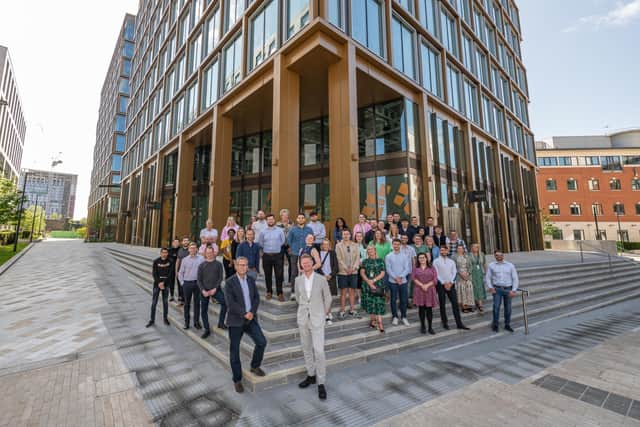
When JLL downsized from a 12,500sq ft office to a 10,000sq ft one at 12 Wellington Place, Leeds, uppermost in mind was an energy-led, circular, healthy and inclusive design.
JLL has seen a 64 per cent reduction in energy use compared to its previous office and the project is on track for BREEAM Excellent and WELL Platinum ratings as well as being one of the first UK offices to pursue a NABERS tenant rating.
Reuse and refurbishment has been prioritised so that more than eighty percent of the furniture was reused or refurbished. Durat worktops are made from recyclable post-industrial plastic waste and the reception desk is reconstituted offcuts from the Italian shoe industry.

“Second life doesn't mean second best though,” JLL UK workplace sustainability lead Stuart Cochrane says. “Our circular economy approach costs the company less rather than more but you also end up getting better quality products, so if a chair is £450 brand new you’ll get something that is ok. In the reused market, £450 gets you a refurbished Herman Miller Aeron so you aren’t comparing like for like.
“One of the untold stories is actually that you can end up giving a better experience to office employees by adopting the circular approach. Materials are the story that people love, that waste to wonder.”
The fit out was delivered largely by an in-house JLL team which helped in identifying reusable furniture from its other UK offices. In energy usage, the new office is running at 45 kilowatt-hours compared to the market ‘good’ of between 90 and 110 kW hours.
Cochrane says: “Most office fit outs don’t design with energy efficiency in mind. We reduced the number of cellular spaces (rooms) that we built so we minimised the amount of mechanical equipment to service the whole floor. That builds energy efficiency.
“It’s the same with lighting. But we have also taken a philosophical decision in our wellbeing design to give employees the main access to natural light so all the workstations are adjacent to the facades so they get human uplift of being connected to the outdoor world.
“For me, offices are an expression of who we are and what we do as a business. We talk about sustainability being embedded in every aspect of our business, if we aren’t delivering on our corporate real estate it is a massive point of vulnerability. When our global head of ESG goes around the various territories of the world, the first question he gets asked by clients is ‘what is JLL doing?”
Tom McWilliams, head of JLL’s Leeds office, says that while the office has sustainability at its core, colleague collaboration was also a crucial consideration. “We wanted to be on one floor with one point of entry and exit and while people are coming back to the office, they need space and not just a desk.
“In our old office we had five meeting rooms and two small booths so individuals would take a call or Teams meeting in a big meeting room, which is crazy. We now have eight different pods for people to sit in and quieter areas for them to go on a call. The space is working far harder and we wanted to do more in-person events so we have the flexibility to configure spaces to do whatever we see fit. That’s the triumph of it for me.”
There are about a hundred people contracted to JLL’s Leeds office which has 60 desks. On top of that, there’s another hundred places where people can sit while the region trials full hotdesking. As it stands, attendance is well up on the previous office.
Users have been placed at the heart of this democratised space to encourage organic interaction, but also provide areas for privacy and focus.
Other features include space for expectant mums or new mums who are expressing milk and a fridge. If people are unwell, they have a space they can go to away from the wider office. There’s a library space created to support neurodiverse users looking to escape distractions.
Alex Stork, Leeds-based business development manager at fit out specialist Overbury and Northern Chapter chair at the British Council for Offices (BCO), says that while the office market has seen a ‘flight to quality’ and amenity rich environments, the biggest trend is to support business culture and community.
“Ultimately, the workplaces that win hearts and minds are those that understand behaviour and create the very best experience. We’re seeing leaps forward in acoustic comfort and biophilic design, to support air quality and well-being. Destination services such as contemplation/multifaith rooms, yoga studios, rooftop gardens and gyms are becoming much more commonplace; particularly for multi-tenanted buildings. There’s also a number of workplaces that provide a range of social spaces, support good nutrition and access to subsidised catering provision. The best offices are those that provide a range of environments on any given day, that supports not only their personality but the tasks they’re working on. From a BCO perspective we are making it a priority to recognise workplaces that support flexibility, connectivity, circular economy, wellbeing and inclusion.”
Real estate investor Kinrise specialises in restoring older buildings. Occupants vary from freelancers on a flexible day’s use to global companies. Its average let is 8.5 years. It has completed projects at Trevelyan Square and 34 Boar Lane, Leeds.
Managing partner Samuel Lawson Johnston says that the satisfaction of seeing an old asset brought back to life is incredibly powerful.
“The key to good fit out is to do as little as possible. If you have a building of character and you let it breathe, you really work with its fabric and end up with something that's much more authentic, much more interesting, and is set apart from other fit outs in the market.
“The big danger with office fit out is you end up looking like ten other buildings in the city because you're using the same furniture, sourcing and contractors.”
This article originally appeared in The Yorkshire Post’s sister publication Insider Yorkshire