
Sir Hugh Sykes obituary: The former Master Cutler who helped revitalise Sheffield
Sir Hugh Sykes, who has died at 93, was an industrialist and investor who played a key role in Sheffield’s regeneration after the collapse of its steel industry.

A former Master Cutler, chairman of Sheffield Development Corporation and founding chairman of Sheffield Galleries and Museums Trust, he also supported the restoration of Henry VII’s Lady Chapel in Westminster Abbey, where a stained glass window is installed in his honour.
He was appointed to the development authority, a government-formed body responsible for regenerating the Lower Don Valley, after the running down of the steel industry precipitated a steep decline in its fortunes.
The corporation attracted £683m of private investment to bolster the £108m of public money, and the investment stimulated the building of thousands of square feet of office space and a road connecting the M1 at junction 34 to Sheffield city centre.
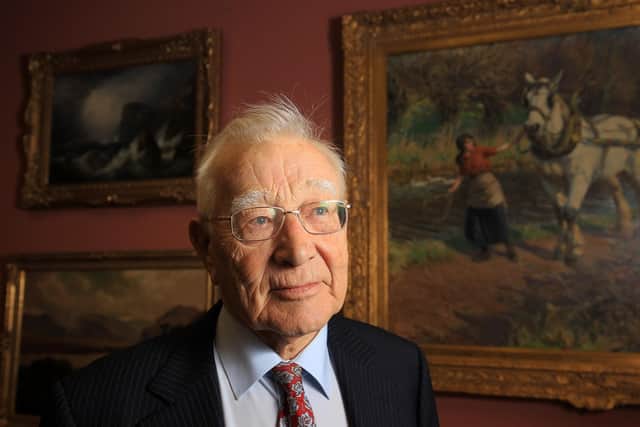

Sir Hugh ran the corporation from 1988 until it was abolished in 1997.
In the early 2000s he led the urban regeneration company Sheffield One, which ran the Heart of the City project that created the Winter Garden, Peace Gardens and Millennium Gallery, where the Sykes Gallery is named after him.
His time as Master Cutler, the figurehead of the ancient manufacturers’ guild based at the Cutlers Hall in the city centre, was followed by a non-executive directorship at Yorkshire Bank, and, later, the chairmanship of its owner NAG Europe. He went on to hold more than 40 directorships.
Hugh Ridley Sykes was not a native Yorkshireman but had family connections to the county. His grandfather had been a vicar in the Sheffield parish of Hillsborough and religion remained a powerful force in Hugh’s life.
His father, William Sykes, was a parson and principal of a theological college in Bristol, where Hugh was born, with his twin brother, Richard. Their younger brother Stephen, who died in 2014, became Bishop of Ely. Their mother Phyllis (née Dodgson) was a devout follower of the Lord’s Day Observance Society.
Money became tight for the family when William took early retirement after the Second World War, and Hugh recalled the disappearance of the family car, the nanny, the big house and the expected place at public school.
“We felt humiliated and inferior,” he wrote in a 2017 memoir. “Probably that sense of inferiority made me even more determined to succeed.”
With a fee-paying school no longer an option, Hugh went to Bristol Grammar with Richard. After National Service he studied law at Cambridge and became an articled accountant.
He re-established the family connection to Sheffield after setting up his own company in 1977.
Carbolite, later renamed Thermal Scientific, supplied high-temperature furnaces to the steel industry, and when it was sold in 1988, four years after being floated on the stock market, the £72m proceeds helped to bankroll the public work which would dominate Hugh’s life from that point.
He would admit that regenerating Sheffield was a greater challenge than running a company.
“One of the mistakes of the past has been to think that solving regional inequalities is just about money,” he wrote in 2021, arguing that locally representative bodies had to work more closely with ministers in Whitehall.
Not all the projects he supported were successful.
Sheffield City Airport, just off the M1, could not compete with facilities in Manchester or Leeds and lasted only a single decade.
But there was no doubting Sir Hugh’s impact on the region and in 1997 he was rewarded with a knighthood for his contributions to charity and the post-industrial revival.
His coat of arms and motto, Instanter Operare (Determined to Work) is inscribed in the west window of the Lady Chapel at Westminster, to whose restoration in 1995 he was a major donor.
His first marriage, in 1957, was to Rosemary Dougan. They had two sons.
The marriage ended in 1976 and two years later he married Ruby Anderson, who had been his personal assistant, and with whom he had two more sons.
Together they set up the Hugh and Ruby Sykes Charitable Trust. She and his sons survive him.