
'Accident waiting to happen' - Chemicals firm fined £400,000 after 'near miss' at Yorkshire base

A global chemicals company has been fined £400,000 after a worker ‘narrowly’ escaped serious injury at its Yorkshire base.
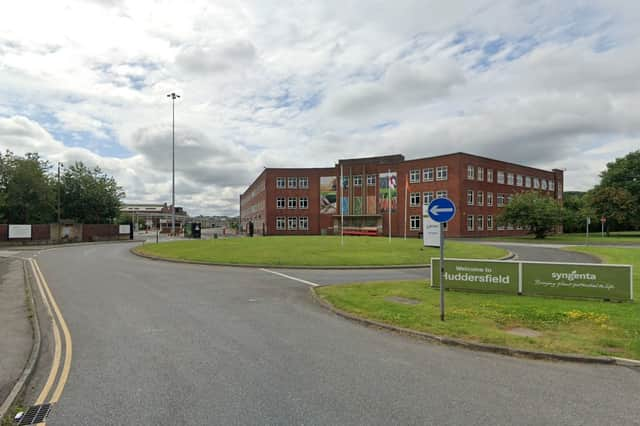
Sygenta was given the fine after the 59-year-old contractor was carrying out unsafe maintenance work at its site in Huddersfield, the Health and Safety Executive (HSE) said.
The man was working a mechanical fitter in November 2023 when high-pressured steam was released during his work - but he fortunately narrowly escaped serious injury.
The company reported the incident to the HSE as a “dangerous occurrence”.
The company operates a large agrichemicals production site on Leeds Road in Huddersfield, where some of the production plants rely on high pressure steam to manufacture products.
A HSE investigation found the incident occurred during the planned replacement of a faulty steam trap on small-bore pipework.
Steam traps are devices that automatically remove condensate (water) and air from the high-pressure steam system. There was a sudden failure of the valve used to isolate the work location from the steam, and this resulted in the uncontrolled high-pressure release.

The HSE investigation also revealed several failures with the system of work in operation. These included:
- The isolation valve failed when the mechanical fitter was separating a bolted flange by cutting the bolts using a battery powered reciprocating saw.
- The isolation valve and flange bolts were affected by corrosion and were in a poor condition.
- Due to widespread corrosion of flange bolts on the steam distribution system, it was considered necessary to routinely cut bolts rather than unscrew them using a spanner.
- Cutting flange bolts reduces the ability to control any unexpected, trapped material or pressure remaining in the pipework.
Syngenta Ltd pleaded guilty to having failed to ensure that the isolation valve and flange bolts were maintained in an efficient state, in efficient working order and in good repair.
It was also found there was an issue with Sygenta’s risk assessment procedure before such work was undertaken.
The HSE said it was routine for the maintenance work on small-bore pipework to be carried out using a single method of isolation, but the HSE’s guidance is that double isolation is safer.
Syngenta Ltd also pleaded guilty to having failed to make a suitable and sufficient assessment of the risk involved in carrying out the specific maintenance work.
The company, whose head office is at Bracknell, Berkshire, admitted the two offences at Leeds Magistrates’ Court on Wedneday (Jan 28) and was fined £400,000 and ordered to pay costs of £8,288.
HSE Inspector David Welsh said: “If a safe system of work had been in place at the site when the maintenance was being carried out, this dangerous incident would not have happened.
“The company did not appreciate the extent of the risk posed because of the way the maintenance work was being done, and the relatively simple control measures that could have been applied to make it safer.
“Syngenta not only failed produce an appropriate risk assessment, but also failed to maintain work equipment in a safe condition – which taken together meant that this was a dangerous accident waiting to happen.”