
‘The day the east coast bled’: New book reveals Scarborough’s dramatic wartime past and hidden history
For anyone living on the Yorkshire coast, December 16, 1914 is a date which will always live in infamy.

Like vast, malevolent spectres, German warships appeared out of the morning murk and trained their guns on Scarborough.
The carnage that followed was so horrific that it became known as ‘the day the east coast bled’; an atrocity that inspired one of the most powerful recruitment posters of the First World War.
It’s among the stories of war and peace captured by the Richard M. Jones in his latest book, A-Z of Scarborough, which shows this historic town is more than just a bucket and spade resort.

In the book, Mr Jones describes the morning war came to the Yorkshire coast: “With a fleet of ships off Hartlepool, Whitby and Scarborough, the guns opened fire at around 8 a.m. that morning, the shells landing in the town, smashing into shops and homes and causing death and injury in the dozens. While Hartlepool was worse hit, they did fight back at Heugh Battery which then became the only place on British soil that can claim to be an official First World War battlefield.
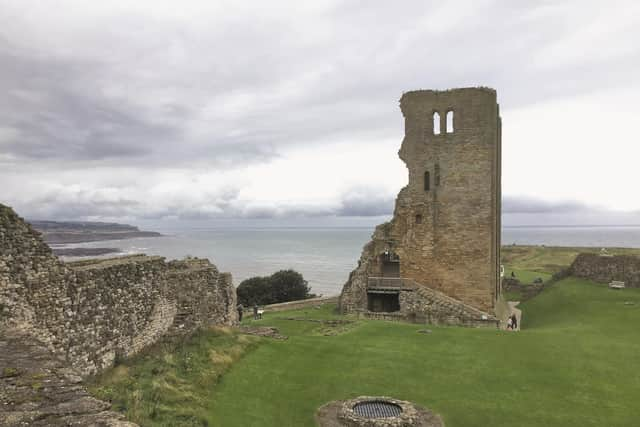
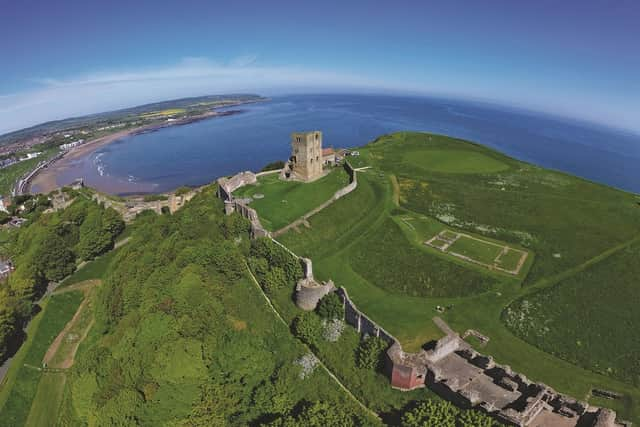
"In Scarborough the battleships Von der Tann and Derfflinger pounded the town as explosions ripped into streets, demolishing houses, blowing out windows and destroying the coastguard station at the cliff. The castle was struck by several shells causing damage to the keep and also the barracks which were thankfully unoccupied at the time.
“The entire attack only lasted thirty minutes, but with 500 shells hitting the town, the raid caused the deaths of eighteen people, a further 80 were injured and it led to a huge campaign which saw many people enlist into the British army to help defeat their enemy.”
The poster which followed, featuring a bombed coastal house, and the message “Men of Britain? Will You Stand for This?” must have led to queues at local recruitment offices.
"Since 2018 local historian Wayne Murray has been raising money for plaques to commemorate each individual victim of the 1914 bombardment and having them placed at significant spots around the town. His first plaque was unveiled in 2019 on the 105th anniversary, and since then he has tried to get at least one plaque a year put up,’’ says Mr Jones in the book.
In the era of globalisation, people still love to find out about their neighbourhood and its history. Mr Jones said his previous book - the A-Z of Bridlington – had proved so popular that he held two separate launch events for it.
"I saw there was a demand for this sort of book, “he said. “Scarborough, a place with incredible buildings and a great history, was one of the towns without a historical A-Z.
"There are so many hidden gems,’’ he added. "I want people to understand Scarborough's rich history and the fascinating people associated with it. I was particularly moved by the story of the town's lifeboat, which was one of the first in the country when it was launched in 1801. The earliest lifeboats were just rowing boats with sails who went to sea in terrible conditions.
"The lifeboat capsized at least four times over its first century in operation, in the first of these disasters 10 people tragically lost their lives. That's why I've dedicated my latest book to the crews of Scarborough lifeboat.
"Charles Dickens also has links with Scarborough. He held public readings at a building in Scarborough which until recently was a pizza restaurant.”
The town has connections with the golden age of cinema. Hollywood actor Charles Laughton, famous for starring in classic movies such as Mutiny on the Bounty (1935) and The Hunchback of Notre Dame (1939), was born in Scarborough in 1899.
"Laughton would always make time to come back to Scarborough and would go on to make many more films over the years, so much so that he was forced to quit the stage acting roles in order to concentrate on the bigger film contracts,’’ says Mr Jones in the book.
The Oscar-winning actor Sir Ben Kingsley was born just outside the town in the village of Snainton. He came to Scarborough in 2008 to pick up an honorary degree from the University of Hull’s Scarborough campus and attended the graduation ceremony with the students, taking the time to visit the town and reminisce on his childhood in this area.
Scarborough is also the final resting place of Anne Bronte, whose novel 'The Tenant of Wildfell Hall', shocked Victorian society with its brave depiction of drunkenness and domestic abuse. She visited Scarborough in 1849, in the hope that the fresh sea air might ease the symptoms of her TB, but she died in a guest house in the town.
Mr Jones said: “She was buried in the churchyard at St Mary’s next to Scarborough Castle. Only one person attended her funeral.
“The building where she died was demolished and today the Grand Hotel occupies the site; a plaque on the side of the hotel marks her passing here.”
The town certainly has a special place in the hearts of fans of Simon and Garfunkel, whose version of “Scarborough Fair” was a hit in the mid 1960s. The fair can trace its roots back to the charter granted by King Henry III in 1253. The song’s heritage appears lost in the mists of time, although some sources date it from 1670.
Scarborough boasts its own Italian Gardens, designed by a local civic engineer named Harry W. Smith more than a century ago. Its creation apparently called for one worker to go well beyond the call of duty in the name of art.
"Within the middle of the gardens is a statue based on the sixteenth-century version of the Roman god Mercury that once graced the fountain of the Villa de Medici in Rome itself,’’ says Mr Jones. “According to the website of the attraction, Smith had one of his workers assume the same pose on a pedestal within the pond as he was deciding where exactly the statue would be situated.”
A-Z of Scarborough – Places-People-History
By Richard M. Jones is published by Amberley Publishing