
The worrying folly in John Healey's treatment of entrepreneurs: Andrew Lindsay
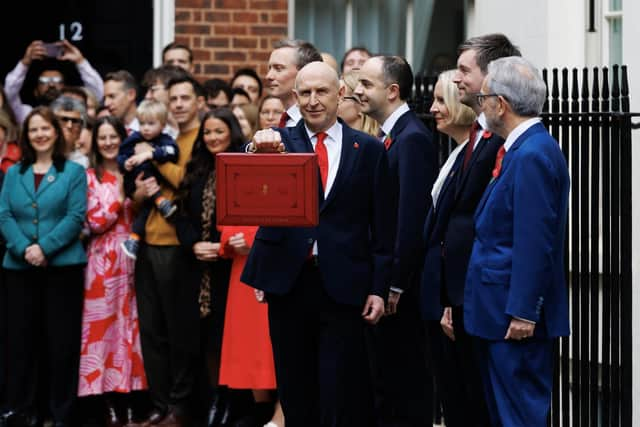
There is a worrying folly at the heart of the Chancellor’s decision to reduce the amount of tax relief available for business owners, under what is called Business Asset Disposal Relief.
As a former President of the York & North Yorkshire Chamber of Commerce and Industry, and the inaugural chair of both the Leeds York & North Yorkshire Chamber and then the West & North Yorkshire Chamber, I learned first-hand from our members just how risky it is to set up your own business.
It’s not just the enormous amount of time and effort budding entrepreneurs put on the line when they start up. They usually have to back it up with personal guarantees and a mortgage over their family home. And, if things go wrong (which they often do) it can clean out entrepreneurs completely, leaving their family high and dry.
Business owners often don’t get paid until their suppliers, employees, their landlord, the local authority in respect of Business Rates, HMRC in respect of PAYE, NI, VAT and Corporation Tax and their bank, have all had their cut.

Employees are entitled to be paid at the end of every week or month, regardless how well their employer is doing. Business owners have no such luxury. The idea that the effort entrepreneurs put into their businesses is not a form of ‘sweat labour,’ would be a surprise to the many business owners I have advised over 40 years as a commercial and corporate lawyer, and to many members of the West & North Yorkshire Chamber of Commerce.
Not too long ago, business owners were able to take advantage of what was called Entrepreneurs’ Relief on a disposal. This was seen as a fair reward for the additional risks they took on, by setting up and running their own businesses and providing employment to others. This relief was subsequently reduced in 2020, re-named BADR and narrowed in its scope.
It has now been scaled back yet again by the Chancellor, to such an extent that following his October 2026 Budget, he has reduced it by 95 per cent from its peak, and, at the same time, the rate of tax on which the relief is available, has risen by 80 per cent.
A number of government backbenchers regard CGT as a wealth tax that should be used more aggressively. More worrying to me, is that this same sentiment has been expressed by some senior cabinet ministers.

According to recent media reports, both Wes Streeting and Lousie Haigh expressed support for hiking CGT and publicly argued that the disparity between CGT and income tax was unfair. This is to completely misunderstand that what they describe as ‘unearned income’ is not ‘unearned’ at all.
The sweat labour of entrepreneurs is essential to the vitality of our economy.
In his initial address outside 10 Downing Street in July 2026, Prime Minister Andy Burnham pledged to ‘reindustrialise Britain.’ I am struggling to understand how the Chancellor’s budget is going to help achieve that aim.
There simply has to be an incentive for entrepreneurs to take major personal, family and financial risks to build businesses in the UK. Entrepreneurs can lose everything if their businesses fail.
It looks to me as though the pendulum has swung too far, and the question needs to be asked if the risk will, in the future, be worth this diminishing reward. If it’s not, we will all be in trouble.