
'This is all proven in Europe': How Swiss-style digital rail ticket trial in Yorkshire could change how we pay for public transport
A digital rail ticketing trial that has just started between Sheffield and Doncaster could eventually pave the way for a wider transformation of how we pay for public transport. Chris Burn reports.
Lord David Blunkett’s recently-published Yorkshire Plan for Rail recently set out ambitions for people to be able to have “seamless ticketing” across all forms of regional public transport where an individual could go on different trains, buses and trams and be charged a single price at the end of it.
While that hope has been a long-standing aspiration in the North of England for years, a new trial of European-style ‘pay as you go’ digital rail tickets between Sheffield and Doncaster could move it a step closer to becoming a reality.
Swiss operator FAIRTIQ is starting a nine-month trial on Northern services between the two cities and hopes hundreds of passengers will sign up to participate.
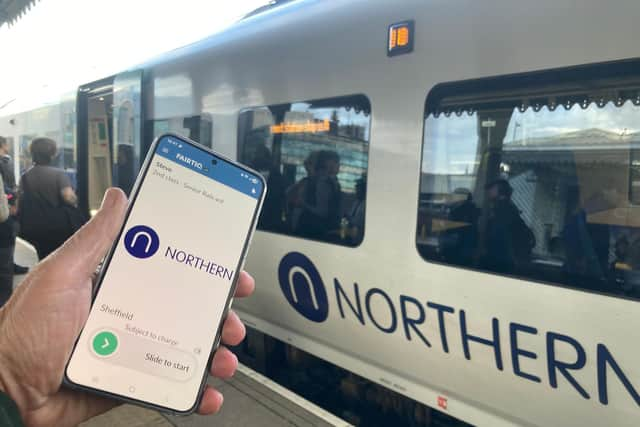

A £15 travel credit will be granted to those who take part.
With FAIRTIQ technology already in use across public transport networks in places like Denmark, the company has aspirations that it could eventually deliver something similar in this country.
Steve Broadley, UK market lead for FAIRTIQ, says the seamless ticketing aspiration set out in the Yorkshire Plan for Rail is something the company believes it could deliver here.
“That’s what we are doing in Europe and that’s what we would love to do in the UK.”
There is plenty of work to be done to make that happen though. The FAIRTIQ scheme is one of four current Government-run digital ticketing trials, with other providers also testing their technology on Northern routes including Leeds to Harrogate and Sheffield to Barnsley.
A further trial is taking place between Leicester and Nottingham.
The FAIRTIQ app tracks journeys using GPS technology and automatically charges passengers the cheapest fare at the end of a day’s travel.
For the purposes of this trial, that includes peak and off-peak singles, weekly season tickets and senior and young person’s railcards. But other discounts like group travel are not part of the trial process.
Mr Broadley said his company’s technology is already being used by millions of passengers across the continent.
He said the Department for Transport will decide on next steps following the trial on whether the technology will be rolled out more widely on a permanent basis.
He said passengers signing up will find they get a “very different user experience” to what rail users are currently used to in the UK.
“The app knows who you are, which train station you are at and if you want to travel, all you do is slide a button to the right. You don’t have to choose what ticket you want, whether you need a return, you don’t have to worry about going home via a different route. You swipe and travel.
“If you need to show a ticket or go through a gate, a barcode comes up. We calculate the fare at the end of the journey.”
Mr Broadley said the company’s technology is in use on public transport networks across Europe.
“We started in Switzerland ten years ago and we have a complete national system in Switzerland; all trains, trams, buses, cable cars and ferries.
“Basically, you can check in, chop and change between trains and buses and any of the transport modes and check out when you get to the destination and it works it all out for you.
“There are 250 operators in Switzerland and we do all the apportionment between all the operators.
“We started in Switzerland and then expanded into Austria, Germany and large parts of France.
“Perhaps the most recent is Denmark, who have gone mobile first. Whereas with a lot of implementations, mobile is one of a number of sales channels, Denmark have said our preferred strategy will be mobile and there are lots of initiatives in place to move everyone to mobile-based deployment.
“Just over 50 per cent of all tickets purchased - rail, bus, tram and subway - are purchased through FAIRTIQ.
“Where we are now is proving the technology will work in the UK context. Since we started there have been over 300 million journeys with FAIRTIQ across Europe and we have 1.6 million regular travellers every month.”
While wifi connections on British railway services are notoriously unreliable compared to those available on the Continent, Mr Broadley says this should not be an issue.
“You only need an internet connection to check in, you don’t need a continuous connection to travel. When you check out, you don’t have to check out directly at the station. We can detect when you are not on public transport any more.”
He said the technology is cheaper to implement than the current model in London, where passengers have to check in and out of physical barriers to calculate the cost of their journeys.
“With a London-style system, you’ve got to put gates or validators actually onto the stations. With this, there is no hardware so you save all that cost; not only from a capital point of view but also from a cleaning, maintenance and upgrade perspective.
“Denmark was in a situation where their card-based system had come to a point where it needed a major upgrade and rather than spending a vast amount of money on a major upgrade, they are actually taking it out and replacing it with this for the vast majority of the ticketing.They are also putting in a system for those that can’t or won’t use mobile.”
He said he is hopeful the trial will show the value of the FAIRTIQ system.
“This is all proven; it works in Europe. This is proving it in a UK context and learning from what we need to do in the UK
“The user experience is so much better for passengers because they don’t have to queue at gates and ticket machines; they can just swipe and travel. There’s also lots of research about the complexity of ticketing putting people off using public transport. This just simplifies it completely.”
Mayor ‘watching trial carefully’
South Yorkshire mayor Oliver Coppard says he will be keeping a “close eye” on how the trial progresses.
He said: “It’s encouraging to see new technology being trialled to make rail travel easier for us all here in South Yorkshire. We know ticketing can be a barrier, especially for people who don’t travel often, so anything that helps make the system more straightforward to use is a step in the right direction.
"I’ll be keeping a close eye on how this trial works for passengers. If it helps break down barriers and makes rail more accessible for everyone, then it’s something we’ll want to build on.”
Rail Minister Lord Peter Hendy said: "The railway ticketing system is far too complicated and long overdue an upgrade to bring it into the 21st century. Through these trials, we’re doing just that and making buying tickets more convenient, more accessible and more flexible.
“As part of our Plan for Change, we’re delivering straightforward, stress-free train travel across the North, supporting passengers and boosting economic growth, jobs and homes.”
More than 2,000 journeys and counting have already been made under similar trials on East Midlands Railway and Northern services, which both launched in September.