
What I learnt about Andy Burnham's political talents from Leeds rail announcement: Chris Burn
There’s little question that Andy Burnham has been an effective and popular Mayor of Greater Manchester – and indeed his time in the post has proved the template in many respects for other regional mayors when it comes to pursuing bold policies like bus franchising.
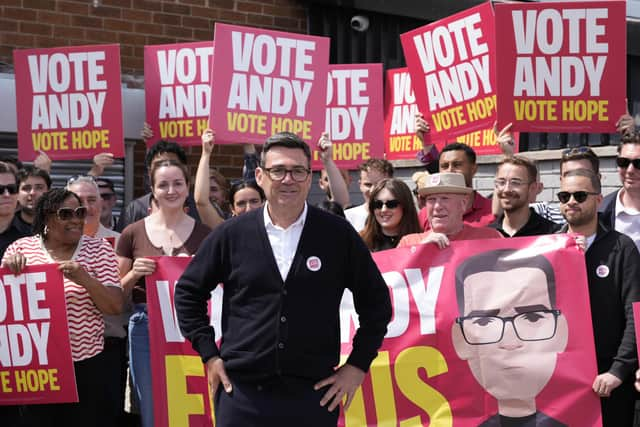
He is also a superb political communicator – whenever I attended public meetings and press conferences of Northern mayors in my previous role as Yorkshire Post political editor, Mr Burnham would without fail have a clear, and normally headline-grabbing, message to impart.
It sounds obvious but the ability to explain what you want to do and why you want to do it in a simple and memorable way is something that was lacking from Sir Keir Starmer’s approach.
To give just one example, in late 2021 shortly after the Conservative Government had cancelled HS2 to Yorkshire and failed to deliver on hopes for a fully-funded Northern Powerhouse Rail network, Mr Burnham swooped in late to a packed Transport for the North board meeting in Leeds and swiftly proposed Hong Kong-style land taxes as a potential way of helping to fund the latter plan.

When I asked whether the proposal would really be enough to fill the £25bn funding gap, details were – to put it kindly – somewhat sketchy. Addressing that question, then South Yorkshire mayor Dan Jarvis diplomatically described the idea as the “beginning of a grown-up conversation with Government to explore the art of the possible”.
But the central aim of Mr Burnham was to demonstrate a refusal to admit defeat on the issue and keep it on the political agenda by presenting an alternative option. That has ultimately borne fruit, with Rachel Reeves announcing in January this year that up to £45bn will be committed to delivering NPR – far above the £17bn fait accompli proposed by the Tories in 2021.
Being a regional mayor is not an easy job but it is far simpler than being Prime Minister. In the former role, you are largely master of your own domain and mainly charged with spraying a money cannon on worthy regional projects. Because mayoral authority funding generally comes from central Government pots, they also have the advantage of not being directly tied to raising the cash that pay for such initiatives.
The nature of the role means is actually quite difficult for a regional mayor to be unpopular – something borne out by the extraordinarily high re-election rates for incumbents of all political stripes.
As Prime Minister, even a sizeable majority does not guarantee success as the downfalls of Boris Johnson and Sir Keir Starmer have demonstrated.
Keeping hundreds of your own MPs, all with their own agendas and ambitions, happy is arguably harder than fighting political opponents. Meanwhile the country’s continued failure to deliver sizeable economic growth and its stretched public finances mean almost every choice that has to be made is a trade-off which will upset a large segment of voters.
The relentless pace of our social media age means every Prime Minister of the last decade has been unpopular and widely derided while in office – often getting swiftly reassessed in a kinder light once they have been turfed out of Downing Street.
Yet Mr Burnham is arguably better equipped to handle the Westminster snakepit than most. He joined Labour at 15, was a special adviser to sports minister Chris Smith in the 1990s and became an MP all the way back in 2001. He worked his way up through the ranks to become Health Secretary and serve in Gordon Brown’s Cabinet.
So while he has successfully disassociated himself from the London political scene since becoming Greater Manchester mayor in 2017 in the minds of voters, he well understands how Westminster operates.
He and his team have pulled off what appears to be a remarkably bloodless coup in forcing the resignation of Sir Keir by persuading Labour MPs that he is the stronger option for fighting Nigel Farage at the next election – an act requiring significant political skill.
Mr Burnham will also take over a Labour party desperate for his leadership to work out and knowing they are in the last chance saloon with millions of voters; something that should work in his favour.
Don’t bet against him proving a success in Downing Street.
Chris Burn is head of business and features at The Yorkshire Post