
Why almost every house may soon have their own C-3PO as humanoid robots become a reality: David Richards
When Star Wars arrived in cinemas in 1977, it transported audiences to a galaxy far, far away where humanoid robots were commonplace.
C-3PO, the anxious golden protocol droid, could speak over six million languages, perform instant calculations and navigate complex social situations with neurotic precision.
A polite machine fluent in communication and social interaction. It was charming precisely because it was impossible.
Fast forward to 2026, and something uncomfortable has happened. None of that sounds fantastical anymore.
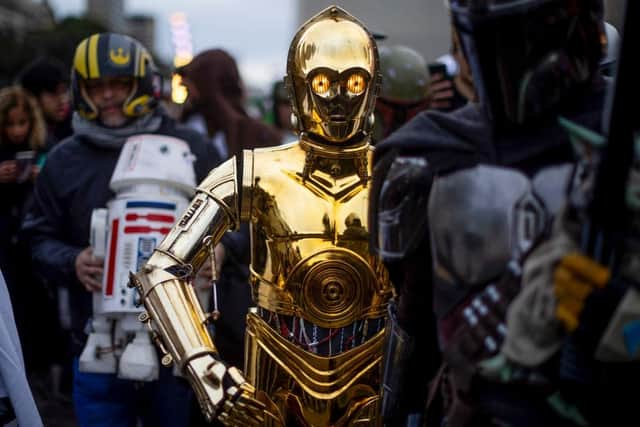

Language models already converse fluently across languages. Real-time translation is mundane. Machines routinely outperform humans at probability, logistics and optimisation.
The missing piece was never intelligence. It was embodiment. Giving cognition arms, legs and hands that can actually do something useful in the physical world. That gap is closing faster than most people realise.
Tesla’s humanoid robot, Optimus, can now serve popcorn and pour drinks with an ease that would have seemed absurd even five years ago. The latest generation moves with smooth, almost human fluidity. Tesla has explicitly designed it for domestic work: cooking, cleaning, tidying.
Sales are expected to begin later this year at a price between $20,000 and $30,000, with Elon Musk talking openly about producing millions to address global labour shortages.

That price point matters. It puts a humanoid robot in the same mental category as a modest car.
Tesla is hardly alone. Figure AI, backed by OpenAI, Microsoft and NVIDIA, is already testing robots inside BMW factories and has pulled forward home trials to late 2025. Boston Dynamics has retired its hydraulic Atlas in favour of a fully electric version designed for real industrial work. Agility Robotics has its Digit moving boxes in Amazon warehouses. And 1X Technologies, also backed by OpenAI, has begun taking pre-orders for a home robot called NEO.
China may be moving even faster. Unitree Robotics is targeting price points as low as $16,000. UBTECH Robotics already has robots piloted inside Nio and BYD factories. China now has more than 100 humanoid robotics firms and leads the world in annual installations. That concentration of effort rarely ends as a sideshow.
The rollout path is becoming clearer. We will see early adopters hosting alpha and beta units in homes. They will be limited, supervised and imperfect. By the late 2020s, reliability improves, costs fall, and capabilities broaden. Many experts believe that by around 2030, household humanoids will be able to perform unscripted chores without constant oversight. Cleaning a kitchen. Assisting an elderly person. Handling basic repairs.
There are real hurdles. Safety and trust matter profoundly. A robot must be able to read a room and adjust its behaviour around humans. Battery life remains measured in hours, not days. Affordability will initially favour leasing over outright purchase. But none of these are fundamental barriers. They are engineering problems. And engineering problems get solved.
Project forward 10 to 20 years. Picture an 80-year-old living independently at home, not just with a cleaner or a cook, but with what amounts to a 24-hour medical assistant, plumber, electrician and carer. Not average ones either, but systems trained on the collective expertise of the best professionals in the world.
When asked whether you would trust AI to diagnose or treat you, the question may well invert. Why would you rely solely on a human?
The societal implications are vast. Musk talks about a future of universal high income, where goods and services become so cheap that scarcity collapses.
Others argue that work becomes optional, something pursued for purpose rather than survival. Some forecasts suggest billions of humanoid robots by 2040, potentially outnumbering humans.
There will be disruption. Jobs will disappear. Human interaction may decline in some sectors. But ageing populations and chronic labour shortages make this transition inevitable rather than optional.
George Lucas created C-3PO as comic relief in a space fantasy. A fussy butler worrying about protocol in the middle of a galactic rebellion. It turns out he was not imagining the future so much as sketching a blueprint for it. The only real question left is not whether humanoid robots will enter our homes, but how quickly we choose to let them in.
David Richards is managing partner of Yorkshire AI Labs